Loading...
Afonso de Albuquerque vs Fu Jian
Afonso de Albuquerque leads by 15.2 pts · 2 figures compared
…
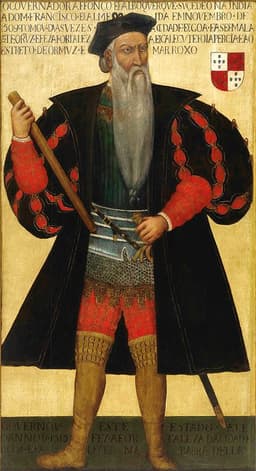
Afonso de Albuquerque
General · Medieval
79.6Total
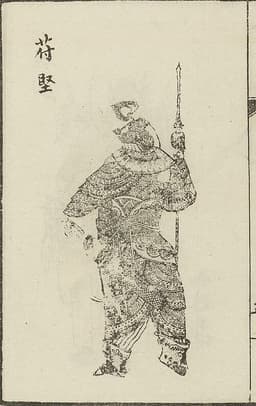
Fu Jian
Emperor · Ancient
64.4Total
Basic Information
Born
1453
338
Died
1515
385
Era
Medieval
Ancient
Nationality
Portugal
China
Occupation
General
Emperor
Civilization
Western
Eastern
Score Comparison
Military (10%)
77.5
78.0
Political (20%)
88.0
72.0
Influence (20%)
80.0
59.0
Legacy (20%)
75.0
50.0
Leadership (15%)
78.0
85.0
Strategy (15%)
82.0
58.0
TOTAL
79.6
64.4
Afonso de Albuquerque — Complete Timeline
1503 AD
First voyage to IndiaWar◆ Major
Afonso de Albuquerque led a fleet to India, establishing the first Portuguese fort at Cochin. This voyage laid the foundation for Portuguese control of the Indian Ocean trade.
ExplorationColonialismIndia
Impact: global
1510 AD
Conquest of GoaWar◆ Major
Albuquerque captured Goa from the Sultan of Bijapur. He made Goa the capital of Portuguese India, a position it held for over 400 years.
ConquestColonialismIndia
Impact: regional
1511 AD
Conquest of MalaccaWar◆ Major
Albuquerque led a Portuguese fleet to capture the strategic port of Malacca. This gave Portugal control of the spice trade route between the Indian Ocean and the Pacific.
ConquestSpice TradeSoutheast Asia
Impact: global
1513 AD
Siege of AdenWar
Albuquerque attempted to capture Aden in Yemen but failed. This failure prevented Portugal from controlling the entrance to the Red Sea and limited their influence in the region.
SiegeFailureRed Sea
Impact: regional
1515 AD
Death at seaOther◆ Major
Afonso de Albuquerque died at sea off the coast of Goa, possibly from illness or poison. His death left the Portuguese Empire in the Indian Ocean without its most capable leader.
DeathLeadershipEmpire
Impact: regionaltragic
Fu Jian — Complete Timeline
370 AD
Conquest of Former YanWar◆ Major
Fu Jian's Former Qin forces conquered the Former Yan state, annexing its territory in northern China. This victory significantly expanded Former Qin's power and territory, bringing Fu Jian closer to unifying the north.
ConquestExpansion
Impact: regionalconstructive
376 AD
Conquest of Former LiangWar◆ Major
Fu Jian's forces conquered the Former Liang state in the northwest, incorporating its territory into Former Qin. This further consolidated his control over northern China.
ConquestExpansion
Impact: regionalconstructive
Conquest of DaiWar
Fu Jian's army conquered the Dai state, a Xianbei confederation in the north. This eliminated a rival and extended Former Qin's influence into the steppe region.
ConquestExpansion
Impact: regionalconstructive
379 AD
Capture of XiangyangWar
Fu Jian's forces captured the strategic city of Xiangyang from the Eastern Jin dynasty. This victory gave Former Qin a foothold south of the Huai River, setting the stage for the invasion that led to the Battle of Fei River.
ConquestCampaign
Impact: regionalconstructive
383 AD
Battle of Fei RiverWar
Fu Jian led a massive Former Qin army against the Eastern Jin dynasty at the Fei River. The Jin forces defeated the Qin army, causing a catastrophic rout. This defeat shattered Fu Jian's unification efforts and led to the collapse of Former Qin.
BattleUnificationDefeat
Impact: regionaltragic
Expert Analysis
Fu Jian vs Afonso de Albuquerque
# The Conqueror’s Mirror: Fu Jian and Afonso de Albuquerque
In the autumn of 383, on the banks of the Fei River in southern China, a vast army of perhaps 300,000 men stood poised to crush a smaller force from the Eastern Jin dynasty. The commander of this colossal host, Fu Jian, Emperor of Former Qin, was so confident of victory that he had already appointed officials to govern the lands he would soon annex. Across the river, the Jin general Xie Xuan sent a daring message: let us cross and fight, or you withdraw and let us meet on open ground. Fu Jian, eager to end the campaign decisively, ordered his forces to pull back. What happened next would echo through Chinese history for millennia—the retreat became a rout, the rout a catastrophe, and Fu Jian’s dream of unifying China dissolved into dust.
Half a world away and more than a century later, another conqueror faced his own turning point. Afonso de Albuquerque, Governor of Portuguese India, had just failed to capture Aden in 1513, the gateway to the Red Sea. Unlike Fu Jian, he did not retreat in disgrace. He regrouped, refocused, and died at sea two years later, his empire still intact. Why did one man’s ambition shatter at a single river crossing, while another’s survived repeated setbacks? The answer lies not in luck, but in the very different worlds that shaped them.
Origins
Fu Jian was born in 338 into a powerful Di clan, a non-Han people who had carved out a kingdom in the chaos following the fall of the Western Jin dynasty. His grandfather was a warlord; his uncle founded the Former Qin state. Fu Jian grew up in a world of constant warfare, where loyalty was measured in blood and survival demanded ruthlessness. Yet he was also deeply influenced by Chinese Confucian ideals, surrounding himself with Han scholars who taught him that a true emperor rules through virtue, not force alone. This tension—between the steppe warrior’s instinct and the civil administrator’s wisdom—would define his reign.
Afonso de Albuquerque, born in 1453 near Lisbon, emerged from a very different crucible. Portugal was a small, ambitious kingdom on the edge of Europe, driven by a crusading zeal and a hunger for spices that could make a man rich beyond imagining. Albuquerque came from a noble but impoverished family; his father served at court, but young Afonso learned early that glory was won at sea, not in palaces. He fought in North Africa against Muslims, absorbing the military tactics and religious fervor that would later fuel his campaigns. Where Fu Jian inherited a kingdom, Albuquerque had to earn his command.
Rise to Power
Fu Jian’s ascent was swift and bloody. In 357, at age nineteen, he staged a coup against his cruel cousin, the reigning emperor, and took the throne himself. He immediately set about consolidating power, not just through war but through careful administration. He appointed capable ministers, reduced taxes, and promoted agriculture. His early reign was a model of enlightened despotism—a barbarian prince who had read his Confucian classics and knew that a stable state required contented subjects.
Albuquerque’s rise was slower and never secure. He first sailed to India in 1503, at age fifty, commanding a fleet that established a small fort at Cochin. The Portuguese king, Manuel I, was skeptical of this abrasive, ambitious nobleman. Albuquerque was passed over for higher commands, recalled to Lisbon in disgrace, and only returned to the East in 1509 after his rival died. Even then, his authority was constantly challenged by jealous captains and court officials who saw him as a dangerous upstart. Where Fu Jian ruled by hereditary right, Albuquerque ruled by sheer force of will.
Leadership & Governance
Fu Jian governed as a unifier. After conquering the Former Yan state in 370, he did not massacre its Xianbei rulers but incorporated them into his administration. He granted titles to defeated kings, married his sons to their daughters, and allowed conquered peoples to retain their customs. This policy of magnanimity won him allies but also sowed the seeds of disaster—discontented nobles waited for a moment of weakness to reclaim their thrones.
Albuquerque governed as a builder. After capturing Goa from the Sultan of Bijapur in 1510, he transformed it into the capital of Portuguese India, complete with churches, hospitals, and a mint. He encouraged Portuguese soldiers to marry local women, creating a loyal mixed-race population. In 1511, he seized Malacca, the spice trade’s chokehold, and established a network of forts from East Africa to the Moluccas. His strategy was not conquest for its own sake but control of commerce—he understood that the Indian Ocean’s real wealth flowed through trade routes, not tax rolls.
Militarily, both men were formidable. Fu Jian’s campaigns from 370 to 379 were a masterclass in rapid conquest: he absorbed Former Yan, Former Liang, and the Dai confederation, expanding Former Qin to cover nearly all of northern China. Albuquerque’s capture of Goa and Malacca were daring amphibious operations that required both naval supremacy and tactical brilliance. But Fu Jian’s strategy relied on overwhelming numbers; Albuquerque’s on audacity and precision.
Triumph & Tragedy
Fu Jian’s greatest triumph was also his undoing. By 383, he ruled an empire that stretched from the Gobi Desert to the Yangtze River. Only the Eastern Jin dynasty, clinging to the south, remained. He assembled an army of unprecedented size—Chinese sources speak of 870,000 men, though modern estimates suggest 300,000—and marched south. At the Fei River, his overconfidence met Jin ingenuity. The retreat he ordered turned into a panic when a captured Jin soldier shouted that the Qin army was defeated. The rumor spread like fire; soldiers threw down their weapons and fled. Fu Jian watched his empire dissolve in a single afternoon.
Albuquerque’s tragedy was more subtle. He never suffered a Fei River—his only major defeat, the failed siege of Aden in 1513, was a strategic setback, not a catastrophic rout. But he died at sea in 1515, aged 62, possibly poisoned by rivals or struck by illness. His last letter to the king begged for recognition for his sons; it was ignored. He died believing his life’s work would crumble without him. In a sense, he was right—later governors lacked his vision, and the Portuguese Empire slowly declined. But his empire did not collapse overnight.
Character & Destiny
Fu Jian’s character was his destiny. He was generous to a fault, trusting men who had every reason to betray him. When his Xianbei general Murong Chui fled during the Fei River disaster, Fu Jian refused to pursue him, saying, “Let him go—he has served me well.” Murong Chui promptly raised a rebellion that tore the empire apart. Fu Jian’s Confucian idealism made him a great peacetime ruler but a flawed wartime commander. He believed that virtue could bind men’s loyalty; he learned too late that only power does.
Albuquerque was the opposite: ruthless, suspicious, and relentless. He executed captured Muslim merchants without trial, burned ships, and destroyed cities. He trusted no one, not even his own captains. Yet this paranoia served him—it kept his empire intact while he lived. His legacy was built on fear, not love. Where Fu Jian dreamed of a united China under a benevolent emperor, Albuquerque dreamed of a Portuguese monopoly on spice. Both were utopian visions, but Albuquerque’s was narrower, more achievable—and therefore more durable.
Legacy
Fu Jian is remembered as a cautionary tale. In Chinese historiography, his story illustrates the dangers of hubris and the fragility of conquest. The Fei River became a byword for overconfidence; the phrase “the grass and trees are all soldiers” still describes a panicked retreat. His empire vanished within a decade of his death, and his name lives on mainly as a warning.
Albuquerque is remembered as a founder. The Portuguese Empire in Asia was his creation; Goa remained Portuguese until 1961, and the strategic patterns he established—forts, alliances with local rulers, control of choke points—shaped European imperialism for centuries. His title, “The Great,” is not a Chinese honorific but a European one, earned through concrete achievement.
Conclusion
Standing on the deck of his flagship off Goa, Afonso de Albuquerque might have envied Fu Jian’s vast armies and continental ambition. But Fu Jian, watching his soldiers drown in the Fei River, might have envied Albuquerque’s pragmatism. Both men sought to build something permanent in a world of chaos. One trusted too much in virtue; the other, too little. One fell from a great height; the other died at sea, still fighting. Their stories remind us that the line between triumph and tragedy is not always drawn by skill or courage, but by the quiet, stubborn limits of a single human character.
Rankings
🥇
Afonso de AlbuquerqueLeader
Mil: 77.5Pol: 88.0Inf: 80.0
79.6
🥈
Fu Jian
Mil: 78.0Pol: 72.0Inf: 59.0
64.4
+15.2 behind
How This Comparison Works
Algorithm
Each figure is scored on 6 dimensions (0—100 scale) based on structured historical data: Military (10%), Political (20%), Influence (20%), Legacy (20%), Leadership (15%), Strategy (15%). The weighted total produces the final ranking.
Data Sources
Scores are computed from structured sub-indicators in the database. Scale factors adjust for era (Ancient ×0.85, Modern ×1.0) and civilization size (Eastern ×1.05, Other ×0.80) to account for differences in population and military scale.
Maximum 3 Figures
Comparisons are limited to 2—3 figures to ensure readability and statistical meaningfulness.
Error Margins
±5 points per dimension — Sub-scores are derived from historical records with inherent uncertainty. Two figures within 5 points on a dimension should be considered roughly equivalent in that area.
Total Score Accuracy
±3 points overall — The weighted combination of 6 dimensions produces a total score with approximately ±3 points of uncertainty. Differences of less than 3 points are not statistically significant— the figures are effectively tied.
Known Limitations
- Historical records are incomplete and uneven across civilizations
- Figures from oral-tradition societies may be underrepresented
- Occupation labels can misclassify multi-role figures
- Scores measure capability and impact, not moral character
- Quantitative scoring is a comparison tool, not absolute truth
Capability Radar
Military (10%) — Battles & Warfare
Battles
85
75
Win Rate
80
70
Expansion
95
80
Political (20%) — Governance & Reform
Reform
80
70
Diplomacy
85
60
Economy
80
65
Influence (20%) — Cultural & Global Reach
Cultural
70
50
Global
85
45
Legacy (20%) — Historical Impact
Historical
85
60
Longevity
80
40
Leadership (15%) — Power & Stability
Tenure
70
65
Stability
65
55
Strategy (15%) — Tactics & Innovation
Strategy
95
70
Tactics
90
65
Reform
75
60
Similar Comparisons
Comments & Discussion
FeiRiverGhost6/16/2026
The real difference isn't luck but logistics and dissent. Fu Jian's force of 300,000 was a coerced coalition of ethnically diverse groups—Xiongnu, Xianbei, Qiang, Di—who hated each other and him. One panicked order to withdraw and they collapsed. Albuquerque commanded maybe 2,000 Portuguese, but they were veterans united by crown and cross, not tribal grudges. Numbers don't conquer; cohesion does. Fu Jian, for all his charisma, built an army of hostages, not soldiers.
雁门飞将6/16/2026
把苻坚和阿布奎基并列,本身就是对前秦皇帝的不公。苻坚的敌人是东晋,一个根深蒂固的汉人王朝,背后是江南士族和北府兵的整饬;阿布奎基的敌人是分散的印度洋城邦,每个都是孤立的个体。即便算战略,苻坚输在淝水一役,全局崩盘,阿布奎基输在亚丁,却保住核心——这是因为他的对手马穆鲁克和奥斯曼太遥远,而苻坚的敌人就站在河对岸。地域就决定了宿命。
SilkRoadStrategist6/16/2026
阿布奎基的幸存逻辑很简单:欧洲人的海外帝国,败了可以修整两年再打,因为补给线漫长但可靠,盟友是葡萄牙皇室和威尼斯银行。苻坚的后方呢?关中连年饥荒,鲜卑和羌人部落蠢蠢欲动,他一撤兵,慕容垂和姚苌就反了。淝水不是致命伤,而是安定了叛乱种子。阿布奎基死时帝国完整,苻坚死时帝国碎成二十二块——根本原因不是个人能力,是他们维护的帝国根基厚度差了三个数量级。
HorseArcherSkeptic6/16/2026
Let's not romanticize Albuquerque's "resilience" while trashing Fu Jian. Aden was a failure he never recovered from strategically—the Red Sea was permanently closed to Portugal. Fu Jian had one catastrophic defeat, yes, but he conquered almost all of northern China in a decade. Albuquerque's career was a series of brutal sieges and massacres (Malabar, Hormuz) held together by terror and a tiny navy. Different scales, different stakes. Fu Jian's empire was a continental superpower; Albuquerque's
运河总督6/16/2026
我永远选择苻坚。阿布奎基是殖民者的典型:冷酷、务实、成功,但缺乏悲剧的壮美。苻坚的梦想是统一天下,让汉人和胡人共居一统,他礼遇王猛,宽容前燕宗室,甚至击败东晋后不屠杀——这种理想主义在乱世中是软肋,却