Loading...
Afonso de Albuquerque vs Ferdinand I of Leon
Afonso de Albuquerque leads by 20.4 pts · 2 figures compared
…
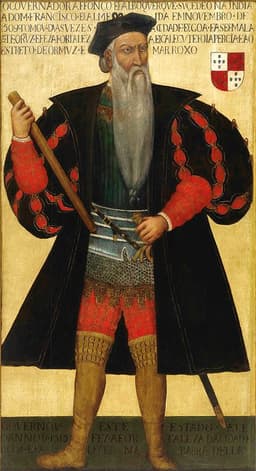
Afonso de Albuquerque
General · Medieval
79.6Total
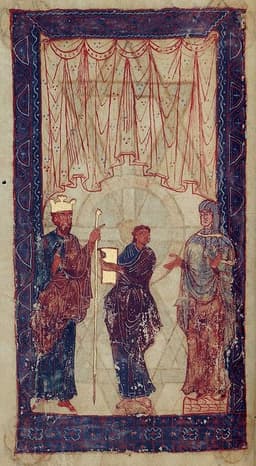
Ferdinand I of Leon
Emperor · Medieval
59.2Total
Basic Information
Born
1453
1015
Died
1515
1065
Era
Medieval
Medieval
Nationality
Portugal
Leon
Occupation
General
Emperor
Civilization
Western
Western
Score Comparison
Military (10%)
77.5
70.0
Political (20%)
88.0
68.0
Influence (20%)
80.0
56.4
Legacy (20%)
75.0
49.2
Leadership (15%)
78.0
66.0
Strategy (15%)
82.0
57.5
TOTAL
79.6
59.2
Afonso de Albuquerque — Complete Timeline
1503 AD
First voyage to IndiaWar◆ Major
Afonso de Albuquerque led a fleet to India, establishing the first Portuguese fort at Cochin. This voyage laid the foundation for Portuguese control of the Indian Ocean trade.
ExplorationColonialismIndia
Impact: global
1510 AD
Conquest of GoaWar◆ Major
Albuquerque captured Goa from the Sultan of Bijapur. He made Goa the capital of Portuguese India, a position it held for over 400 years.
ConquestColonialismIndia
Impact: regional
1511 AD
Conquest of MalaccaWar◆ Major
Albuquerque led a Portuguese fleet to capture the strategic port of Malacca. This gave Portugal control of the spice trade route between the Indian Ocean and the Pacific.
ConquestSpice TradeSoutheast Asia
Impact: global
1513 AD
Siege of AdenWar
Albuquerque attempted to capture Aden in Yemen but failed. This failure prevented Portugal from controlling the entrance to the Red Sea and limited their influence in the region.
SiegeFailureRed Sea
Impact: regional
1515 AD
Death at seaOther◆ Major
Afonso de Albuquerque died at sea off the coast of Goa, possibly from illness or poison. His death left the Portuguese Empire in the Indian Ocean without its most capable leader.
DeathLeadershipEmpire
Impact: regionaltragic
Ferdinand I of Leon — Complete Timeline
1029 AD
Inheritance of the County of CastilePolitical Action◆ Major
Ferdinand I inherited the County of Castile from his father Sancho III of Navarre. He later expanded his territory through conquest and marriage, laying the foundation for the Kingdom of Castile.
Impact: regionalconstructive
1037 AD
Conquest of LeónWar◆ Major
Ferdinand I defeated and killed King Bermudo III of Le
Impact: regional
1056 AD
First Emperor of SpainPolitical Action◆ Major
Ferdinand I was crowned 'Imperator totius Hispaniae' (Emperor of all Spain) in 1056, claiming suzerainty over all Christian and Muslim rulers in Iberia. This title reflected his military dominance and political ambition.
Impact: regional
1065 AD
Division of the kingdomPolitical Action◆ Major
Upon his death, Ferdinand I divided his kingdom among his sons: Sancho II received Castile, Alfonso VI received Le
Impact: regionaldestructive
Expert Analysis
Ferdinand I of Leon vs Afonso de Albuquerque
### The Conqueror and the King: Two Visions of Empire
In the winter of 1515, a dying man on a ship off the coast of Goa dictated a final letter to the King of Portugal. He had just lost a great city, his health was shattered, and he knew his enemies in Lisbon were already sharpening their knives. Half a world away and four centuries earlier, another ruler, Ferdinand I of León, lay on his deathbed in 1065, dividing his hard-won kingdom among his three sons. One man died believing his life’s work had collapsed; the other died believing he had secured his legacy. Both were wrong. And both, in their very different failures, reveal something profound about the nature of power in the medieval world.
### Origins
Afonso de Albuquerque was born in 1453, the year Constantinople fell to the Ottoman Turks. He was a younger son of a noble family, raised in the court of King Afonso V, where he learned mathematics, Latin, and the art of war. The air he breathed was filled with the ambition of a small, poor kingdom on the edge of Europe that had decided to leap outward—across the Atlantic, around Africa, into the Indian Ocean. He was a product of the Portuguese Renaissance, a man who believed that God, gold, and glory were one and the same.
Ferdinand I, born in 1015, came from a very different world. He was the second son of Sancho III of Navarre, a powerful Christian king in the fractured, war-torn landscape of medieval Spain. The Reconquista—the centuries-long struggle to push the Moors out of the Iberian Peninsula—was his inheritance. He grew up not in a palace of learning, but in a world of oaths, betrayals, and border skirmishes. His father had conquered Castile, and when Sancho died, Ferdinand inherited it. He was a man of the land, of feudal loyalties, of Christian crusade.
The difference in their worlds is the difference between a man who looked outward at the ocean and a man who looked inward at the soil.
### Rise to Power
Albuquerque’s path was slow and methodical. He first sailed to India in 1503, commanding a fleet that established a fort at Cochin. He was not a young man—he was fifty. He spent the next years learning the complex politics of the Malabar Coast, understanding that the Portuguese could not conquer India with armies, but could control it with ports, alliances, and terror. His great opportunity came in 1510, when he captured Goa from the Sultan of Bijapur. It was a stunning victory, achieved with a small force and brilliant tactics. He made Goa the capital of Portuguese India, and it would remain so for four centuries.
Ferdinand’s rise was more straightforward. He inherited the County of Castile from his father in 1029, but he wanted more. In 1037, at the Battle of Tamarón, he killed King Bermudo III of León and claimed that kingdom for himself. He was now the most powerful Christian ruler in Spain. In 1056, he had himself crowned “Imperator totius Hispaniae”—Emperor of all Spain. It was a title that meant little in practice, but everything in ambition.
Albuquerque earned his power through audacity and seamanship; Ferdinand through inheritance and battlefield luck. One was an architect, the other a builder.
### Leadership & Governance
Albuquerque was a military genius of the highest order. In 1511, he captured Malacca, the richest port in Southeast Asia, with a fleet of eighteen ships and just over a thousand men. He understood that the spice trade was the key to Portuguese wealth, and that controlling the narrow straits of the world was the key to the spice trade. He also understood that cruelty could be a tool: he ordered massacres, burned cities, and executed prisoners to spread terror. But he was also a political realist. He married Portuguese soldiers to local women, encouraged mixed-race communities, and tried to build a permanent empire, not just a series of looting expeditions.
Ferdinand was a different kind of leader. His military score is lower—60.1 to Albuquerque’s 82.2—but his political score is higher. He understood that the Reconquista was not just about war, but about settlement, law, and integration. He repopulated captured lands with Christians, built monasteries, and issued charters that granted rights to towns. He was crowned Emperor in 1056, but he knew his real power came from the loyalty of his nobles, not from a title. His strategy score is low—45.7—because he was not a grand strategist. He fought when he had to, made peace when he could, and always kept his eye on the next castle, the next border.
Albuquerque ruled through fear and vision; Ferdinand through patience and piety.
### Triumph & Tragedy
Albuquerque’s greatest triumph was the conquest of Malacca in 1511. It gave Portugal control of the spice route and broke the monopoly of Muslim traders. His greatest failure was the Siege of Aden in 1513. He tried to capture the city at the entrance to the Red Sea, hoping to block Ottoman access to the Indian Ocean. He failed, and that failure allowed the Ottomans to remain a threat to Portuguese power for decades. Worse, the failure haunted him. He returned to Goa in disgrace, and his enemies at court used it to destroy his reputation.
Ferdinand’s greatest triumph was his coronation as Emperor of Spain in 1056. It was the first time a Christian ruler had claimed that title, and it set the stage for the eventual unification of Spain under his grandson, Alfonso VI. His greatest tragedy came after his death. In 1065, he divided his kingdom among his three sons, as was the custom. The result was civil war. His sons fought each other for years, undoing much of what he had built.
Albuquerque died at sea in 1515, possibly poisoned, possibly of illness. He had just lost the city of Ormuz, and he believed his empire was crumbling. But it was not. The Portuguese Empire in the East would survive for another century. Ferdinand died in his bed, surrounded by his sons, believing he had secured peace. He had not.
### Character & Destiny
Albuquerque was a man of iron will and volcanic temper. He could be ruthless—he once ordered the execution of a captured sultan’s son in front of the city walls—but he could also be magnanimous. He wrote long, passionate letters to his king, begging for reinforcements, explaining his strategies, defending his actions. He was a man who believed that he alone understood the true nature of empire, and that he was always right. That certainty gave him courage, but it also made him enemies.
Ferdinand was more cautious, more traditional. He was a king who followed the rules of his time: conquer, convert, divide. He did not try to create something new; he tried to preserve what he had. His division of the kingdom was not a mistake in his eyes—it was the proper way of things. He could not imagine a different future.
Albuquerque’s personality drove him to reach for the impossible; Ferdinand’s kept him within the boundaries of his age.
### Legacy
Albuquerque’s legacy is enormous. He is remembered as the founder of the Portuguese Empire in the East, the man who gave Portugal control of the Indian Ocean for a generation. His name is carved into the history of Goa, Malacca, and the spice trade. His legacy score is 67.4, lower than his contemporaries, but that is because his empire was eventually lost. Still, he is a national hero in Portugal, a symbol of daring and ambition.
Ferdinand’s legacy is more complex. He is remembered as the first Emperor of Spain, but his empire was divided and his sons fought. His legacy score is 65.2, close to Albuquerque’s, but for different reasons. He is a figure of the Reconquista, a stepping stone to the unification of Spain. He is not a hero; he is a chapter.
### Conclusion
Standing on the deck of that ship off Goa in 1515, Afonso de Albuquerque looked at the horizon and saw only failure. He had spent his life building an empire of ports and alliances, and now he was dying, disgraced, alone. On his deathbed in León in 1065, Ferdinand I looked at his sons and saw only success. He had conquered, built, and crowned. He had passed the torch.
Both were wrong. Albuquerque’s empire survived; Ferdinand’s kingdom collapsed. But both men were right in a deeper sense. Albuquerque had seen that the future belonged to those who dared to cross oceans, to mix peoples, to think in global terms. Ferdinand had seen that the past belonged to those who respected the land, the faith, and the family. One man looked outward, the other inward. And in the end, history needed both.
Rankings
🥇
Afonso de AlbuquerqueLeader
Mil: 77.5Pol: 88.0Inf: 80.0
79.6
🥈
Ferdinand I of Leon
Mil: 70.0Pol: 68.0Inf: 56.4
59.2
+20.4 behind
How This Comparison Works
Algorithm
Each figure is scored on 6 dimensions (0—100 scale) based on structured historical data: Military (10%), Political (20%), Influence (20%), Legacy (20%), Leadership (15%), Strategy (15%). The weighted total produces the final ranking.
Data Sources
Scores are computed from structured sub-indicators in the database. Scale factors adjust for era (Ancient ×0.85, Modern ×1.0) and civilization size (Eastern ×1.05, Other ×0.80) to account for differences in population and military scale.
Maximum 3 Figures
Comparisons are limited to 2—3 figures to ensure readability and statistical meaningfulness.
Error Margins
±5 points per dimension — Sub-scores are derived from historical records with inherent uncertainty. Two figures within 5 points on a dimension should be considered roughly equivalent in that area.
Total Score Accuracy
±3 points overall — The weighted combination of 6 dimensions produces a total score with approximately ±3 points of uncertainty. Differences of less than 3 points are not statistically significant— the figures are effectively tied.
Known Limitations
- Historical records are incomplete and uneven across civilizations
- Figures from oral-tradition societies may be underrepresented
- Occupation labels can misclassify multi-role figures
- Scores measure capability and impact, not moral character
- Quantitative scoring is a comparison tool, not absolute truth
Capability Radar
Military (10%) — Battles & Warfare
Battles
85
55
Win Rate
80
60
Expansion
95
60
Political (20%) — Governance & Reform
Reform
80
50
Diplomacy
85
55
Economy
80
45
Influence (20%) — Cultural & Global Reach
Cultural
70
40
Global
85
30
Legacy (20%) — Historical Impact
Historical
85
45
Longevity
80
40
Leadership (15%) — Power & Stability
Tenure
70
65
Stability
65
50
Strategy (15%) — Tactics & Innovation
Strategy
95
55
Tactics
90
50
Reform
75
40
Similar Comparisons
Comments & Discussion
No comments yet. Be the first to share your thoughts!