Loading...
Afonso de Albuquerque vs Eurico Gaspar Dutra
Afonso de Albuquerque leads by 26.9 pts · 2 figures compared
…
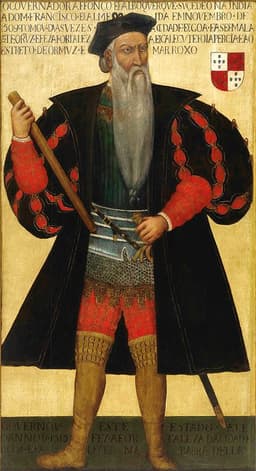
Afonso de Albuquerque
General · Medieval
79.6Total

Eurico Gaspar Dutra
General · Modern
52.7Total
Basic Information
Born
1453
1883
Died
1515
1974
Era
Medieval
Modern
Nationality
Portugal
Brazil
Occupation
General
General
Civilization
Western
Western
Score Comparison
Military (10%)
77.5
50.0
Political (20%)
88.0
68.0
Influence (20%)
80.0
51.8
Legacy (20%)
75.0
44.2
Leadership (15%)
78.0
62.0
Strategy (15%)
82.0
41.7
TOTAL
79.6
52.7
Afonso de Albuquerque — Complete Timeline
1503 AD
First voyage to IndiaWar◆ Major
Afonso de Albuquerque led a fleet to India, establishing the first Portuguese fort at Cochin. This voyage laid the foundation for Portuguese control of the Indian Ocean trade.
ExplorationColonialismIndia
Impact: global
1510 AD
Conquest of GoaWar◆ Major
Albuquerque captured Goa from the Sultan of Bijapur. He made Goa the capital of Portuguese India, a position it held for over 400 years.
ConquestColonialismIndia
Impact: regional
1511 AD
Conquest of MalaccaWar◆ Major
Albuquerque led a Portuguese fleet to capture the strategic port of Malacca. This gave Portugal control of the spice trade route between the Indian Ocean and the Pacific.
ConquestSpice TradeSoutheast Asia
Impact: global
1513 AD
Siege of AdenWar
Albuquerque attempted to capture Aden in Yemen but failed. This failure prevented Portugal from controlling the entrance to the Red Sea and limited their influence in the region.
SiegeFailureRed Sea
Impact: regional
1515 AD
Death at seaOther◆ Major
Afonso de Albuquerque died at sea off the coast of Goa, possibly from illness or poison. His death left the Portuguese Empire in the Indian Ocean without its most capable leader.
DeathLeadershipEmpire
Impact: regionaltragic
Eurico Gaspar Dutra — Complete Timeline
1945 AD
Elected President of BrazilPolitical Action◆ Major
Eurico Gaspar Dutra was elected President of Brazil, succeeding Get
Presidency1946 RepublicElection
Impact: national
1946 AD
Promulgated the 1946 ConstitutionReform◆ Major
Dutra oversaw the promulgation of a new democratic constitution, which restored civil liberties and established a presidential system. The 1946 Constitution replaced the authoritarian 1937 Charter and marked Brazil's return to democracy.
ConstitutionDemocracyPost-Estado Novo
Impact: nationalprogressive
Implemented the 'Dutra Plan' (Plano Dutra) for Economic DevelopmentReform
Dutra launched an economic development plan focused on infrastructure, energy, and transportation. The plan aimed to modernize the Brazilian economy and reduce dependence on imports, but its implementation was limited by fiscal constraints.
Economic PlanDevelopmentInfrastructure
Impact: nationalconstructive
1947 AD
Banned the Communist PartyPolitical Action◆ Major
Dutra banned the Brazilian Communist Party (PCB) and broke diplomatic relations with the Soviet Union. This action was part of his alignment with the United States during the early Cold War and aimed to suppress leftist opposition.
Cold WarCommunist BanAnti-Communism
Impact: nationaldestructive
1950 AD
Ended Presidency and RetiredPolitical Action
Dutra completed his term and was succeeded by Get
End of TermRetirementLegacy
Impact: national
Expert Analysis
Afonso de Albuquerque vs Eurico Gaspar Dutra
# The Conqueror and the Constitution-Maker
On a sweltering December day in 1515, a dying man was carried ashore near Goa, his body ravaged by fever and perhaps poison. Afonso de Albuquerque, the architect of Portugal’s eastern empire, had just learned that his king had replaced him with a rival. He died bitter, convinced his life’s work was crumbling. Four centuries later, in January 1946, another general stood before the Brazilian Congress, not to seize power but to receive it peacefully. Eurico Gaspar Dutra had just been elected president, the first democratically chosen leader after decades of dictatorship. One man built an empire from cannon fire; the other helped build a democracy with ink and paper. Both were generals. Their worlds could not have been more different.
Origins
Albuquerque was born in 1453, the year Constantinople fell, into a Portuguese nobility that breathed the salt air of exploration. His father was a courtier, his uncle a navigator who had sailed with Prince Henry. The young Afonso learned early that Portugal’s future lay not in Europe but beyond the horizon. He was shaped by a medieval worldview where glory meant conquest, where the cross followed the sword, and where a single man could carve kingdoms from distant shores.
Dutra came into the world four centuries later, in 1883, in the Brazilian interior of Mato Grosso. His father was a modest rancher, his mother a homemaker. Brazil had been independent for six decades, but its politics remained a game of regional strongmen and military coups. Dutra entered the army young, a path of stability for a boy from the provinces. Where Albuquerque inherited a world of expanding horizons, Dutra inherited one of consolidating borders. The age of conquest was over; the age of institutions had begun.
Rise to Power
Albuquerque’s ascent was forged in battle. In 1503, he led his first fleet to India, establishing a fort at Cochin that became Portugal’s foothold in the spice trade. The voyage was brutal—storms, scurvy, skirmishes—but it proved his mettle. He returned to Portugal a hero, then spent years lobbying the crown for greater authority. In 1506, he was appointed governor of Portuguese India, but his real power came from audacity: he captured territories faster than Lisbon could approve them.
Dutra rose through the ranks of Brazil’s army during a period of political upheaval. He served as Minister of War under Getúlio Vargas, the dictator who had ruled since 1930. Dutra was no revolutionary; he was a loyal soldier who believed in order. When Vargas was overthrown in 1945, Dutra emerged as the compromise candidate—a general acceptable to both the military and the emerging democratic forces. He won the presidency not by storming a fortress, but by winning an election.
Leadership & Governance
Albuquerque governed with a sword in one hand and a ledger in the other. After capturing Goa in 1510 from the Sultan of Bijapur, he made it the capital of Portuguese India—not just a military outpost but a city with churches, hospitals, and a civil administration. He encouraged Portuguese men to marry local women, creating a mixed-race population loyal to Lisbon. His conquest of Malacca in 1511 gave Portugal control of the spice routes, a strategic coup that enriched the crown for generations. Yet his rule was harsh: he crucified rebels, burned villages, and enforced Portuguese law with relentless severity.
Dutra governed with a pen. In 1946, he oversaw the promulgation of a new constitution that restored civil liberties, established presidential term limits, and guaranteed free elections. His economic plan, the “Plano Dutra,” invested in roads, railways, and hydroelectric dams—infrastructure that modernized a rural nation. But his record was mixed: he banned the Communist Party in 1947, broke relations with the Soviet Union, and aligned Brazil with the United States in the Cold War. Where Albuquerque built an empire through violence, Dutra built a state through legislation. Both were effective; both left blood on their hands.
Triumph & Tragedy
Albuquerque’s greatest triumph was the conquest of Malacca in 1511. The port controlled the spice trade between India and China; its fall made Portugal the dominant European power in Asia. His tragedy came in 1513, when he failed to capture Aden in Yemen. That failure left the Red Sea open to rival powers, a strategic gap that would haunt Portugal for decades. His death at sea in 1515, possibly poisoned, sealed the tragedy: he died believing his empire would collapse without him.
Dutra’s triumph was the 1946 Constitution, which endured for nearly two decades and provided the framework for Brazilian democracy. His tragedy was the suppression of political dissent. By banning the Communist Party, he alienated a significant portion of the working class and set a precedent for military intervention in politics that would plague Brazil for decades. He completed his term in 1951 and retired quietly, a general who had traded his uniform for a suit.
Character & Destiny
Albuquerque was driven by a vision of permanent empire. He wrote to King Manuel I: “If you want to hold India, you must hold the sea.” He understood that power required both force and administration. But his ambition outpaced his resources; he constantly begged Lisbon for men and ships that never came. His pride made him enemies at court, and his success made him rivals. He was a man of the 15th century, when one general could change the world—but also when one king’s whim could destroy him.
Dutra was a man of the 20th century, when systems mattered more than individuals. He was cautious, methodical, and deeply conservative. He believed in order above all, which explains both his support for democracy (which provided stable rule) and his suppression of communism (which threatened order). He was not a visionary; he was a manager. His destiny was to preside over a transition, not to create a new world.
Legacy
Albuquerque is remembered as the founder of the Portuguese Empire in Asia. His name adorns streets in Goa, forts in Malacca, and statues in Lisbon. His methods—brutal, efficient, and visionary—shaped European colonialism for centuries. His legacy score of 67.4 reflects both his achievements and the transience of empire: Portugal’s Asian holdings were lost within a century of his death.
Dutra is remembered as the first president of Brazil’s Fourth Republic, a transitional figure between dictatorship and democracy. His legacy score of 60.6 is modest, reflecting his role as a caretaker rather than a transformer. He is honored in history books but not celebrated in popular memory. His constitution is gone; his economic plans are forgotten. Yet he did something Albuquerque never could: he gave power away peacefully.
Conclusion
Two generals, four centuries apart, each facing the same question: how does a soldier rule in peacetime? Albuquerque answered with conquest, building an empire that collapsed when he died. Dutra answered with institutions, building a democracy that outlasted him. One created glory; the other created stability. The difference between them is the difference between the medieval and the modern—between a world where power meant personal rule and a world where power meant constitutional order. Both were necessary for their times. Both remind us that generals, no matter how brilliant, are ultimately servants of something larger: for Albuquerque, a king; for Dutra, a people.
Rankings
🥇
Afonso de AlbuquerqueLeader
Mil: 77.5Pol: 88.0Inf: 80.0
79.6
🥈
Eurico Gaspar Dutra
Mil: 50.0Pol: 68.0Inf: 51.8
52.7
+26.9 behind
How This Comparison Works
Algorithm
Each figure is scored on 6 dimensions (0—100 scale) based on structured historical data: Military (10%), Political (20%), Influence (20%), Legacy (20%), Leadership (15%), Strategy (15%). The weighted total produces the final ranking.
Data Sources
Scores are computed from structured sub-indicators in the database. Scale factors adjust for era (Ancient ×0.85, Modern ×1.0) and civilization size (Eastern ×1.05, Other ×0.80) to account for differences in population and military scale.
Maximum 3 Figures
Comparisons are limited to 2—3 figures to ensure readability and statistical meaningfulness.
Error Margins
±5 points per dimension — Sub-scores are derived from historical records with inherent uncertainty. Two figures within 5 points on a dimension should be considered roughly equivalent in that area.
Total Score Accuracy
±3 points overall — The weighted combination of 6 dimensions produces a total score with approximately ±3 points of uncertainty. Differences of less than 3 points are not statistically significant— the figures are effectively tied.
Known Limitations
- Historical records are incomplete and uneven across civilizations
- Figures from oral-tradition societies may be underrepresented
- Occupation labels can misclassify multi-role figures
- Scores measure capability and impact, not moral character
- Quantitative scoring is a comparison tool, not absolute truth
Capability Radar
Military (10%) — Battles & Warfare
Battles
85
10
Win Rate
80
15
Expansion
95
10
Political (20%) — Governance & Reform
Reform
80
50
Diplomacy
85
45
Economy
80
40
Influence (20%) — Cultural & Global Reach
Cultural
70
20
Global
85
20
Legacy (20%) — Historical Impact
Historical
85
30
Longevity
80
25
Leadership (15%) — Power & Stability
Tenure
70
55
Stability
65
50
Strategy (15%) — Tactics & Innovation
Strategy
95
25
Tactics
90
20
Reform
75
30
Similar Comparisons
Comments & Discussion
No comments yet. Be the first to share your thoughts!