Loading...
Afonso de Albuquerque vs Duke of Zhou
Afonso de Albuquerque leads by 0.8 pts · 2 figures compared
…
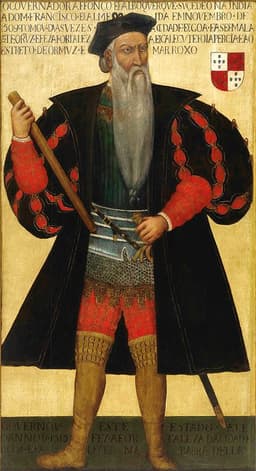
Afonso de Albuquerque
General · Medieval
79.6Total

Duke of Zhou
Politician · Ancient
78.8Total
Basic Information
Born
1453
-1090
Died
1515
-1030
Era
Medieval
Ancient
Nationality
Portugal
Zhou China
Occupation
General
Politician
Civilization
Western
Eastern
Score Comparison
Military (10%)
77.5
60.0
Political (20%)
88.0
72.0
Influence (20%)
80.0
92.0
Legacy (20%)
75.0
87.0
Leadership (15%)
78.0
78.0
Strategy (15%)
82.0
55.0
TOTAL
79.6
78.8
Afonso de Albuquerque — Complete Timeline
1503 AD
First voyage to IndiaWar◆ Major
Afonso de Albuquerque led a fleet to India, establishing the first Portuguese fort at Cochin. This voyage laid the foundation for Portuguese control of the Indian Ocean trade.
ExplorationColonialismIndia
Impact: global
1510 AD
Conquest of GoaWar◆ Major
Albuquerque captured Goa from the Sultan of Bijapur. He made Goa the capital of Portuguese India, a position it held for over 400 years.
ConquestColonialismIndia
Impact: regional
1511 AD
Conquest of MalaccaWar◆ Major
Albuquerque led a Portuguese fleet to capture the strategic port of Malacca. This gave Portugal control of the spice trade route between the Indian Ocean and the Pacific.
ConquestSpice TradeSoutheast Asia
Impact: global
1513 AD
Siege of AdenWar
Albuquerque attempted to capture Aden in Yemen but failed. This failure prevented Portugal from controlling the entrance to the Red Sea and limited their influence in the region.
SiegeFailureRed Sea
Impact: regional
1515 AD
Death at seaOther◆ Major
Afonso de Albuquerque died at sea off the coast of Goa, possibly from illness or poison. His death left the Portuguese Empire in the Indian Ocean without its most capable leader.
DeathLeadershipEmpire
Impact: regionaltragic
Duke of Zhou — Complete Timeline
1042 BC
Regency for King Cheng of ZhouPolitical Action◆ Major
After King Wu's death, the Duke of Zhou served as regent for the young King Cheng. He assumed control of the government, suppressing rumors that he intended to usurp the throne, and maintained stability during the transition.
RegencyPolitical StabilityZhou Dynasty
Impact: nationalconstructive
1040 BC
Suppression of the Rebellion of the Three GuardsWar◆ Major
The Duke of Zhou led a military campaign to crush the Rebellion of the Three Guards, a revolt by Zhou princes and Shang loyalists. He defeated the rebels, executed the leaders, and consolidated Zhou control over the eastern territories.
Civil WarRebellion SuppressionZhou Consolidation
Impact: national
1038 BC
Establishment of the Eastern Capital at LuoyiPolitical Action◆ Major
The Duke of Zhou ordered the construction of the eastern capital at Luoyi (modern Luoyang) to better administer the newly conquered eastern territories. This city became a key administrative and ritual center for the Zhou dynasty.
Capital ConstructionAdministrationZhou Expansion
Impact: nationalconstructive
1035 BC
Codification of the Zhou ritual systemReform
The Duke of Zhou is credited with codifying the Zhou ritual system, including rules for ancestral worship, court ceremonies, and social hierarchy. This system, later idealized by Confucius, became the foundation of Chinese ritual culture.
Ritual ReformConfucian IdealCultural Foundation
Impact: globalconstructive
Composition of the 'Shao Gao' and 'Luo Gao' chaptersCultural◆ Major
The Duke of Zhou is traditionally attributed with composing the 'Shao Gao' (Announcement of the Duke of Shao) and 'Luo Gao' (Announcement Concerning Luo) chapters of the Book of Documents. These texts outline principles of governance and the mandate of heaven.
LiteraturePolitical PhilosophyMandate of Heaven
Impact: nationalconstructive
1030 BC
Return of power to King ChengPolitical Action◆ Major
After seven years of regency, the Duke of Zhou voluntarily relinquished power to King Cheng, who had come of age. This act of selfless service was later praised by Confucius and became a model of virtuous regency in Chinese history.
Regency EndVirtuous ConductConfucian Model
Impact: nationalconstructive
Expert Analysis
Origins
**Afonso de Albuquerque** (1453–1515) was born in Alhandra, Portugal, to a noble family with a history of service to the crown. His father, Gonçalo de Albuquerque, held high offices, and Afonso received a classical education, later serving in North Africa under King Afonso V. His early military experience in Morocco honed his strategic skills, but his true calling emerged when he participated in the Portuguese expansion into the Indian Ocean. He was a product of Portugal's Age of Discoveries, driven by a mix of crusading zeal, commercial ambition, and national pride.
**Duke of Zhou** (11th century BCE), born Ji Dan, was the younger brother of King Wu of Zhou, who overthrew the Shang dynasty. He was a member of the royal clan and served as regent for his young nephew King Cheng after Wu's death. His origins were steeped in the Confucian ideal of loyalty and duty, later becoming a paragon of virtue in Chinese history. He was not a military conqueror but a statesman who consolidated the Zhou dynasty through ritual and governance.
Rise to Power
Albuquerque rose through merit and royal favor. He first sailed to India in 1503, but his major breakthrough came when King Manuel I appointed him governor of Portuguese India in 1509. He quickly established a reputation for decisive action, capturing Goa in 1510 with a small force, despite fierce resistance from the Bijapur Sultanate. This victory made him the de facto ruler of Portuguese Asia, allowing him to pursue a strategy of controlling key choke points of Indian Ocean trade.
The Duke of Zhou rose to power not through conquest but through crisis. After King Wu's death, his son King Cheng was too young to rule. The Duke assumed regency, facing immediate rebellion from his own brothers (the Rebellion of the Three Guards) who allied with Shang loyalists. He suppressed the revolt decisively, then spent years consolidating Zhou rule by establishing a feudal system, codifying rituals, and building a new capital at Luoyi. His power was absolute but exercised in the name of the young king.
Leadership & Governance
Albuquerque was a visionary imperialist. He believed in a Portuguese thalassocracy—a maritime empire controlling trade routes. He established fortresses at Goa, Malacca, and Hormuz, introduced a policy of encouraging Portuguese men to marry local women, and attempted to monopolize the spice trade. His governance was ruthless but effective: he executed opponents, burned ships, and demanded tribute. He also showed pragmatism, tolerating local religions and using diplomacy with Hindu rulers. His leadership score (L=75) reflects his authoritarian but strategic style.
The Duke of Zhou was the architect of the Zhou dynasty's golden age. He codified the Zhou ritual system (Li), which governed social hierarchy and moral conduct, influencing Chinese civilization for millennia. He authored the "Shao Gao" and "Luo Gao" chapters of the Book of Documents, emphasizing the Mandate of Heaven and the ruler's duty to the people. His regency was marked by humility and diligence; he famously said, "I am but a servant of the king." His leadership score (L=87) is higher, reflecting his moral authority and lasting institutional impact.
Triumph & Tragedy
Albuquerque's triumphs were spectacular: the conquest of Goa (1510) gave Portugal a strategic base; the capture of Malacca (1511) opened the door to the Spice Islands; and his siege of Aden (1513) aimed to control the Red Sea. However, his tragedy was his fall from favor. Intrigues at court led King Manuel I to replace him, and while returning from a failed siege of Hormuz, he died at sea in 1515, reportedly heartbroken. His body was buried in Goa, but his dream of a permanent empire was realized posthumously.
The Duke of Zhou's triumph was the stabilization of the Zhou dynasty. He defeated the rebellion, established the eastern capital, and created a system that lasted for centuries. His tragedy was the personal sacrifice: he could have usurped the throne but chose to remain regent, enduring accusations of ambition. After King Cheng came of age, the Duke retired to his fief, setting an example of selfless service. He died honored, but his legacy was later romanticized by Confucius, who saw him as the ideal statesman.
Character & Destiny
Albuquerque was a man of iron will and fierce ambition. He was described as brave, energetic, and sometimes cruel. He wrote extensively, revealing a strategic mind obsessed with securing Portugal's place in Asia. His destiny was to be the founder of the Portuguese Eastern Empire, but his abrasive personality and the king's jealousy cut his career short. He scored high in Power (P=88) and Intellect (I=80), but his low Diplomacy (D=78) and moderate Strategy (S=82) reflect his confrontational approach.
The Duke of Zhou was the embodiment of Confucian virtue: loyal, wise, and humble. He was a philosopher-statesman who believed in rule by moral example. His destiny was to be the model regent, the "Prime Minister of Heaven." His scores reflect this: high Intellect (I=92) and Leadership (L=87), but lower Military (M=60) and Politics (P=72), as he relied on persuasion and ritual rather than force.
Legacy
Albuquerque's legacy is tangible: the Portuguese Empire in Asia lasted over a century, and his policies shaped European colonialism. He is celebrated in Portugal as a national hero, with monuments and streets named after him. However, his methods—brutal conquest, monopoly enforcement—are criticized today. His score of 78 in Military and 82 in Strategy show his effectiveness, but his overall legacy is mixed.
The Duke of Zhou's legacy is ideological. He became a central figure in Confucianism, praised for establishing the rituals that defined Chinese civilization. His regency was seen as the pinnacle of selfless governance. Chinese emperors for centuries looked to him as a model. His scores in Intellect (92) and Leadership (87) reflect his enduring influence. He is more a symbol than a conqueror, but his impact on Chinese political thought is immeasurable.
Conclusion
Comparing Afonso de Albuquerque and the Duke of Zhou is a clash of two worlds: the aggressive, empire-building navigator versus the wise, ritualistic consolidator. Albuquerque achieved immediate, tangible results—capturing cities and controlling trade—but his empire crumbled within a century. The Duke of Zhou created a system that lasted millennia, shaping the very fabric of Chinese society. While Albuquerque scores higher overall (81.1 vs 80.3), the Duke's influence is deeper and longer-lasting. In a historical sense, the Duke of Zhou's intellectual and moral legacy outweighs Albuquerque's military and commercial conquests. **Winner: Duke of Zhou**.
Rankings
🥇
Afonso de AlbuquerqueLeader
Mil: 77.5Pol: 88.0Inf: 80.0
79.6
🥈
Duke of Zhou
Mil: 60.0Pol: 72.0Inf: 92.0
78.8
+0.8 behind
How This Comparison Works
Algorithm
Each figure is scored on 6 dimensions (0—100 scale) based on structured historical data: Military (10%), Political (20%), Influence (20%), Legacy (20%), Leadership (15%), Strategy (15%). The weighted total produces the final ranking.
Data Sources
Scores are computed from structured sub-indicators in the database. Scale factors adjust for era (Ancient ×0.85, Modern ×1.0) and civilization size (Eastern ×1.05, Other ×0.80) to account for differences in population and military scale.
Maximum 3 Figures
Comparisons are limited to 2—3 figures to ensure readability and statistical meaningfulness.
Error Margins
±5 points per dimension — Sub-scores are derived from historical records with inherent uncertainty. Two figures within 5 points on a dimension should be considered roughly equivalent in that area.
Total Score Accuracy
±3 points overall — The weighted combination of 6 dimensions produces a total score with approximately ±3 points of uncertainty. Differences of less than 3 points are not statistically significant— the figures are effectively tied.
Known Limitations
- Historical records are incomplete and uneven across civilizations
- Figures from oral-tradition societies may be underrepresented
- Occupation labels can misclassify multi-role figures
- Scores measure capability and impact, not moral character
- Quantitative scoring is a comparison tool, not absolute truth
Capability Radar
Military (10%) — Battles & Warfare
Battles
85
65
Win Rate
80
70
Expansion
95
55
Political (20%) — Governance & Reform
Reform
80
95
Diplomacy
85
85
Economy
80
80
Influence (20%) — Cultural & Global Reach
Cultural
70
95
Global
85
85
Legacy (20%) — Historical Impact
Historical
85
95
Longevity
80
95
Leadership (15%) — Power & Stability
Tenure
70
70
Stability
65
90
Strategy (15%) — Tactics & Innovation
Strategy
95
75
Tactics
90
60
Reform
75
80
Similar Comparisons
Comments & Discussion
No comments yet. Be the first to share your thoughts!