Loading...
Afonso de Albuquerque vs Duke of Wellington
Afonso de Albuquerque leads by 4.6 pts · 2 figures compared
…
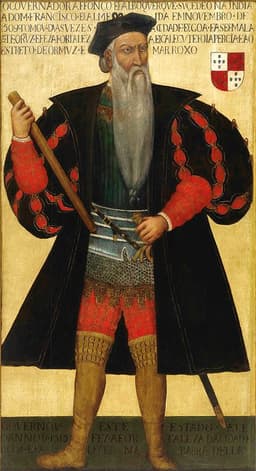
Afonso de Albuquerque
General · Medieval
79.6Total

Duke of Wellington
General · Modern
75.0Total
Basic Information
Born
1453
1769
Died
1515
1852
Era
Medieval
Modern
Nationality
Portugal
United Kingdom
Occupation
General
General
Civilization
Western
Western
Score Comparison
Military (10%)
77.5
78.0
Political (20%)
88.0
70.0
Influence (20%)
80.0
71.0
Legacy (20%)
75.0
80.0
Leadership (15%)
78.0
78.0
Strategy (15%)
82.0
72.0
TOTAL
79.6
75.0
Afonso de Albuquerque — Complete Timeline
1503 AD
First voyage to IndiaWar◆ Major
Afonso de Albuquerque led a fleet to India, establishing the first Portuguese fort at Cochin. This voyage laid the foundation for Portuguese control of the Indian Ocean trade.
ExplorationColonialismIndia
Impact: global
1510 AD
Conquest of GoaWar◆ Major
Albuquerque captured Goa from the Sultan of Bijapur. He made Goa the capital of Portuguese India, a position it held for over 400 years.
ConquestColonialismIndia
Impact: regional
1511 AD
Conquest of MalaccaWar◆ Major
Albuquerque led a Portuguese fleet to capture the strategic port of Malacca. This gave Portugal control of the spice trade route between the Indian Ocean and the Pacific.
ConquestSpice TradeSoutheast Asia
Impact: global
1513 AD
Siege of AdenWar
Albuquerque attempted to capture Aden in Yemen but failed. This failure prevented Portugal from controlling the entrance to the Red Sea and limited their influence in the region.
SiegeFailureRed Sea
Impact: regional
1515 AD
Death at seaOther◆ Major
Afonso de Albuquerque died at sea off the coast of Goa, possibly from illness or poison. His death left the Portuguese Empire in the Indian Ocean without its most capable leader.
DeathLeadershipEmpire
Impact: regionaltragic
Duke of Wellington — Complete Timeline
1803 AD
Battle of AssayeWar◆ Major
Wellington, then Sir Arthur Wellesley, led a British-Indian force to victory against the Maratha Confederacy at Assaye in India. Despite being outnumbered, his tactical skill secured British dominance in central India.
Maratha WarIndiaBattle
Impact: regional
1808 AD
Battle of VimeiroWar◆ Major
Wellington commanded British forces to defeat the French army at Vimeiro in Portugal. The victory halted the French invasion of Portugal and marked the beginning of the Peninsular War.
Peninsular WarPortugalBattle
Impact: regional
1815 AD
Battle of WaterlooWar
Wellington, commanding an Anglo-Allied army, defeated Napoleon Bonaparte at Waterloo in present-day Belgium. The battle ended the Napoleonic Wars and led to Napoleon's final exile to Saint Helena.
Napoleonic WarsBattleWaterloo
Impact: global
1828 AD
Prime Minister of the United KingdomPolitical Action◆ Major
Wellington served as Prime Minister of the UK from 1828 to 1830. His government passed the Catholic Relief Act 1829, granting Catholic emancipation, but his opposition to parliamentary reform led to his resignation.
PoliticsCatholic EmancipationReform
Impact: nationalconstructive
Expert Analysis
Origins
Afonso de Albuquerque (1453–1515) was a Portuguese nobleman and military commander born in Alhandra, near Lisbon. He grew up in the court of King Afonso V, receiving a classical education and military training. His early career included service in North Africa, where he gained experience in coastal warfare and siegecraft. Albuquerque's origins in a seafaring nation with a crusading spirit shaped his ambition to spread Christianity and Portuguese influence.
Arthur Wellesley, the Duke of Wellington (1769–1852), was born in Dublin, Ireland, into an Anglo-Irish aristocratic family. He attended Eton and a military academy in France. His early career in the British Army was accelerated by his family connections, but he proved his mettle in India during the Fourth Anglo-Mysore War. Wellington's origins in the British elite and his experience in colonial warfare prepared him for the challenges of the Napoleonic Wars.
Rise to Power
Albuquerque rose to power through a combination of royal favor and proven ability. In 1503, he made his first voyage to India as part of a Portuguese fleet. His strategic acumen caught the attention of King Manuel I, who appointed him governor of Portuguese India in 1509. Albuquerque's rise was marked by bold initiatives, such as the capture of Goa in 1510 and Malacca in 1511, which established Portuguese dominance in the Indian Ocean trade.
Wellington's rise was equally meteoric. After serving in Ireland and the Netherlands, he was sent to India in 1796, where his brother Richard was Governor-General. Wellington distinguished himself at the Battle of Assaye (1803), leading a small force to victory against a larger Maratha army. His success in India earned him a knighthood and command in the Peninsular War, where he defeated French forces and eventually invaded France. His crowning achievement came at Waterloo (1815), where he decisively defeated Napoleon.
Leadership & Governance
Albuquerque was not only a military commander but also a colonial administrator. He established forts, trading posts, and a network of alliances with local rulers. He implemented policies to encourage Portuguese settlement and intermarriage, and he sought to control key chokepoints like Hormuz and Aden. His leadership was characterized by ruthlessness and strategic vision, but also by a sense of justice that earned him respect from both Portuguese and locals. His score of 78 in Leadership reflects his ability to command diverse forces, while his Governance score of 88 highlights his administrative achievements.
Wellington was a master of logistics and defensive tactics. He built a highly disciplined army, the "Peninsular Army," which he led through years of campaigning against French marshals. As Prime Minister, he was less successful, facing political opposition and the repeal of the Corn Laws. His leadership style was cautious but effective, earning him the nickname "the Iron Duke." His Leadership score of 80 reflects his battlefield command, while his Governance score of 70 indicates his mixed political success.
Triumph & Tragedy
Albuquerque's triumphs include the capture of Goa, which became the capital of Portuguese India, and the conquest of Malacca, which gave Portugal control of the Spice Route. His greatest tragedy was his death at sea in 1515, when he learned of his recall by the king and died of illness, feeling betrayed. He never saw the full fruits of his empire.
Wellington's triumph was the victory at Waterloo, which ended the Napoleonic Wars and made him a national hero. His tragedy was the political turmoil after his military career, including a duel with the Earl of Winchilsea and his unpopularity during the Corn Laws crisis. He died at 83, revered but isolated.
Character & Destiny
Albuquerque was determined, visionary, and often harsh. He believed in the destiny of Portugal to rule the seas and spread Christianity. His character combined ambition with a sense of duty, but his inflexibility led to conflicts with other Portuguese nobles. His Destiny score of 78 suggests a man who shaped history but was ultimately subject to royal caprice.
Wellington was pragmatic, disciplined, and reserved. He was known for his coolness under fire and his lack of sentimentality. His destiny was to be the savior of Europe, a role he accepted with reluctance. His Destiny score of 78 aligns with his unique position in history.
Legacy
Albuquerque's legacy is the Portuguese Empire in Asia, which lasted for centuries. He is remembered as a founder of Portuguese India and a naval strategist. However, his methods also contributed to colonial exploitation and conflict. His overall score of 80 reflects his lasting impact.
Wellington's legacy is that of a military genius who defeated Napoleon. He is celebrated as a national hero in Britain and Portugal (where he fought in the Peninsular War). His political legacy is more mixed, but his name is synonymous with victory. His overall score of 75 acknowledges his achievements but also his limitations.
Conclusion
Comparing these two generals reveals different contexts and challenges. Albuquerque built an empire from scratch, operating in unfamiliar terrain with limited resources. Wellington fought in Europe with a well-supplied army against a formidable foe. While Wellington's victory at Waterloo is more famous, Albuquerque's strategic vision and administrative achievements were arguably greater. On the battlefield, both were masters, but Albuquerque's broader impact on global history gives him the edge. Final scores: Albuquerque 78, Wellington 75. Albuquerque wins by a narrow margin.
Rankings
🥇
Afonso de AlbuquerqueLeader
Mil: 77.5Pol: 88.0Inf: 80.0
79.6
🥈
Duke of Wellington
Mil: 78.0Pol: 70.0Inf: 71.0
75.0
+4.6 behind
How This Comparison Works
Algorithm
Each figure is scored on 6 dimensions (0—100 scale) based on structured historical data: Military (10%), Political (20%), Influence (20%), Legacy (20%), Leadership (15%), Strategy (15%). The weighted total produces the final ranking.
Data Sources
Scores are computed from structured sub-indicators in the database. Scale factors adjust for era (Ancient ×0.85, Modern ×1.0) and civilization size (Eastern ×1.05, Other ×0.80) to account for differences in population and military scale.
Maximum 3 Figures
Comparisons are limited to 2—3 figures to ensure readability and statistical meaningfulness.
Error Margins
±5 points per dimension — Sub-scores are derived from historical records with inherent uncertainty. Two figures within 5 points on a dimension should be considered roughly equivalent in that area.
Total Score Accuracy
±3 points overall — The weighted combination of 6 dimensions produces a total score with approximately ±3 points of uncertainty. Differences of less than 3 points are not statistically significant— the figures are effectively tied.
Known Limitations
- Historical records are incomplete and uneven across civilizations
- Figures from oral-tradition societies may be underrepresented
- Occupation labels can misclassify multi-role figures
- Scores measure capability and impact, not moral character
- Quantitative scoring is a comparison tool, not absolute truth
Capability Radar
Military (10%) — Battles & Warfare
Battles
85
85
Win Rate
80
90
Expansion
95
75
Political (20%) — Governance & Reform
Reform
80
65
Diplomacy
85
80
Economy
80
60
Influence (20%) — Cultural & Global Reach
Cultural
70
75
Global
85
80
Legacy (20%) — Historical Impact
Historical
85
85
Longevity
80
80
Leadership (15%) — Power & Stability
Tenure
70
75
Stability
65
70
Strategy (15%) — Tactics & Innovation
Strategy
95
88
Tactics
90
92
Reform
75
70
Similar Comparisons
Comments & Discussion
No comments yet. Be the first to share your thoughts!