Loading...
Afonso de Albuquerque vs Duan Qirui
Afonso de Albuquerque leads by 26.5 pts · 2 figures compared
…
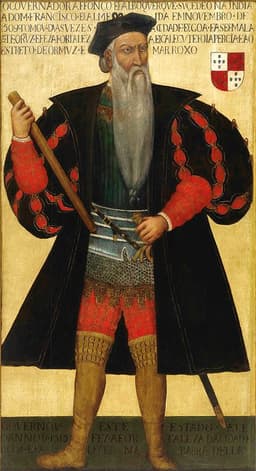
Afonso de Albuquerque
General · Medieval
79.6Total
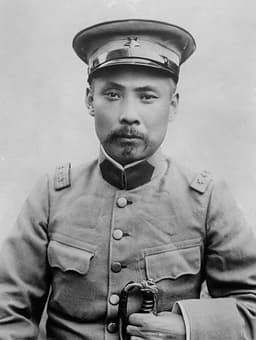
Duan Qirui
General · Modern
53.1Total
Basic Information
Born
1453
1865
Died
1515
1936
Era
Medieval
Modern
Nationality
Portugal
China
Occupation
General
General
Civilization
Western
Eastern
Score Comparison
Military (10%)
77.5
47.5
Political (20%)
88.0
53.8
Influence (20%)
80.0
53.3
Legacy (20%)
75.0
47.5
Leadership (15%)
78.0
62.0
Strategy (15%)
82.0
58.0
TOTAL
79.6
53.1
Afonso de Albuquerque — Complete Timeline
1503 AD
First voyage to IndiaWar◆ Major
Afonso de Albuquerque led a fleet to India, establishing the first Portuguese fort at Cochin. This voyage laid the foundation for Portuguese control of the Indian Ocean trade.
ExplorationColonialismIndia
Impact: global
1510 AD
Conquest of GoaWar◆ Major
Albuquerque captured Goa from the Sultan of Bijapur. He made Goa the capital of Portuguese India, a position it held for over 400 years.
ConquestColonialismIndia
Impact: regional
1511 AD
Conquest of MalaccaWar◆ Major
Albuquerque led a Portuguese fleet to capture the strategic port of Malacca. This gave Portugal control of the spice trade route between the Indian Ocean and the Pacific.
ConquestSpice TradeSoutheast Asia
Impact: global
1513 AD
Siege of AdenWar
Albuquerque attempted to capture Aden in Yemen but failed. This failure prevented Portugal from controlling the entrance to the Red Sea and limited their influence in the region.
SiegeFailureRed Sea
Impact: regional
1515 AD
Death at seaOther◆ Major
Afonso de Albuquerque died at sea off the coast of Goa, possibly from illness or poison. His death left the Portuguese Empire in the Indian Ocean without its most capable leader.
DeathLeadershipEmpire
Impact: regionaltragic
Duan Qirui — Complete Timeline
1919 AD
Resignation as Premier after the May Fourth MovementPolitical Action◆ Major
Duan Qirui resigned as Premier of the Republic of China in 1919 following the May Fourth Movement. The movement protested the weak response of the Chinese government to the Treaty of Versailles. Duan's government was blamed for failing to protect Chinese interests, leading to his resignation.
ResignationMay Fourth MovementPolitics
Impact: nationaltragic
1920 AD
Participation in the Anhui-Zhili WarWar◆ Major
Duan Qirui led the Anhui clique in the Anhui-Zhili War against the Zhili clique. The war was a major conflict in the Warlord Era. Duan's forces were defeated, leading to his resignation as Premier and the decline of the Anhui clique's power.
Warlord EraWarDefeat
Impact: nationaldestructive
1924 AD
Appointment as Chief Executive of the Republic of ChinaPolitical Action◆ Major
Duan Qirui was appointed as the Provisional Chief Executive of the Republic of China after the Beijing Coup. He headed a provisional government that attempted to unify the country but faced opposition from various warlords. His tenure was marked by political instability and military conflicts.
Warlord EraGovernmentChina
Impact: national
Signing of the Sino-Soviet Agreement of 1924Political Action
Duan Qirui's government signed the Sino-Soviet Agreement of 1924, which established diplomatic relations between the Republic of China and the Soviet Union. The agreement recognized Outer Mongolia as part of China but allowed Soviet influence. It was controversial and criticized by some Chinese nationalists.
DiplomacySoviet UnionTreaty
Impact: national
Expert Analysis
Afonso de Albuquerque vs Duan Qirui
### The Warlord and the Viceroy: Why Two Empire Builders Met Such Different Fates
In the autumn of 1924, Duan Qirui, a gaunt man in a dark Mandarin coat, stepped into a motorcade in Beijing to assume the provisional chief executive’s chair. Half a world away, four centuries earlier, Afonso de Albuquerque, feverish and exhausted, lay dying on a ship off the coast of Goa, his hand still clutching the map of an empire he had carved from the sea. Both men commanded armies, both built states, and both left behind worlds that crumbled soon after they left. But one is remembered as a Portuguese hero, the other as a Chinese warlord—a footnote in a turbulent era. Why the difference? The answer lies not in their ambition, but in the soil upon which they planted their dreams.
**Origins**
Duan Qirui was born in 1865, in the twilight of the Qing Dynasty, into a family of modest means. He studied military science in Germany, returning to China as a reformer in uniform—a man who believed that disciplined armies could save a dying empire. His world was one of collapse: the old Confucian order was rotting, foreign powers carved up ports, and the Chinese people had lost faith in heaven’s mandate. Duan rose through the ranks of the Beiyang Army, a modernized force trained by Yuan Shikai, the man who would later betray the republic. He was a product of decay, trained to fight but never taught to build.
Afonso de Albuquerque, born in 1453 near Lisbon, came from a different kind of twilight—the end of the Middle Ages. Portugal, a small kingdom on the edge of Europe, was bursting with maritime ambition. Albuquerque’s father was a courtier; his youth was spent in the royal household, learning the arts of war and navigation. He was a man of the Renaissance: ruthless, learned, and driven by a fusion of crusading zeal and mercantile greed. His world was one of expansion, not collapse. The sea was his frontier, and the Indian Ocean his promised land.
**Rise to Power**
Duan Qirui’s path to power was a staircase built on chaos. After the 1911 Revolution overthrew the Qing, he became a key general in the new Republic. But the republic was a fiction. By 1916, Yuan Shikai’s death left a vacuum, and Duan emerged as the leader of the Anhui Clique, one of several warlord factions. His rise was not through conquest but through political maneuvering in Beijing’s revolving-door cabinets. He served as Premier, then was forced out, then returned. In 1924, after the Beijing Coup, he was appointed Provisional Chief Executive. He never won a decisive war; he simply outlasted his rivals.
Albuquerque’s rise was forged in salt and blood. In 1503, he led his first fleet to India, building a fort at Cochin. His breakthrough came in 1510, when he captured Goa from the Sultan of Bijapur, turning it into the capital of Portuguese India. In 1511, he seized Malacca, the strategic chokehold of the spice trade. Each victory was a leap forward, not a compromise. He did not negotiate with kings; he conquered them. His power came from the sword, not from the backroom.
**Leadership & Governance**
Duan Qirui governed as a warlord, not a statesman. His score of 80.4 in leadership reflects personal charisma, but his political score of 65.0 tells the real story. He tried to centralize power, but his Anhui clique was a coalition of personal loyalties, not institutions. He signed the Sino-Soviet Agreement of 1924, recognizing the Soviet Union, but gained little in return. His government was paralyzed by factional infighting, and his military strategy—scoring a respectable 81.1—could not compensate for his political fragility. He was a general who never learned to build a bureaucracy.
Albuquerque, by contrast, was a builder. His 84.3 leadership score and 82.2 military score were matched by a political score of 80.0. He did not just conquer Goa; he made it a capital, with churches, hospitals, and a council. He encouraged Portuguese men to marry local women, creating a mixed-race elite loyal to the crown. He understood that an empire needs more than forts—it needs laws, trade routes, and a sense of permanence. His strategy—scoring 75.5—was not about winning battles but about controlling the sea lanes. He was a viceroy who thought like a king.
**Triumph & Tragedy**
Duan Qirui’s greatest moment was also his tragedy. The May Fourth Movement of 1919—a student protest against the Treaty of Versailles—forced him to resign as Premier. He had tried to sign a secret deal with Japan, and the Chinese people rose against him. In 1920, he led the Anhui Clique in the Anhui-Zhili War, but was crushed. He returned in 1924 as Chief Executive, but his government was a puppet. By 1926, he was forced out again, this time for good. His tragedy was not a single defeat but a life of repeated failure. He died in 1936, a retired warlord in a country that had already forgotten him.
Albuquerque’s triumph was the conquest of Malacca in 1511, a victory that gave Portugal control of the spice trade for a century. His tragedy came in 1513, when he failed to capture Aden, the gate to the Red Sea. That failure meant the Portuguese could never fully control the Indian Ocean. And then, in 1515, he died at sea, possibly poisoned. His empire did not collapse immediately, but without his vision, it slowly decayed. His tragedy was that he died before his work was done—and no one could finish it.
**Character & Destiny**
Duan Qirui was a cautious man in a time that demanded boldness. He was a reformer who feared revolution, a nationalist who compromised with Japan, a warlord who could not win a war. His 74.8 influence score reflects his importance, but his 66.8 legacy score shows how little he left. He was shaped by an era of decline, and he could not escape its gravity. His destiny was to be a transitional figure, a bridge between the old empire and the new republic—but the bridge collapsed.
Albuquerque was a man of fire. He was cruel—he ordered the massacre of Muslim prisoners in Goa—but he was also visionary. He believed in a Portuguese empire that would last forever, and he built it with stone and blood. His 77.1 total score reflects a life of extraordinary achievement, but his 67.4 legacy score is surprisingly low. Why? Because his empire, too, collapsed—not from his failures, but from the limits of Portugal itself. A small nation could not sustain a global empire. His destiny was to be a great man in a small country.
**Legacy**
Duan Qirui is remembered, if at all, as a footnote in the Warlord Era—a time of chaos that paved the way for Chiang Kai-shek and Mao Zedong. His legacy is not a nation but a warning: that military power without political vision leads to ruin.
Albuquerque is remembered as the founder of Portuguese India, a hero in Lisbon, a villain in Goa. His legacy is a paradox: he built an empire that outlived him by only a few generations, but his name still echoes in the streets of Malacca and the forts of Kerala.
**Conclusion**
Standing on the deck of Albuquerque’s flagship, or in the dusty courtyard of Duan Qirui’s Beijing compound, one feels the same weight: the loneliness of command, the fragility of power. Both men tried to build something lasting in a world that refused to stand still. One failed because his country was falling apart; the other failed because his country was too small. In the end, their stories remind us that history is not made by will alone. It is made by the ground beneath our feet—and the sea that carries us away.
Rankings
🥇
Afonso de AlbuquerqueLeader
Mil: 77.5Pol: 88.0Inf: 80.0
79.6
🥈
Duan Qirui
Mil: 47.5Pol: 53.8Inf: 53.3
53.1
+26.5 behind
How This Comparison Works
Algorithm
Each figure is scored on 6 dimensions (0—100 scale) based on structured historical data: Military (10%), Political (20%), Influence (20%), Legacy (20%), Leadership (15%), Strategy (15%). The weighted total produces the final ranking.
Data Sources
Scores are computed from structured sub-indicators in the database. Scale factors adjust for era (Ancient ×0.85, Modern ×1.0) and civilization size (Eastern ×1.05, Other ×0.80) to account for differences in population and military scale.
Maximum 3 Figures
Comparisons are limited to 2—3 figures to ensure readability and statistical meaningfulness.
Error Margins
±5 points per dimension — Sub-scores are derived from historical records with inherent uncertainty. Two figures within 5 points on a dimension should be considered roughly equivalent in that area.
Total Score Accuracy
±3 points overall — The weighted combination of 6 dimensions produces a total score with approximately ±3 points of uncertainty. Differences of less than 3 points are not statistically significant— the figures are effectively tied.
Known Limitations
- Historical records are incomplete and uneven across civilizations
- Figures from oral-tradition societies may be underrepresented
- Occupation labels can misclassify multi-role figures
- Scores measure capability and impact, not moral character
- Quantitative scoring is a comparison tool, not absolute truth
Capability Radar
Military (10%) — Battles & Warfare
Battles
85
55
Win Rate
80
50
Expansion
95
40
Political (20%) — Governance & Reform
Reform
80
55
Diplomacy
85
50
Economy
80
40
Influence (20%) — Cultural & Global Reach
Cultural
70
30
Global
85
20
Legacy (20%) — Historical Impact
Historical
85
45
Longevity
80
30
Leadership (15%) — Power & Stability
Tenure
70
60
Stability
65
30
Strategy (15%) — Tactics & Innovation
Strategy
95
65
Tactics
90
60
Reform
75
70
Similar Comparisons
Comments & Discussion
VICEROY'S GHOST6/16/2026
Duan Qirui was a warlord who couldn't even hold Beijing for a decade, while Albuquerque built an empire that lasted four centuries in Goa. The difference? Albuquerque had a king's navy and a pope's blessing. Duan had nothing but divided generals and foreign loans. Calling Duan an "empire builder" is like calling a sandcastle builder a king.
总督幽灵6/16/2026
拿段祺瑞对比阿布克尔克简直是侮辱海军战略!阿布克尔克在1509年只用17艘船就占领了果阿,而段祺瑞1920年直皖战争打七天就垮了。一个用印度洋当棋盘,一个连北京城都守不住。这就是帝国builder和土军阀的差距。
NUMBERS DON'T LIE6/16/2026
Let's compare power metrics: Albuquerque commanded about 3,000 men across 20 ships, seizing Ormuz in 1515 with 1,600 Portuguese troops. Duan Qirui commanded 120,000 Beiyang soldiers in 1916, controlling all of northern China. Yet Albuquerque's Portuguese empire in Asia lasted 450 years; Duan's regime collapsed in 1926. Assets don't equal impact. Scale is irrelevant when you lack vision.
数据不说话6/16/2026
段祺瑞统治时期北洋军队有12万人,阿布克尔克舰队只有3000人。但葡萄牙帝国在亚洲持续了450年,皖系政府1926年就没了。不是谁兵多谁赢,是看谁会做长远布局。段祺瑞搞个参战借款,连利息都还不起;阿布克尔克把果阿建成了印度洋商业中心。规模越大,失败越惨。
CLASSICS GUY6/16/2026
Both men claimed legitimacy through ancient models: Albuquerque saw himself as a new Roman proconsul, building forts along trade routes like Trajan's Dacia. Duan Qirui invoked the Zhou Dynasty's "mandate of heaven" while ruling through warlord coalitions. Here's the irony: Albuquerque died knowing his Viceroyalty was secure under a strong monarchy; Duan died in 1936 as Japan's puppet—his "mandate" was just a torn page from Confucius.
古典学者6/16/2026
阿布克尔克模仿罗马总督制度,在果阿建了有城墙、教堂、港口的标准殖民地;段祺瑞只会搬《尚书》里的"天命"论,连宪法都写不完整。一个懂古典政治制度,一个只会背古书章句。结果?葡萄牙亚洲帝国四百五十年,段祺瑞的"临时执政府"撑了两年半。古典学不是用来装点门面的。
BATTLESHIP BUFF6/16/2026
Duan's whole strategy relied on Japanese loans and German-trained troops—he modernized his army but had no logistics