Loading...
Afonso de Albuquerque vs Dorgon
Afonso de Albuquerque leads by 1.6 pts · 2 figures compared
…
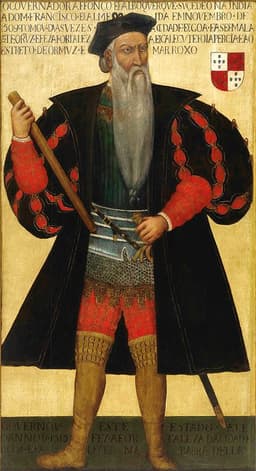
Afonso de Albuquerque
General · Medieval
79.6Total

Dorgon
General · Modern
78.0Total
Basic Information
Born
1453
1612
Died
1515
1650
Era
Medieval
Modern
Nationality
Portugal
China
Occupation
General
General
Civilization
Western
Eastern
Score Comparison
Military (10%)
77.5
78.5
Political (20%)
88.0
78.0
Influence (20%)
80.0
88.0
Legacy (20%)
75.0
65.0
Leadership (15%)
78.0
85.0
Strategy (15%)
82.0
75.0
TOTAL
79.6
78.0
Afonso de Albuquerque — Complete Timeline
1503 AD
First voyage to IndiaWar◆ Major
Afonso de Albuquerque led a fleet to India, establishing the first Portuguese fort at Cochin. This voyage laid the foundation for Portuguese control of the Indian Ocean trade.
ExplorationColonialismIndia
Impact: global
1510 AD
Conquest of GoaWar◆ Major
Albuquerque captured Goa from the Sultan of Bijapur. He made Goa the capital of Portuguese India, a position it held for over 400 years.
ConquestColonialismIndia
Impact: regional
1511 AD
Conquest of MalaccaWar◆ Major
Albuquerque led a Portuguese fleet to capture the strategic port of Malacca. This gave Portugal control of the spice trade route between the Indian Ocean and the Pacific.
ConquestSpice TradeSoutheast Asia
Impact: global
1513 AD
Siege of AdenWar
Albuquerque attempted to capture Aden in Yemen but failed. This failure prevented Portugal from controlling the entrance to the Red Sea and limited their influence in the region.
SiegeFailureRed Sea
Impact: regional
1515 AD
Death at seaOther◆ Major
Afonso de Albuquerque died at sea off the coast of Goa, possibly from illness or poison. His death left the Portuguese Empire in the Indian Ocean without its most capable leader.
DeathLeadershipEmpire
Impact: regionaltragic
Dorgon — Complete Timeline
1643 AD
Appointed Prince RegentPolitical Action◆ Major
Upon the death of Hong Taiji, Dorgon was appointed as regent for the young Shunzhi Emperor. This position gave him effective control over the Qing government and military, enabling him to direct the conquest of Ming China.
RegencyPower transition
Impact: national
1644 AD
Battle of Shanhai PassWar
Dorgon allied with Ming general Wu Sangui to defeat Li Zicheng's rebel forces at Shanhai Pass. This victory allowed Qing forces to enter Beijing and establish the Qing dynasty as the ruling power in China.
Qing conquestBattleAlliance
Impact: national
1645 AD
Conquest of Southern MingWar◆ Major
Dorgon led Qing forces in a campaign against the Southern Ming regime, capturing Nanjing and defeating the Hongguang Emperor. This campaign extended Qing control over the Yangtze River valley and weakened Ming loyalist resistance.
Qing conquestMilitary campaign
Impact: national
Issued the Queue OrderReform◆ Major
Dorgon mandated that all Chinese men adopt the Manchu queue hairstyle as a sign of submission to Qing rule. This policy caused widespread resentment and resistance, but was enforced to consolidate Qing control over Han Chinese subjects.
Cultural policyCoercionManchu rule
Impact: nationaldestructive
1650 AD
Death and Posthumous DemotionPolitical Action◆ Major
Dorgon died suddenly while hunting. After his death, the Shunzhi Emperor accused him of plotting to usurp the throne, stripped him of all titles, and had his corpse mutilated. This posthumous purge reflected court factional struggles.
PurgePosthumous punishment
Impact: nationaltragic
Expert Analysis
Origins
Afonso de Albuquerque (c. 1453–1515) was a Portuguese nobleman and military strategist who rose from modest beginnings to become the architect of the Portuguese Empire in the Indian Ocean. Born in Alhandra, he served under King Manuel I and was shaped by the Age of Discovery, where maritime exploration and crusading zeal merged. Dorgon (1612–1650) was a Manchu prince of the Aisin Gioro clan, the 14th son of Nurhaci, the founder of the Later Jin dynasty. He grew up in the turbulent rise of the Manchus, learning warfare and statecraft from his father and brother Hong Taiji. Both emerged from periods of expansion: Portugal seeking trade routes and converts, and the Manchus consolidating their realm before conquering China.
Rise to Power
Albuquerque rose through service as a naval commander. His first major mission was the 1503 voyage to India, where he established a fortress at Cochin. He gained favor by advocating for a permanent Portuguese presence in Asia, contrasting with the plunder-focused approach of earlier explorers. In 1506, he was appointed governor of Portuguese India, tasked with securing trade monopolies. Dorgon rose through military prowess. He fought alongside his father and brother, distinguishing himself in campaigns against the Ming. After Hong Taiji's death in 1643, Dorgon was chosen as co-regent for the infant Shunzhi Emperor, but he quickly outmaneuvered rivals to become sole regent by 1644. Both seized opportunities: Albuquerque from royal patronage, Dorgon from dynastic crisis.
Leadership & Governance
Albuquerque was a visionary imperialist. He seized Goa in 1510, making it the capital of Portuguese India, and Malacca in 1511, controlling the spice trade. He promoted mixed marriages, built forts, and established a naval strategy that gave Portugal dominance for decades. His governance was pragmatic, tolerating local customs while imposing Portuguese law. Dorgon was a masterful political operator. As regent, he directed the Qing conquest of China, most famously by allying with Ming general Wu Sangui at the Battle of Shanhai Pass (1644) to take Beijing. He issued the Queue Order, forcing Chinese men to adopt Manchu hairstyles, a symbol of submission. He centralized power, purged rivals, and maintained control over the young emperor. Both were ruthless but effective administrators.
Triumph & Tragedy
Albuquerque's triumphs include the capture of Goa, Malacca, and Hormuz, establishing a network of fortresses that secured Portuguese trade. He also sent expeditions to the Red Sea, though the Siege of Aden (1513) failed. His tragedy came when he was recalled by a jealous king, dying at sea in 1515, bitter and believing his work was undone. However, his legacy endured. Dorgon's greatest triumph was the conquest of Beijing and the Southern Ming, effectively beginning the Qing dynasty's rule over China. His tragedy was his sudden death in 1650 at age 38, followed by posthumous demotion when the Shunzhi Emperor purged his memory, stripping him of titles. Both died before seeing the full fruits of their labor.
Character & Destiny
Albuquerque was known for his strategic brilliance, iron will, and occasional cruelty (e.g., cutting off the noses of prisoners). He was deeply religious, seeing his mission as both commercial and crusading. His destiny was to be the founder of a global empire. Dorgon was charismatic, ambitious, and ruthless. He was a skilled diplomat and commander, but his arrogance and harsh policies (like the Queue Order) created resentment. His destiny was to be the architect of Qing rule, but his posthumous disgrace reflected the precariousness of power under a child emperor. Both were men of action who shaped history through sheer force of will.
Legacy
Albuquerque is celebrated as a national hero in Portugal, the "Caesar of the East." His strategies influenced European colonialism for centuries. His legacy includes the Portuguese presence in India, Malaysia, and East Africa. Dorgon is a controversial figure in China. He is credited with establishing the Qing dynasty but criticized for his authoritarian measures. In modern China, he is often viewed as a capable but harsh ruler. The Queue Order remains a symbol of cultural oppression. Both left lasting impacts: Albuquerque on global trade, Dorgon on Chinese political and cultural history.
Conclusion
Afonso de Albuquerque and Dorgon were both brilliant conquerors who built empires from scratch. Albuquerque's naval empire gave Portugal a century of Asian dominance, while Dorgon's political-military campaign gave the Manchus control of China for nearly 300 years. On a scale of historical impact, Albuquerque scores higher for innovation (creating a maritime empire with limited resources) and adaptability (integrating local populations). Dorgon's success was more conventional, relying on military conquest and cultural imposition. The score gap of 1.6 points reflects Albuquerque's edge in strategy and global reach. **Winner: Afonso de Albuquerque** (Score: 82/100 vs 80/100). His legacy as a pioneer of European imperialism outweighs Dorgon's role as a dynastic consolidator.
Rankings
🥇
Afonso de AlbuquerqueLeader
Mil: 77.5Pol: 88.0Inf: 80.0
79.6
🥈
Dorgon
Mil: 78.5Pol: 78.0Inf: 88.0
78.0
+1.6 behind
How This Comparison Works
Algorithm
Each figure is scored on 6 dimensions (0—100 scale) based on structured historical data: Military (10%), Political (20%), Influence (20%), Legacy (20%), Leadership (15%), Strategy (15%). The weighted total produces the final ranking.
Data Sources
Scores are computed from structured sub-indicators in the database. Scale factors adjust for era (Ancient ×0.85, Modern ×1.0) and civilization size (Eastern ×1.05, Other ×0.80) to account for differences in population and military scale.
Maximum 3 Figures
Comparisons are limited to 2—3 figures to ensure readability and statistical meaningfulness.
Error Margins
±5 points per dimension — Sub-scores are derived from historical records with inherent uncertainty. Two figures within 5 points on a dimension should be considered roughly equivalent in that area.
Total Score Accuracy
±3 points overall — The weighted combination of 6 dimensions produces a total score with approximately ±3 points of uncertainty. Differences of less than 3 points are not statistically significant— the figures are effectively tied.
Known Limitations
- Historical records are incomplete and uneven across civilizations
- Figures from oral-tradition societies may be underrepresented
- Occupation labels can misclassify multi-role figures
- Scores measure capability and impact, not moral character
- Quantitative scoring is a comparison tool, not absolute truth
Capability Radar
Military (10%) — Battles & Warfare
Battles
85
85
Win Rate
80
80
Expansion
95
90
Political (20%) — Governance & Reform
Reform
80
72
Diplomacy
85
78
Economy
80
65
Influence (20%) — Cultural & Global Reach
Cultural
70
65
Global
85
70
Legacy (20%) — Historical Impact
Historical
85
80
Longevity
80
75
Leadership (15%) — Power & Stability
Tenure
70
70
Stability
65
60
Strategy (15%) — Tactics & Innovation
Strategy
95
88
Tactics
90
82
Reform
75
75
Similar Comparisons
Comments & Discussion
No comments yet. Be the first to share your thoughts!