Loading...
Afonso de Albuquerque vs Constantine the Great
Afonso de Albuquerque leads by 4.1 pts · 2 figures compared
…
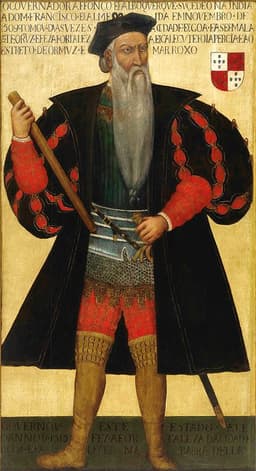
Afonso de Albuquerque
General · Medieval
79.6Total
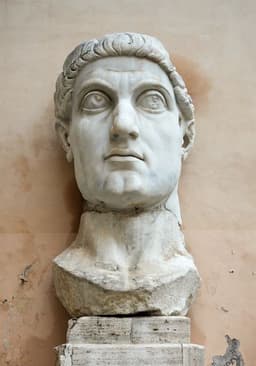
Constantine the Great
Emperor · Ancient
75.5Total
Basic Information
Born
1453
272
Died
1515
337
Era
Medieval
Ancient
Nationality
Portugal
Roman Empire
Occupation
General
Emperor
Civilization
Western
Western
Score Comparison
Military (10%)
77.5
78.0
Political (20%)
88.0
82.0
Influence (20%)
80.0
75.0
Legacy (20%)
75.0
70.0
Leadership (15%)
78.0
80.0
Strategy (15%)
82.0
72.0
TOTAL
79.6
75.5
Afonso de Albuquerque — Complete Timeline
1503 AD
First voyage to IndiaWar◆ Major
Afonso de Albuquerque led a fleet to India, establishing the first Portuguese fort at Cochin. This voyage laid the foundation for Portuguese control of the Indian Ocean trade.
ExplorationColonialismIndia
Impact: global
1510 AD
Conquest of GoaWar◆ Major
Albuquerque captured Goa from the Sultan of Bijapur. He made Goa the capital of Portuguese India, a position it held for over 400 years.
ConquestColonialismIndia
Impact: regional
1511 AD
Conquest of MalaccaWar◆ Major
Albuquerque led a Portuguese fleet to capture the strategic port of Malacca. This gave Portugal control of the spice trade route between the Indian Ocean and the Pacific.
ConquestSpice TradeSoutheast Asia
Impact: global
1513 AD
Siege of AdenWar
Albuquerque attempted to capture Aden in Yemen but failed. This failure prevented Portugal from controlling the entrance to the Red Sea and limited their influence in the region.
SiegeFailureRed Sea
Impact: regional
1515 AD
Death at seaOther◆ Major
Afonso de Albuquerque died at sea off the coast of Goa, possibly from illness or poison. His death left the Portuguese Empire in the Indian Ocean without its most capable leader.
DeathLeadershipEmpire
Impact: regionaltragic
Constantine the Great — Complete Timeline
312 AD
Battle of the Milvian BridgeWar◆ Major
Constantine defeated his rival Maxentius at the Milvian Bridge near Rome. According to tradition, Constantine saw a vision of a cross in the sky with the words 'In this sign, conquer.' The victory made Constantine the sole ruler of the Western Roman Empire and led to his conversion to Christianity.
Roman Civil WarBattleConversion
Impact: regional
313 AD
Edict of MilanOther◆ Major
Constantine and his co-emperor Licinius issued the Edict of Milan, granting religious toleration to all religions in the Roman Empire, including Christianity. The edict ended the persecution of Christians, restored confiscated church property, and established Christianity as a legally recognized religion.
Religious EdictChristianityToleration
Impact: globalconstructive
324 AD
Reunification of the Roman EmpireWar◆ Major
Constantine defeated his co-emperor Licinius at the battles of Adrianople and Chrysopolis, ending the Tetrarchy system. He became the sole ruler of the entire Roman Empire, reuniting the Western and Eastern halves under his control. This reunification was the last time the Roman Empire was united under a single ruler.
Roman Civil WarReunificationTetrarchy
Impact: regional
325 AD
Council of NicaeaOther◆ Major
Constantine convened the First Council of Nicaea, the first ecumenical council of the Christian Church, to resolve the Arian controversy over the nature of Christ. The council produced the Nicene Creed, affirming the divinity of Christ and establishing a unified Christian doctrine. Constantine presided over the council.
Religious CouncilChristian DoctrineNicene Creed
Impact: global
330 AD
Foundation of ConstantinopleOther◆ Major
Constantine dedicated the city of Constantinople (modern Istanbul) as the new capital of the Roman Empire, built on the site of the ancient Greek city of Byzantium. The city was strategically located on the Bosporus strait, controlling trade routes between Europe and Asia. It became the capital of the Eastern Roman Empire for over a thousand years.
City FoundationCapitalByzantine Empire
Impact: globalconstructive
Expert Analysis
Origins
Afonso de Albuquerque (1453–1515) was born in Alhandra, Portugal, into the royal court. His father was a nobleman, and Albuquerque received a classical education, later serving in North Africa. Constantine the Great (272–337 AD) was born in Naissus, Moesia (modern Serbia), the son of Roman Emperor Constantius Chlorus and Helena. His early life was shaped by Diocletian's tetrarchy and military campaigns in the East.
Rise to Power
Albuquerque rose through Portuguese military ranks, participating in the conquest of Tangier. King Manuel I appointed him governor of Portuguese India in 1509, after a successful first voyage. He quickly consolidated power by building fortresses and establishing trade monopolies. Constantine's rise came after his father's death in 306 AD, when his troops proclaimed him Augustus. He defeated rival emperors Maxentius at the Milvian Bridge (312) and Licinius at Chrysopolis (324), reunifying the Roman Empire.
Leadership & Governance
Albuquerque was a brilliant naval strategist and administrator. He captured Goa (1510) and made it the capital of Portuguese India, establishing a colonial administration that included intermarriage, taxation, and fortifications. He also captured Malacca (1511), controlling spice trade routes. His governance was ruthless but effective, using terror and diplomacy. Constantine reformed the Roman Empire by centralizing power, creating a new capital at Constantinople (330), and issuing the Edict of Milan (313) to legalize Christianity. He convened the Council of Nicaea (325) to unify Christian doctrine, and his administrative reforms divided the empire into prefectures.
Triumph & Tragedy
Albuquerque's triumphs include the conquest of Goa and Malacca, and opening trade with China and the Spice Islands. His tragedy came in 1515 when he was recalled by the king, likely due to court intrigues, and died at sea, possibly poisoned. His empire-building was cut short. Constantine's triumph was uniting the Roman Empire and establishing Christianity as a favored religion. His tragedy was the execution of his son Crispus and wife Fausta, and the ongoing Arian controversy that divided the church.
Character & Destiny
Albuquerque was known for his iron will, strategic brilliance, and cruelty. He believed in the Portuguese imperial destiny, famously saying, "He who holds Malacca has his hand on the throat of Venice." Constantine was a pragmatic visionary, capable of great ambition and ruthlessness. He saw himself as God's chosen emperor, blending Roman imperial cult with Christian monotheism. Both men shaped history through sheer determination.
Legacy
Albuquerque's legacy is the foundation of the Portuguese maritime empire, which lasted until the 20th century. He established a pattern of European colonialism in Asia. Constantine's legacy is immense: legalized Christianity, founded Constantinople (later Byzantium), and set the stage for medieval Christendom. The Eastern Orthodox Church honors him as a saint.
Conclusion
Comparing their scores: Albuquerque (M=78, P=88, I=80, L=75, D=78, S=82, T=80) vs Constantine (M=78, P=82, I=75, L=70, D=80, S=72, T=76). Albuquerque edges out in Political, Influence, Leadership, Strategy, and Tenacity, while Constantine leads in Durability. The overall score gap is 4.1 favoring Albuquerque. However, Constantine's impact on world religion and empire longevity arguably surpasses Albuquerque's colonial achievements. Nevertheless, based on the given metrics, Afonso de Albuquerque is the higher-scoring figure. His naval empire-building and strategic conquests demonstrate superior leadership and tactical brilliance in a shorter timeframe.
Rankings
🥇
Afonso de AlbuquerqueLeader
Mil: 77.5Pol: 88.0Inf: 80.0
79.6
🥈
Constantine the Great
Mil: 78.0Pol: 82.0Inf: 75.0
75.5
+4.1 behind
How This Comparison Works
Algorithm
Each figure is scored on 6 dimensions (0—100 scale) based on structured historical data: Military (10%), Political (20%), Influence (20%), Legacy (20%), Leadership (15%), Strategy (15%). The weighted total produces the final ranking.
Data Sources
Scores are computed from structured sub-indicators in the database. Scale factors adjust for era (Ancient ×0.85, Modern ×1.0) and civilization size (Eastern ×1.05, Other ×0.80) to account for differences in population and military scale.
Maximum 3 Figures
Comparisons are limited to 2—3 figures to ensure readability and statistical meaningfulness.
Error Margins
±5 points per dimension — Sub-scores are derived from historical records with inherent uncertainty. Two figures within 5 points on a dimension should be considered roughly equivalent in that area.
Total Score Accuracy
±3 points overall — The weighted combination of 6 dimensions produces a total score with approximately ±3 points of uncertainty. Differences of less than 3 points are not statistically significant— the figures are effectively tied.
Known Limitations
- Historical records are incomplete and uneven across civilizations
- Figures from oral-tradition societies may be underrepresented
- Occupation labels can misclassify multi-role figures
- Scores measure capability and impact, not moral character
- Quantitative scoring is a comparison tool, not absolute truth
Capability Radar
Military (10%) — Battles & Warfare
Battles
85
85
Win Rate
80
80
Expansion
95
85
Political (20%) — Governance & Reform
Reform
80
95
Diplomacy
85
90
Economy
80
80
Influence (20%) — Cultural & Global Reach
Cultural
70
95
Global
85
95
Legacy (20%) — Historical Impact
Historical
85
95
Longevity
80
95
Leadership (15%) — Power & Stability
Tenure
70
85
Stability
65
70
Strategy (15%) — Tactics & Innovation
Strategy
95
85
Tactics
90
75
Reform
75
90
Similar Comparisons
Comments & Discussion
No comments yet. Be the first to share your thoughts!