Loading...
Afonso de Albuquerque vs Chen Qun
Afonso de Albuquerque leads by 23.7 pts · 2 figures compared
…
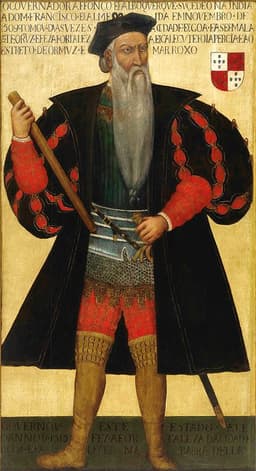
Afonso de Albuquerque
General · Medieval
79.6Total

Chen Qun
Politician · Ancient
55.9Total
Basic Information
Born
1453
160
Died
1515
237
Era
Medieval
Ancient
Nationality
Portugal
China
Occupation
General
Politician
Civilization
Western
Eastern
Score Comparison
Military (10%)
77.5
10.0
Political (20%)
88.0
72.0
Influence (20%)
80.0
40.0
Legacy (20%)
75.0
75.0
Leadership (15%)
78.0
72.0
Strategy (15%)
82.0
45.5
TOTAL
79.6
55.9
Afonso de Albuquerque — Complete Timeline
1503 AD
First voyage to IndiaWar◆ Major
Afonso de Albuquerque led a fleet to India, establishing the first Portuguese fort at Cochin. This voyage laid the foundation for Portuguese control of the Indian Ocean trade.
ExplorationColonialismIndia
Impact: global
1510 AD
Conquest of GoaWar◆ Major
Albuquerque captured Goa from the Sultan of Bijapur. He made Goa the capital of Portuguese India, a position it held for over 400 years.
ConquestColonialismIndia
Impact: regional
1511 AD
Conquest of MalaccaWar◆ Major
Albuquerque led a Portuguese fleet to capture the strategic port of Malacca. This gave Portugal control of the spice trade route between the Indian Ocean and the Pacific.
ConquestSpice TradeSoutheast Asia
Impact: global
1513 AD
Siege of AdenWar
Albuquerque attempted to capture Aden in Yemen but failed. This failure prevented Portugal from controlling the entrance to the Red Sea and limited their influence in the region.
SiegeFailureRed Sea
Impact: regional
1515 AD
Death at seaOther◆ Major
Afonso de Albuquerque died at sea off the coast of Goa, possibly from illness or poison. His death left the Portuguese Empire in the Indian Ocean without its most capable leader.
DeathLeadershipEmpire
Impact: regionaltragic
Chen Qun — Complete Timeline
220 AD
Proposed the Nine-rank SystemReform◆ Major
Chen Qun proposed the Nine-rank system for civil service appointments to Cao Pi, the first emperor of Wei. This system ranked candidates based on family background and personal merit, replacing the earlier recommendation system and becoming the standard for official selection in China for centuries.
Civil Service ReformWei DynastyBureaucracy
Impact: nationalconstructive
Advised Cao Pi on Legal CodeReform
Chen Qun assisted Cao Pi in drafting the new legal code for the Wei dynasty. He advocated for clearer laws and more consistent punishments, contributing to the legal framework that helped stabilize Wei's early rule.
Legal ReformWei DynastyLaw
Impact: nationalconstructive
226 AD
Served as Minister over the MassesPolitical Action
Chen Qun was appointed Minister over the Masses (Sikong) under Emperor Cao Rui of Wei. In this high-ranking position, he oversaw civil administration and continued to refine the implementation of the Nine-rank system, solidifying its role in Wei governance.
AppointmentWei DynastyGovernment
Impact: nationalconstructive
Expert Analysis
Chen Qun vs Afonso de Albuquerque
### The Conqueror and the Codifier: Two Visions of Empire
In the year 1510, a Portuguese fleet bombarded the walls of Goa, its cannons roaring against the Indian Ocean sky. Afonso de Albuquerque, a man of iron will and relentless ambition, waded ashore to claim a city that would become the heart of a maritime empire. Half a world away and thirteen centuries earlier, in the court of a newly proclaimed Chinese emperor, a different kind of conquest was unfolding. Chen Qun, a quiet bureaucrat with ink-stained fingers, presented a scroll—the Nine-rank System—that would quietly reshape the governance of a civilization. One man seized cities with fire and steel; the other captured the future with paper and ink. Both were architects of empires, yet their methods, their worlds, and their legacies could not have been more different.
### Origins: The Sea and the Court
Afonso de Albuquerque was born in 1453, a year that saw the fall of Constantinople, a fact that likely stirred the crusading fervor of his era. He was a child of Portugal’s Age of Discovery, a kingdom perched on the edge of Europe, driven by a hunger for spices, souls, and glory. His father was a courtier, but Albuquerque learned his trade at sea, where survival demanded ruthlessness and a navigator’s precision. The world he knew was a violent mosaic of competing sultanates, uncharted oceans, and shifting alliances. For him, power was something to be taken, held by the sword, and defended by the gun.
Chen Qun, born in 160, entered a world already old and weary. The Han Dynasty was crumbling, its once-mighty bureaucracy rotting from within. He was a scholar-official in a land where legitimacy came not from brute force but from the Mandate of Heaven, a cosmic contract between ruler and ruled. His China was a tapestry of warring states, but its deepest traditions were those of order, hierarchy, and written law. Where Albuquerque saw a world to be conquered, Chen Qun saw a system to be repaired.
### Rise to Power: The Sword and the Seal
Albuquerque’s path to power was carved by salt and gunpowder. In 1503, he led his first fleet to India, establishing a fort at Cochin—a toehold on a vast continent. This was not a diplomatic mission; it was a declaration of war. He understood that in the Indian Ocean, trade was war by other means. His rise was a series of gambles, each victory a stepping stone, each defeat a lesson in survival. By 1510, he had the king’s trust and a fleet at his command.
Chen Qun’s ascent was quieter, but no less deliberate. He rose through the ranks of a dying dynasty, advising warlords and emperors. His great moment came in 220, when Cao Pi, the son of the legendary Cao Cao, declared himself emperor of the new Wei dynasty. Chen Qun was at his side, not with a sword, but with a plan. The Nine-rank System was his masterstroke: a method to evaluate candidates for civil service based on their talents, not their bloodlines. It was a quiet revolution, one that would outlast any fortress.
### Leadership & Governance: The Hammer and the Scales
Albuquerque governed as he conquered: with absolute authority and a willingness to use terror. He made Goa the capital of Portuguese India in 1510, transforming a captured city into a fortress of commerce and faith. He ordered the execution of prisoners, burned ships, and enforced Portuguese law with a zeal that bordered on fanaticism. Yet he was no mere brute. He understood that empire required more than force; it needed infrastructure. He built hospitals, encouraged intermarriage, and sought to create a permanent Portuguese presence in Asia. His military score of 82.2 reflects a commander who could win battles, but his political score of 80.0 reveals a man who knew that victory was only the first step.
Chen Qun’s governance was the opposite of Albuquerque’s violent pragmatism. As Minister over the Masses under Emperor Cao Rui from 226 onward, he was the architect of a system that valued stability over conquest. His Nine-rank System, with its legacy score of 89.6, was not a weapon but a tool—a way to select officials based on merit, reducing the chaos of patronage and corruption. He also helped draft a new legal code, advocating for clarity and consistency. Where Albuquerque imposed order through fear, Chen Qun sought to embed order in institutions.
### Triumph & Tragedy: The Peak and the Abyss
Albuquerque’s greatest triumph was the conquest of Malacca in 1511. By capturing this strategic port, he seized control of the spice trade that had made Venice rich and the East a legend. It was a masterstroke of naval strategy, a blow that echoed from Lisbon to the Moluccas. But his tragedy came swiftly. In 1513, he failed to capture Aden, the gateway to the Red Sea. This defeat meant that the Portuguese could never fully control the entrance to the Mediterranean, leaving a crack in his empire. And in 1515, he died at sea, possibly poisoned, possibly of illness—a lonely end for a man who had given Portugal the world.
Chen Qun’s triumph was quieter but more enduring. The Nine-rank System, implemented in 220, would shape Chinese governance for centuries. It was not perfect—it could be abused by the powerful—but it was a beacon of meritocracy in an age of chaos. His tragedy was that he lived long enough to see the system he created ossify into a tool of the aristocracy. The very stability he sought became a cage.
### Character & Destiny: The Lion and the Scholar
Albuquerque was a lion: proud, fierce, and utterly convinced of his mission. He once wrote that he would “not rest until the spice trade is in Portuguese hands.” His destiny was tied to the sea, to the relentless expansion of a small European kingdom. His personality—ambitious, ruthless, and visionary—drove him to conquer, but also to die alone, his empire still fragile.
Chen Qun was a scholar: patient, methodical, and loyal to the idea of order. His destiny was to codify, to build systems that would outlast any single ruler. His personality—cautious, analytical, and deeply Confucian—led him to create a legacy that would be debated for millennia. He did not conquer; he organized.
### Legacy: The Empire and the Institution
Albuquerque’s legacy is visible on maps: the Portuguese Empire in the East, a chain of forts and trading posts that lasted for centuries. His total score of 77.1 reflects a man of action, but his influence score of 77.3 shows that his empire was always fragile, dependent on his personal drive. Today, he is remembered as a founder, a conqueror, a symbol of an age of exploration that reshaped the world.
Chen Qun’s legacy is invisible but omnipresent. His Nine-rank System, with its influence score of 92.4, became the blueprint for civil service exams in China and beyond. It influenced the Tang, the Song, and eventually the modern world’s obsession with merit-based selection. He is not a household name, but his idea—that talent should determine power—is one of the most revolutionary in history.
### Conclusion: Two Kinds of Eternity
Afonso de Albuquerque and Chen Qun lived worlds apart, yet both sought to build something that would outlast them. Albuquerque built with stone and iron, carving an empire from the sea. Chen Qun built with ideas, weaving a system that would govern millions. One died at sea, his body lost to the waves; the other died in court, his name preserved in texts. Their stories remind us that power takes many forms: the roar of a cannon and the scratch of a pen, the capture of a city and the codification of a law. Both are conquests. Both are eternal.
Rankings
🥇
Afonso de AlbuquerqueLeader
Mil: 77.5Pol: 88.0Inf: 80.0
79.6
🥈
Chen Qun
Mil: 10.0Pol: 72.0Inf: 40.0
55.9
+23.7 behind
How This Comparison Works
Algorithm
Each figure is scored on 6 dimensions (0—100 scale) based on structured historical data: Military (10%), Political (20%), Influence (20%), Legacy (20%), Leadership (15%), Strategy (15%). The weighted total produces the final ranking.
Data Sources
Scores are computed from structured sub-indicators in the database. Scale factors adjust for era (Ancient ×0.85, Modern ×1.0) and civilization size (Eastern ×1.05, Other ×0.80) to account for differences in population and military scale.
Maximum 3 Figures
Comparisons are limited to 2—3 figures to ensure readability and statistical meaningfulness.
Error Margins
±5 points per dimension — Sub-scores are derived from historical records with inherent uncertainty. Two figures within 5 points on a dimension should be considered roughly equivalent in that area.
Total Score Accuracy
±3 points overall — The weighted combination of 6 dimensions produces a total score with approximately ±3 points of uncertainty. Differences of less than 3 points are not statistically significant— the figures are effectively tied.
Known Limitations
- Historical records are incomplete and uneven across civilizations
- Figures from oral-tradition societies may be underrepresented
- Occupation labels can misclassify multi-role figures
- Scores measure capability and impact, not moral character
- Quantitative scoring is a comparison tool, not absolute truth
Capability Radar
Military (10%) — Battles & Warfare
Battles
85
19
Win Rate
80
22
Expansion
95
25
Political (20%) — Governance & Reform
Reform
80
85
Diplomacy
85
50
Economy
80
60
Influence (20%) — Cultural & Global Reach
Cultural
70
70
Global
85
65
Legacy (20%) — Historical Impact
Historical
85
80
Longevity
80
85
Leadership (15%) — Power & Stability
Tenure
70
40
Stability
65
65
Strategy (15%) — Tactics & Innovation
Strategy
95
31
Tactics
90
32
Reform
75
36
Similar Comparisons
Comments & Discussion
Iron Admiral6/16/2026
Albuquerque’s cannon at Goa was just brute force—Chen Qun’s Nine-Rank System is the real empire-builder. Guns conquer ports, but they don’t create loyalty. By codifying talent selection, Chen Qun ensured China’s bureaucracy could outlast any emperor, while the Portuguese possessions collapsed without constant reinforcement. It’s the quiet bureaucrat who wins history’s long game, not the loud admiral.
中文铁匠6/16/2026
要说硬核,阿尔布开克炸开果阿城墙确实帅,但陈群的九品官人法才是真狠活。你拿火炮轰开印度洋,人家用竹简把全士族绑上朝廷战车。十三世纪后葡萄牙撤了,中国这套选官骨头啃了一千五百年。一个烧船打劫,一个刻字立规,谁更持久还用争?
Skeptic Sam6/16/2026
Ladies and gentlemen, let’s not romanticize. Chen Qun’s Nine-Rank System basically cemented aristocratic rule for centuries—hardly a bureaucratic utopia. Albuquerque’s empire? More like a series of coastal heists with some spice thrown in. Neither is a genius architect; one gave us a rigid caste system in a robe, the other a violent trade monopoly. History’s winners get the nice labels.
古典学者老张6/16/2026
陈群这个九品中正制度啊,可不是什么民主选举,是曹操玩剩下的加强版士族分赃。说到底,阿尔布开克抢港口,陈群抢人心,一模一样。可惜您那位葡萄牙兄弟的海上帝国撑不过三代,中国这套士族套路倒是拖垮了好几个王朝。都是火并,一个炸得好,一个磨得久。
Reform Critic6/16/2026
Please—Albuquerque’s “heroic empire” rested on a genocide of Muslim traders and a slave-driven system that was already rotting. Chen Qun doesn’t get a pass either: his merit-based system was a wolf in sheep’s clothing, actually entrenching landlord power. Both are overrated conquerors who just dressed up violence and privilege as civilization. History needs to take off its rose-tinted glasses.