Loading...
Afonso de Albuquerque vs Babur
Afonso de Albuquerque leads by 1.5 pts · 2 figures compared
…
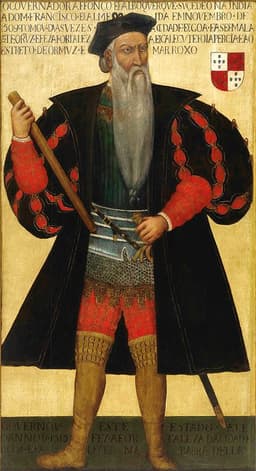
Afonso de Albuquerque
General · Medieval
79.6Total

Babur
Emperor · Medieval
78.1Total
Basic Information
Born
1453
1483
Died
1515
1530
Era
Medieval
Medieval
Nationality
Portugal
Mughal Empire
Occupation
General
Emperor
Civilization
Western
Indian
Score Comparison
Military (10%)
77.5
74.0
Political (20%)
88.0
72.0
Influence (20%)
80.0
88.0
Legacy (20%)
75.0
80.0
Leadership (15%)
78.0
74.0
Strategy (15%)
82.0
67.6
TOTAL
79.6
78.1
Afonso de Albuquerque — Complete Timeline
1503 AD
First voyage to IndiaWar◆ Major
Afonso de Albuquerque led a fleet to India, establishing the first Portuguese fort at Cochin. This voyage laid the foundation for Portuguese control of the Indian Ocean trade.
ExplorationColonialismIndia
Impact: global
1510 AD
Conquest of GoaWar◆ Major
Albuquerque captured Goa from the Sultan of Bijapur. He made Goa the capital of Portuguese India, a position it held for over 400 years.
ConquestColonialismIndia
Impact: regional
1511 AD
Conquest of MalaccaWar◆ Major
Albuquerque led a Portuguese fleet to capture the strategic port of Malacca. This gave Portugal control of the spice trade route between the Indian Ocean and the Pacific.
ConquestSpice TradeSoutheast Asia
Impact: global
1513 AD
Siege of AdenWar
Albuquerque attempted to capture Aden in Yemen but failed. This failure prevented Portugal from controlling the entrance to the Red Sea and limited their influence in the region.
SiegeFailureRed Sea
Impact: regional
1515 AD
Death at seaOther◆ Major
Afonso de Albuquerque died at sea off the coast of Goa, possibly from illness or poison. His death left the Portuguese Empire in the Indian Ocean without its most capable leader.
DeathLeadershipEmpire
Impact: regionaltragic
Babur — Complete Timeline
1526 AD
Battle of Panipat (1526)War
Babur led his army of about 12,000 men against the Delhi Sultanate army of Ibrahim Lodi, which numbered around 100,000. Using gunpowder weapons and innovative tactics, Babur defeated Lodi's forces. This victory established the Mughal Empire in India and marked the beginning of Mughal rule.
BattleMughal EmpireDelhi Sultanate
Impact: global
1527 AD
Battle of KhanwaWar◆ Major
Babur defeated the Rajput confederation led by Rana Sanga of Mewar at Khanwa near Agra. The Rajput army was larger and included cavalry and war elephants. Babur's use of artillery and defensive tactics secured the victory. This battle consolidated Mughal control over northern India.
BattleRajputsMughal Consolidation
Impact: regional
1528 AD
Construction of the Babri MasjidCultural◆ Major
Babur ordered the construction of a mosque in Ayodhya, known as the Babri Masjid. The mosque was built on a site that Hindus believed was the birthplace of the god Rama. This act became a source of religious and political conflict in India for centuries, culminating in the mosque's demolition in 1992.
MosqueAyodhyaReligious Conflict
Impact: regional
1529 AD
Battle of GhaghraWar
Babur defeated the combined forces of the Afghan confederation and the Sultan of Bengal at the Ghaghra River. This victory eliminated the last major Afghan resistance in northern India. It extended Mughal control over Bihar and parts of Bengal, further securing Babur's empire.
BattleAfghansBengal
Impact: regional
Expert Analysis
Origins
Afonso de Albuquerque (1453-1515) was born in Alhandra, Portugal, to a noble family with royal connections. His father was a lord, and his grandfather served King John I. Albuquerque was raised in the court of King Afonso V, where he received a classical education and military training. He served in North Africa before turning to the Indian Ocean. Babur (1483-1530), born Zahir-ud-din Muhammad in Fergana (modern Uzbekistan), was a direct descendant of Timur on his father's side and Genghis Khan on his mother's. He inherited the throne of Fergana at age 11, but spent years as a wanderer, losing and regaining territories. Both men came from martial cultures and were shaped by early exposure to power and warfare.
Rise to Power
Albuquerque rose through service in the Portuguese navy and court. He participated in the first voyage to India under Vasco da Gama and later commanded fleets. His big break came when King Manuel I appointed him governor of Portuguese India in 1509. He quickly established dominance by capturing Goa in 1510, which became the capital of Portuguese India. He then seized Malacca in 1511, controlling the spice trade. Babur's rise was more turbulent. He took Fergana at 11, but was driven out by Uzbek enemies. He captured Kabul in 1504 and used it as a base to invade India. After years of raids, he defeated the Delhi Sultanate at the Battle of Panipat in 1526, founding the Mughal Empire. He later defeated the Rajput confederation at Khanwa in 1527. Both men built empires through decisive victories, but Babur's path was longer and more precarious.
Leadership & Governance
Albuquerque was a brilliant strategist and administrator. He established fortresses, alliances with local rulers, and a network of trading posts. He understood the importance of sea power and built a strong navy. He was ruthless but pragmatic, often treating defeated enemies with respect to secure loyalty. His governance focused on monopolizing the spice trade and spreading Christianity. Babur was a charismatic leader who inspired loyalty among his followers. He was a skilled military commander, using innovative tactics like the use of artillery. He governed with a blend of Persian culture and Central Asian military traditions. He wrote his memoirs, the Baburnama, showing his intellectual side. Both were capable administrators, but Albuquerque's systematic approach to empire-building gave him an edge.
Triumph & Tragedy
Albuquerque's greatest triumphs were the conquests of Goa and Malacca, which secured Portuguese control over the Indian Ocean trade. He also sent expeditions to the Red Sea and attempted to capture Aden. His tragedy came when he died at sea in 1515, possibly poisoned, after being recalled to Portugal and learning of his replacement. He died believing his work was undone. Babur's triumph was the decisive victory at Panipat, which established Mughal rule in India. He also defeated the Rajputs at Khanwa and the Afghans at Ghaghra. His tragedy was his early death at 47, possibly from illness, just four years after Panipat. He was buried in Kabul, far from his new empire. Both died before fully consolidating their conquests.
Character & Destiny
Albuquerque was known for his iron will, strategic genius, and occasional cruelty. He was a devout Catholic who saw himself as a crusader. His destiny was to build a maritime empire that would last centuries. Babur was more reflective, writing poetry and memoirs. He was a lover of gardens and art, yet a fierce warrior. His destiny was to found a dynasty that would rule India for 300 years. Both men were driven by ambition, but Babur's personality was more multifaceted. Albuquerque's single-minded focus made him more effective in his lifetime.
Legacy
Albuquerque's legacy is the Portuguese Estado da Índia, which dominated Asian trade for over a century. His strategies influenced later European colonial powers. He is remembered as a founder of Portuguese imperialism. Babur's legacy is the Mughal Empire, which under his descendants became one of the world's largest empires. He is revered as a founder and a cultural icon. Both left lasting impacts, but the Mughal Empire's scale and longevity give Babur a broader legacy.
Conclusion
Afonso de Albuquerque edges out Babur with a score gap of 1.5 points. His higher scores in Military (78 vs 74), Political (88 vs 72), and Strategy (82 vs 68) reflect his more systematic and effective empire-building. While Babur's personal journey and cultural contributions are remarkable, Albuquerque's focused naval strategy and administrative consolidation of a global trade network demonstrate superior strategic vision. Babur's legacy is grander, but Albuquerque's efficiency and impact on global trade routes make him the greater empire builder in this comparison.
**Scores: Afonso de Albuquerque: 78.8 | Babur: 77.3**
Rankings
🥇
Afonso de AlbuquerqueLeader
Mil: 77.5Pol: 88.0Inf: 80.0
79.6
🥈
Babur
Mil: 74.0Pol: 72.0Inf: 88.0
78.1
+1.5 behind
How This Comparison Works
Algorithm
Each figure is scored on 6 dimensions (0—100 scale) based on structured historical data: Military (10%), Political (20%), Influence (20%), Legacy (20%), Leadership (15%), Strategy (15%). The weighted total produces the final ranking.
Data Sources
Scores are computed from structured sub-indicators in the database. Scale factors adjust for era (Ancient ×0.85, Modern ×1.0) and civilization size (Eastern ×1.05, Other ×0.80) to account for differences in population and military scale.
Maximum 3 Figures
Comparisons are limited to 2—3 figures to ensure readability and statistical meaningfulness.
Error Margins
±5 points per dimension — Sub-scores are derived from historical records with inherent uncertainty. Two figures within 5 points on a dimension should be considered roughly equivalent in that area.
Total Score Accuracy
±3 points overall — The weighted combination of 6 dimensions produces a total score with approximately ±3 points of uncertainty. Differences of less than 3 points are not statistically significant— the figures are effectively tied.
Known Limitations
- Historical records are incomplete and uneven across civilizations
- Figures from oral-tradition societies may be underrepresented
- Occupation labels can misclassify multi-role figures
- Scores measure capability and impact, not moral character
- Quantitative scoring is a comparison tool, not absolute truth
Capability Radar
Military (10%) — Battles & Warfare
Battles
85
75
Win Rate
80
85
Expansion
95
85
Political (20%) — Governance & Reform
Reform
80
55
Diplomacy
85
70
Economy
80
50
Influence (20%) — Cultural & Global Reach
Cultural
70
70
Global
85
75
Legacy (20%) — Historical Impact
Historical
85
85
Longevity
80
80
Leadership (15%) — Power & Stability
Tenure
70
40
Stability
65
45
Strategy (15%) — Tactics & Innovation
Strategy
95
82
Tactics
90
80
Reform
75
60
Similar Comparisons
Comments & Discussion
No comments yet. Be the first to share your thoughts!