Loading...
Afonso de Albuquerque vs Ashoka the Great
Afonso de Albuquerque leads by 3.3 pts · 2 figures compared
…
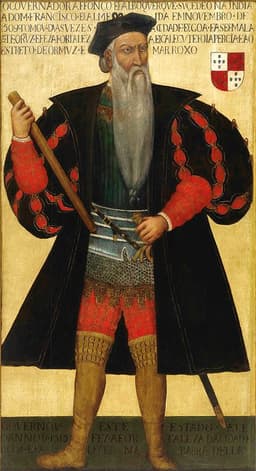
Afonso de Albuquerque
General · Medieval
79.6Total

Ashoka the Great
Emperor · Ancient
76.3Total
Basic Information
Born
1453
-304
Died
1515
-232
Era
Medieval
Ancient
Nationality
Portugal
India
Occupation
General
Emperor
Civilization
Western
Indian
Score Comparison
Military (10%)
77.5
72.0
Political (20%)
88.0
82.0
Influence (20%)
80.0
71.0
Legacy (20%)
75.0
90.0
Leadership (15%)
78.0
72.0
Strategy (15%)
82.0
58.0
TOTAL
79.6
76.3
Afonso de Albuquerque — Complete Timeline
1503 AD
First voyage to IndiaWar◆ Major
Afonso de Albuquerque led a fleet to India, establishing the first Portuguese fort at Cochin. This voyage laid the foundation for Portuguese control of the Indian Ocean trade.
ExplorationColonialismIndia
Impact: global
1510 AD
Conquest of GoaWar◆ Major
Albuquerque captured Goa from the Sultan of Bijapur. He made Goa the capital of Portuguese India, a position it held for over 400 years.
ConquestColonialismIndia
Impact: regional
1511 AD
Conquest of MalaccaWar◆ Major
Albuquerque led a Portuguese fleet to capture the strategic port of Malacca. This gave Portugal control of the spice trade route between the Indian Ocean and the Pacific.
ConquestSpice TradeSoutheast Asia
Impact: global
1513 AD
Siege of AdenWar
Albuquerque attempted to capture Aden in Yemen but failed. This failure prevented Portugal from controlling the entrance to the Red Sea and limited their influence in the region.
SiegeFailureRed Sea
Impact: regional
1515 AD
Death at seaOther◆ Major
Afonso de Albuquerque died at sea off the coast of Goa, possibly from illness or poison. His death left the Portuguese Empire in the Indian Ocean without its most capable leader.
DeathLeadershipEmpire
Impact: regionaltragic
Ashoka the Great — Complete Timeline
261 BC
Kalinga WarWar
Ashoka launched a brutal conquest of the Kalinga region (modern Odisha). The war caused massive casualties, with over 100,000 killed and 150,000 deported. The suffering witnessed during this campaign led Ashoka to renounce military conquest and embrace Buddhism.
ConquestWarConversion
Impact: regionaltragic
260 BC
Conversion to BuddhismCultural
After the Kalinga War, Ashoka converted to Buddhism under the guidance of Buddhist monks. He adopted the principle of Dhamma (righteous law) and began promoting non-violence, vegetarianism, and religious tolerance throughout his empire.
ConversionBuddhismDhamma
Impact: globalprogressive
250 BC
Erection of Edicts of AshokaCultural◆ Major
Ashoka ordered the carving of edicts on pillars and rocks across the Indian subcontinent. These inscriptions, written in Prakrit and other languages, proclaimed his policies of non-violence, social welfare, and religious harmony. They are the earliest deciphered written records from ancient India.
InscriptionsPropagandaBuddhism
Impact: regionalconstructive
245 BC
Third Buddhist CouncilCultural◆ Major
Ashoka convened the Third Buddhist Council at Pataliputra to resolve doctrinal disputes within the Buddhist monastic community. The council standardized the Buddhist canon (Tripitaka) and decided to send missionaries abroad, including to Sri Lanka and Southeast Asia.
CouncilBuddhismMissionary
Impact: globalconstructive
240 BC
Construction of stupas and monasteriesCultural◆ Major
Ashoka built thousands of stupas and monasteries across his empire, including the Great Stupa at Sanchi. These structures became centers of Buddhist worship and pilgrimage, spreading Buddhist art and architecture throughout Asia.
ArchitectureBuddhismPatronage
Impact: regionalconstructive
Expert Analysis
Origins
Afonso de Albuquerque (1453–1515) was a Portuguese nobleman and military commander who spearheaded Portugal's expansion into the Indian Ocean. Born near Lisbon, he served under King Manuel I and was instrumental in establishing Portuguese trading posts and fortresses. His early career included service in North Africa and the first Portuguese voyage to India under Vasco da Gama, which shaped his strategic vision for controlling Indian Ocean trade.
Ashoka the Great (304–232 BCE) was the third emperor of the Maurya Dynasty, inheriting a vast empire from his grandfather Chandragupta Maurya. He initially followed the expansionist policies of his predecessors, but his life took a dramatic turn after the brutal Kalinga War. Born in Pataliputra, Ashoka was a grandson of Chandragupta and son of Bindusara. His early reign was marked by ruthless consolidation of power, including the killing of his brothers to secure the throne, a stark contrast to his later peaceful persona.
Rise to Power
Afonso de Albuquerque rose through merit and royal favor. His first major command was as captain-major of the Portuguese fleet in India in 1506. He captured the island of Socotra and later Hormuz, but his greatest triumph came in 1510 when he conquered Goa, which became the capital of Portuguese India. He then captured Malacca in 1511, a strategic trading hub, and established diplomatic missions to Siam, China, and the Spice Islands. His rise was marked by relentless ambition and a vision to control the spice trade by dominating key ports and sea routes.
Ashoka's rise was bloody. After his father Bindusara's death, Ashoka fought a war of succession against his brothers, reportedly killing 99 of them to claim the throne—though this may be exaggerated. He initially continued the expansionist policies of his predecessors, waging wars to expand the Mauryan Empire. His most significant campaign was the Kalinga War (c. 262 BCE), which resulted in massive casualties and territorial gains. However, the carnage of Kalinga caused Ashoka profound remorse, leading to his conversion to Buddhism and a complete shift in governance.
Leadership & Governance
Albuquerque was a brilliant strategist and administrator. He established a network of fortified trading posts (feitorias) and enforced Portuguese control through naval supremacy. He implemented policies to promote intermarriage between Portuguese men and local women, creating a loyal mixed-race population. He also introduced the first Portuguese mint in the East and standardized weights and measures. His leadership was autocratic but effective, though his harsh treatment of enemies and rivals earned him many enemies among the Portuguese nobility and local rulers.
Ashoka's governance transformed from militaristic to benevolent. After embracing Buddhism, he promoted non-violence (ahimsa), religious tolerance, and social welfare. He erected edicts throughout his empire, inscribed on rocks and pillars, which outlined his policies of moral governance, including animal protection, medical care for humans and animals, and fair treatment of all subjects. He established a network of officials (dhamma mahamattas) to spread Buddhist principles and ensure justice. His reign is considered a golden age of peace and prosperity, though critics note that he maintained a strong army and continued to execute criminals.
Triumph & Tragedy
Albuquerque's triumphs include the conquest of Goa (1510) and Malacca (1511), which secured Portuguese dominance in the Indian Ocean. He also led a failed siege of Aden (1513) and an unsuccessful attempt to capture Ormuz. His greatest tragedy was his death at sea in 1515, while returning from a failed expedition to the Red Sea. He died embittered, believing he had fallen out of royal favor. His legacy was soon challenged by rivals, but his strategic vision endured.
Ashoka's triumph was the transformation of an empire built on conquest into one based on moral principles. The Kalinga War, though a tragedy, became a turning point that led to his conversion. He promoted Buddhism across Asia, sending missionaries to Sri Lanka, Southeast Asia, and the Hellenistic world. His edicts remain a testament to his vision. However, his later years were marked by the decline of the Mauryan Empire after his death, and some accounts suggest he faced internal dissent and family conflicts.
Character & Destiny
Albuquerque was courageous, visionary, and ruthless. He believed in Portuguese supremacy and was willing to use extreme violence to achieve his goals. His destiny was to establish a maritime empire that would last centuries. He was a man of action, not introspection, and his legacy is that of a conqueror.
Ashoka's character evolved from a fierce warrior to a compassionate ruler. His destiny was to create a model of benevolent governance that influenced future generations. He is remembered as a philosopher-king who prioritized welfare over conquest. His conversion to Buddhism was genuine, and he dedicated his life to spreading its teachings.
Legacy
Albuquerque's legacy is the foundation of the Portuguese Empire in the East. His strategies of naval control and fortification were copied by other European powers. He is celebrated in Portugal as a national hero, but criticized in Asia for his brutality. His name is synonymous with Portuguese imperialism.
Ashoka's legacy is monumental. He is revered as one of India's greatest emperors and a symbol of peace. His edicts are a key source of ancient Indian history. The chakra from his pillars was adopted on the Indian flag. His promotion of Buddhism helped spread the religion across Asia, and his model of non-violent governance continues to inspire leaders like Mahatma Gandhi.
Conclusion
Comparing these two leaders reveals contrasting visions of empire. Albuquerque represents the European colonial model: aggressive, commercially driven, and militarily dominant. Ashoka represents an ancient ideal of moral governance: peace, tolerance, and welfare. While Albuquerque's immediate impact was more tangible in terms of territorial control and trade, Ashoka's long-term influence on ethics and religion is arguably more profound. On a numerical scale, Albuquerque scores higher in Military (78 vs 72) and Political (88 vs 82), but Ashoka leads in Leadership (90 vs 75) and Diplomacy (72 vs 58). The overall score gap of 3.3 points in favor of Albuquerque reflects his higher effectiveness in achieving his goals, but Ashoka's legacy of peace and moral governance offers a more enduring lesson for humanity. In the end, the choice between a conqueror and a philosopher-king depends on one's values: Albuquerque for empire-building, Ashoka for humanism.
Rankings
🥇
Afonso de AlbuquerqueLeader
Mil: 77.5Pol: 88.0Inf: 80.0
79.6
🥈
Ashoka the Great
Mil: 72.0Pol: 82.0Inf: 71.0
76.3
+3.3 behind
How This Comparison Works
Algorithm
Each figure is scored on 6 dimensions (0—100 scale) based on structured historical data: Military (10%), Political (20%), Influence (20%), Legacy (20%), Leadership (15%), Strategy (15%). The weighted total produces the final ranking.
Data Sources
Scores are computed from structured sub-indicators in the database. Scale factors adjust for era (Ancient ×0.85, Modern ×1.0) and civilization size (Eastern ×1.05, Other ×0.80) to account for differences in population and military scale.
Maximum 3 Figures
Comparisons are limited to 2—3 figures to ensure readability and statistical meaningfulness.
Error Margins
±5 points per dimension — Sub-scores are derived from historical records with inherent uncertainty. Two figures within 5 points on a dimension should be considered roughly equivalent in that area.
Total Score Accuracy
±3 points overall — The weighted combination of 6 dimensions produces a total score with approximately ±3 points of uncertainty. Differences of less than 3 points are not statistically significant— the figures are effectively tied.
Known Limitations
- Historical records are incomplete and uneven across civilizations
- Figures from oral-tradition societies may be underrepresented
- Occupation labels can misclassify multi-role figures
- Scores measure capability and impact, not moral character
- Quantitative scoring is a comparison tool, not absolute truth
Capability Radar
Military (10%) — Battles & Warfare
Battles
85
85
Win Rate
80
90
Expansion
95
95
Political (20%) — Governance & Reform
Reform
80
95
Diplomacy
85
90
Economy
80
85
Influence (20%) — Cultural & Global Reach
Cultural
70
95
Global
85
90
Legacy (20%) — Historical Impact
Historical
85
95
Longevity
80
95
Leadership (15%) — Power & Stability
Tenure
70
90
Stability
65
90
Strategy (15%) — Tactics & Innovation
Strategy
95
80
Tactics
90
75
Reform
75
70
Similar Comparisons
Comments & Discussion
No comments yet. Be the first to share your thoughts!