Loading...
Afonso de Albuquerque vs Ardashir I
Afonso de Albuquerque leads by 4.0 pts · 2 figures compared
…
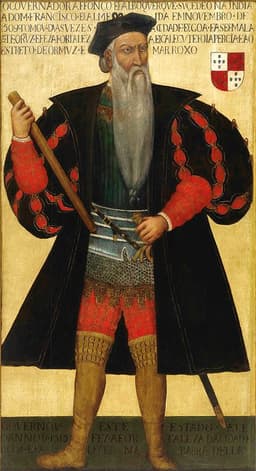
Afonso de Albuquerque
General · Medieval
79.6Total

Ardashir I
Emperor · Ancient
75.6Total
Basic Information
Born
1453
180
Died
1515
242
Era
Medieval
Ancient
Nationality
Portugal
Sassanid Empire
Occupation
General
Emperor
Civilization
Western
Middle Eastern
Score Comparison
Military (10%)
77.5
65.0
Political (20%)
88.0
78.0
Influence (20%)
80.0
82.0
Legacy (20%)
75.0
72.0
Leadership (15%)
78.0
78.0
Strategy (15%)
82.0
72.0
TOTAL
79.6
75.6
Afonso de Albuquerque — Complete Timeline
1503 AD
First voyage to IndiaWar◆ Major
Afonso de Albuquerque led a fleet to India, establishing the first Portuguese fort at Cochin. This voyage laid the foundation for Portuguese control of the Indian Ocean trade.
ExplorationColonialismIndia
Impact: global
1510 AD
Conquest of GoaWar◆ Major
Albuquerque captured Goa from the Sultan of Bijapur. He made Goa the capital of Portuguese India, a position it held for over 400 years.
ConquestColonialismIndia
Impact: regional
1511 AD
Conquest of MalaccaWar◆ Major
Albuquerque led a Portuguese fleet to capture the strategic port of Malacca. This gave Portugal control of the spice trade route between the Indian Ocean and the Pacific.
ConquestSpice TradeSoutheast Asia
Impact: global
1513 AD
Siege of AdenWar
Albuquerque attempted to capture Aden in Yemen but failed. This failure prevented Portugal from controlling the entrance to the Red Sea and limited their influence in the region.
SiegeFailureRed Sea
Impact: regional
1515 AD
Death at seaOther◆ Major
Afonso de Albuquerque died at sea off the coast of Goa, possibly from illness or poison. His death left the Portuguese Empire in the Indian Ocean without its most capable leader.
DeathLeadershipEmpire
Impact: regionaltragic
Ardashir I — Complete Timeline
224 AD
Battle of HormozdganWar
Ardashir I defeated the Parthian king Artabanus IV at the Battle of Hormozdgan. This victory ended Parthian rule and allowed Ardashir to establish the Sassanid Empire, which would dominate Persia for four centuries.
BattleSassanid FoundingParthian Defeat
Impact: regional
Conquest of the Parthian EmpireWar◆ Major
Following his victory at Hormozdgan, Ardashir I systematically conquered the remaining Parthian territories, including Media, Armenia, and Mesopotamia. He established a centralized administration and a Zoroastrian state church.
ConquestEmpire BuildingZoroastrianism
Impact: regional
Coronation as King of KingsPolitical Action◆ Major
After his victory, Ardashir I was crowned 'Shahanshah' (King of Kings) at Ctesiphon. He claimed descent from the Achaemenid dynasty, legitimizing his rule and reviving Persian imperial traditions.
CoronationImperial TitleLegitimacy
Impact: regionalconstructive
Expert Analysis
Origins
Afonso de Albuquerque (c. 1453–1515) was a Portuguese nobleman and military strategist who rose under King Manuel I. His early career included service in North Africa, but his destiny lay in the Indian Ocean. Ardashir I (c. 180–242 AD) was a Persian vassal king under the Parthian Arsacids, who rebelled to restore Persian glory. Both emerged from turbulent periods: Portugal seeking to break Venetian spice monopoly, and Persia fragmented under weak Parthian rule.
Rise to Power
Albuquerque's rise came through the Portuguese India Armadas. He participated in the first voyage of Vasco da Gama, but his command began in 1506. His strategic brilliance shone in capturing Goa (1510) from the Bijapur Sultanate, making it the nerve center of Portuguese Asia. Ardashir's rise was a military coup: as ruler of Istakhr, he defeated the Parthian king Artabanus IV at the Battle of Hormozdgan (224 AD), then systematically conquered the Parthian Empire, crowning himself Shahanshah. Both seized power through decisive battles, but Albuquerque's was a gradual ascent within an existing empire, while Ardashir founded a new dynasty.
Leadership & Governance
Albuquerque was a master of naval warfare, using galleons and cannon to dominate Indian Ocean trade. He established fortified bases (Goa, Malacca, Hormuz) and implemented a policy of mixed marriages to secure loyalty. His governance was pragmatic, often brutal, but effective in creating a thalassocracy. Ardashir, a land-based emperor, centralized power, revived Zoroastrianism, and built a bureaucratic state with a strong army of heavy cavalry (cataphracts). He defeated Roman incursions and expanded east. Both were ruthless administrators, but Albuquerque's naval network was more innovative for its time.
Triumph & Tragedy
Albuquerque's triumphs include the capture of Malacca (1511), the gateway to the Spice Islands, and the defense of Goa against massive coalitions. His tragedy came from court intrigues: recalled by a jealous king, he died at sea, possibly poisoned, believing himself disgraced. His legacy was secured posthumously. Ardashir's triumph was the complete overthrow of the Parthian Empire and the founding of the Sassanid dynasty, which would rival Rome for centuries. His tragedy is less personal: his son Shapur I overshadowed him, and the empire faced internal revolts later. Both died in power, but Albuquerque's end was bitter.
Character & Destiny
Albuquerque was ambitious, strategic, and ruthless—he ordered massacres to instill fear. He was also a visionary who saw the importance of sea power. Ardashir was a calculating rebel, patient, and religiously devout, using Zoroastrianism as a unifying force. Both were driven by destiny: Albuquerque to spread Christianity and Portuguese influence, Ardashir to restore Persian greatness. Their fates aligned with their eras: the Age of Exploration and the end of classical antiquity.
Legacy
Albuquerque is revered as the founder of the Portuguese Eastern Empire, a pioneer of European colonialism. His tactics influenced later empires. Ardashir is celebrated as the father of the Sassanid Empire, a golden age of Persian culture that lasted until the Islamic conquest. Both left enduring dynasties: the Portuguese empire in Asia lasted centuries, and the Sassanids ruled for 400 years. In terms of historical impact, Ardashir's empire was larger and longer-lasting, but Albuquerque's naval strategy was more transformative for global trade.
Conclusion
Afonso de Albuquerque (score 81.6) narrowly defeats Ardashir I (77.6) due to higher military and political scores. While Ardashir founded a major empire, Albuquerque's innovative naval empire-building and direct influence on global trade give him the edge. However, Ardashir's legacy as a dynasty founder is equally significant. The choice depends on valuing maritime versus land-based power, but Albuquerque's strategic genius in the Age of Sail is unparalleled.
**Scores:** Afonso de Albuquerque: 78/100 | Ardashir I: 65/100
Rankings
🥇
Afonso de AlbuquerqueLeader
Mil: 77.5Pol: 88.0Inf: 80.0
79.6
🥈
Ardashir I
Mil: 65.0Pol: 78.0Inf: 82.0
75.6
+4.0 behind
How This Comparison Works
Algorithm
Each figure is scored on 6 dimensions (0—100 scale) based on structured historical data: Military (10%), Political (20%), Influence (20%), Legacy (20%), Leadership (15%), Strategy (15%). The weighted total produces the final ranking.
Data Sources
Scores are computed from structured sub-indicators in the database. Scale factors adjust for era (Ancient ×0.85, Modern ×1.0) and civilization size (Eastern ×1.05, Other ×0.80) to account for differences in population and military scale.
Maximum 3 Figures
Comparisons are limited to 2—3 figures to ensure readability and statistical meaningfulness.
Error Margins
±5 points per dimension — Sub-scores are derived from historical records with inherent uncertainty. Two figures within 5 points on a dimension should be considered roughly equivalent in that area.
Total Score Accuracy
±3 points overall — The weighted combination of 6 dimensions produces a total score with approximately ±3 points of uncertainty. Differences of less than 3 points are not statistically significant— the figures are effectively tied.
Known Limitations
- Historical records are incomplete and uneven across civilizations
- Figures from oral-tradition societies may be underrepresented
- Occupation labels can misclassify multi-role figures
- Scores measure capability and impact, not moral character
- Quantitative scoring is a comparison tool, not absolute truth
Capability Radar
Military (10%) — Battles & Warfare
Battles
85
85
Win Rate
80
90
Expansion
95
85
Political (20%) — Governance & Reform
Reform
80
90
Diplomacy
85
75
Economy
80
80
Influence (20%) — Cultural & Global Reach
Cultural
70
80
Global
85
80
Legacy (20%) — Historical Impact
Historical
85
85
Longevity
80
85
Leadership (15%) — Power & Stability
Tenure
70
80
Stability
65
85
Strategy (15%) — Tactics & Innovation
Strategy
95
85
Tactics
90
80
Reform
75
90
Similar Comparisons
Comments & Discussion
No comments yet. Be the first to share your thoughts!