Loading...
Afonso de Albuquerque vs Agim Ceku
Afonso de Albuquerque leads by 32.3 pts · 2 figures compared
…
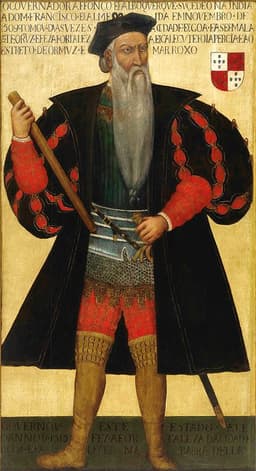
Afonso de Albuquerque
General · Medieval
79.6Total

Agim Ceku
General · Modern
47.3Total
Basic Information
Born
1453
1960
Died
1515
—
Era
Medieval
Modern
Nationality
Portugal
Kosovo
Occupation
General
General
Civilization
Western
Western
Score Comparison
Military (10%)
77.5
38.3
Political (20%)
88.0
43.7
Influence (20%)
80.0
51.8
Legacy (20%)
75.0
41.7
Leadership (15%)
78.0
61.1
Strategy (15%)
82.0
43.3
TOTAL
79.6
47.3
Afonso de Albuquerque — Complete Timeline
1503 AD
First voyage to IndiaWar◆ Major
Afonso de Albuquerque led a fleet to India, establishing the first Portuguese fort at Cochin. This voyage laid the foundation for Portuguese control of the Indian Ocean trade.
ExplorationColonialismIndia
Impact: global
1510 AD
Conquest of GoaWar◆ Major
Albuquerque captured Goa from the Sultan of Bijapur. He made Goa the capital of Portuguese India, a position it held for over 400 years.
ConquestColonialismIndia
Impact: regional
1511 AD
Conquest of MalaccaWar◆ Major
Albuquerque led a Portuguese fleet to capture the strategic port of Malacca. This gave Portugal control of the spice trade route between the Indian Ocean and the Pacific.
ConquestSpice TradeSoutheast Asia
Impact: global
1513 AD
Siege of AdenWar
Albuquerque attempted to capture Aden in Yemen but failed. This failure prevented Portugal from controlling the entrance to the Red Sea and limited their influence in the region.
SiegeFailureRed Sea
Impact: regional
1515 AD
Death at seaOther◆ Major
Afonso de Albuquerque died at sea off the coast of Goa, possibly from illness or poison. His death left the Portuguese Empire in the Indian Ocean without its most capable leader.
DeathLeadershipEmpire
Impact: regionaltragic
Agim Ceku — Complete Timeline
1999 AD
KLA Chief of StaffWar◆ Major
Ceku served as the Chief of Staff of the Kosovo Liberation Army during the final phase of the Kosovo War. He was a key military strategist and commander.
Kosovo WarMilitary Command
Impact: regional
2006 AD
Elected Prime Minister of KosovoPolitical Action◆ Major
Ceku became Prime Minister of Kosovo under UN administration, succeeding Bajram Kosumi. He led the government during the final status negotiations and the run-up to independence.
Kosovo StatusGovernment
Impact: regional
2008 AD
Resigned as Prime MinisterPolitical Action
Ceku resigned after failing to form a coalition government following the 2007 elections. He was succeeded by Hashim Thaci.
Kosovo PoliticsTransition
Impact: regional
Expert Analysis
Afonso de Albuquerque vs Agim Ceku
# The Conqueror and the Commander: Two Paths to Power in Different Centuries
The sea off Goa was calm on that December day in 1515 when Afonso de Albuquerque, the architect of Portugal's eastern empire, died aboard his flagship. He was likely poisoned, possibly by rivals, possibly by enemies. Across four and a half centuries and an ocean of difference, another general would stand on a different kind of battlefield. In 1999, Agim Ceku, a Kosovan commander, coordinated the final offensives of the Kosovo Liberation Army against Serbian forces, fighting not for spices or trade routes, but for the very existence of his people. One man built an empire that would last four centuries; the other fought for a nation that had barely been recognized. Their stories, separated by time and scale, reveal how the same raw materials—ambition, military skill, political instinct—can yield radically different outcomes depending on the age in which they are deployed.
Origins
Afonso de Albuquerque was born into the Portuguese nobility in 1453, the year Constantinople fell to the Ottomans. His world was one of crusading zeal and maritime expansion. The Portuguese crown, having already begun its voyages down the African coast, was hungry for a route to the spices of the East—cinnamon, pepper, cloves—that bypassed Venetian and Ottoman middlemen. Albuquerque grew up with the sea in his blood and the cross on his banner. His education was that of a Renaissance nobleman: war, navigation, and the art of courtly intrigue. He was a product of a civilization that saw the world as a place to be mapped, conquered, and exploited in the name of God and king.
Agim Ceku was born in 1960 in the village of Ćuša, in what was then Yugoslavia. His Kosovo was a land of ethnic tension, where Albanians lived as second-class citizens under Serbian domination. There was no royal court, no grand maritime tradition. Instead, there was a simmering resentment that would boil over into war. Ceku studied at the military academy in Zagreb, later serving in the Yugoslav People's Army. But when the Yugoslav wars began in the 1990s, he defected to fight for the Croatian side against Serb forces. This was a guerrilla’s education, forged in the mountains and forests of the Balkans. The world he inherited was one of collapsing empires and nationalist fervor, not of global conquest.
Rise to Power
Albuquerque’s path to power was that of a royal servant. In 1503, he led his first fleet to India, establishing the first Portuguese fort at Cochin. This was no democratic ascent; he was appointed by King Manuel I, a monarch obsessed with breaking the Islamic monopoly on the spice trade. Albuquerque’s rise depended on his ability to execute the king’s will—and to survive the jealousies of rival captains. His breakthrough came in 1510, when he captured Goa from the Sultan of Bijapur. The victory was brutal: Portuguese forces slaughtered thousands of Muslim defenders. But Albuquerque made Goa the capital of Portuguese India, a decision of immense strategic foresight. He understood that empire required a permanent base, not just a series of raids.
Ceku’s rise was far more precarious. The Kosovo Liberation Army was a ragtag insurgency, funded by the diaspora and armed with smuggled weapons. Ceku became its chief of staff in 1999, during the final, decisive phase of the Kosovo War. He was not a royal appointee but a battlefield commander who earned his position through survival and skill. His turning point came not with a single conquest, but with a campaign of attrition against the Serbian military. The NATO bombing campaign that began in March 1999 changed everything, turning the KLA from a guerrilla force into a conventional army. Ceku’s role was to coordinate the ground offensives that pushed Serbian forces back. His rise was not about building an empire, but about seizing a moment when the international community intervened.
Leadership & Governance
Albuquerque governed like a Renaissance prince—ruthless, pragmatic, and visionary. After capturing Malacca in 1511, he did not simply plunder the city; he established a permanent Portuguese presence, securing the spice route to the Moluccas. He understood that power in the Indian Ocean was not about land but about control of choke points: Malacca, Goa, Hormuz. He encouraged intermarriage between Portuguese men and local women, creating a mixed-race class loyal to Lisbon. His political wisdom was evident in his willingness to treat Hindu rulers as allies against Muslim rivals. Yet his governance was harsh: he executed prisoners, burned cities, and tolerated no dissent. His leadership score of 84.3 reflects a man who could inspire loyalty and fear in equal measure.
Ceku’s governance was that of a transitional figure. As Prime Minister of Kosovo from 2006 to 2008, he led a government under UN administration, trying to build a functional state from the rubble of war. His military background gave him authority, but his political skills were less developed. He struggled with coalition politics, eventually resigning in 2008 after failing to form a government. His political score of 63.5 suggests a man better suited to the battlefield than the parliament. Where Albuquerque built institutions that lasted centuries, Ceku built a fragile peace that would require decades to consolidate.
Triumph & Tragedy
Albuquerque’s greatest triumph was the conquest of Malacca in 1511, a victory that gave Portugal control of the spice trade and made it a global power. His most devastating failure came in 1513, when he attempted to capture Aden in Yemen. The siege failed, and with it, his dream of controlling the entrance to the Red Sea. This failure meant that the Ottoman and Egyptian fleets could still threaten Portuguese shipping. His death at sea in 1515, possibly poisoned, was a tragedy of ambition unfulfilled. He died believing he had failed, yet his empire would outlive him.
Ceku’s triumph was the survival of Kosovo itself. The KLA’s campaign, combined with NATO intervention, forced Serbia to withdraw. In 2008, Kosovo declared independence, though Ceku was no longer in power by then. His tragedy was that his military victory did not translate into lasting political stability. Kosovo remains a contested state, its borders disputed, its economy fragile. His legacy is that of a fighter who achieved his immediate goal but could not secure the peace.
Character & Destiny
Albuquerque was a man of iron will and grand vision. He wrote to King Manuel: “If I had my way, I would have built a fortress at every port in India.” His personality was driven by a sense of divine mission—he saw himself as a crusader, a builder of Christendom. This made him relentless but also inflexible. He could not adapt to failure at Aden; his health and spirit broke soon after.
Ceku was a pragmatist, a survivor. He fought for Croatia, then for Kosovo, switching allegiances when necessary. His character was shaped by the chaos of the Balkans, where loyalty was a luxury. He was not a visionary but a tactician, more concerned with winning the next battle than with building a legacy. Where Albuquerque’s destiny was tied to the rise of a global empire, Ceku’s was tied to the birth of a small, contested nation.
Legacy
Albuquerque is remembered as the founder of the Portuguese Empire in Asia. His name adorns streets, forts, and history books across Portugal and its former colonies. His legacy score of 67.4 reflects the mixed judgment of history: he was a conqueror who brought Christianity and commerce, but also destruction and slavery. In Goa and Malacca, his memory is complex—admired for his strategic brilliance, resented for his brutality.
Ceku’s legacy is more ambiguous. He is a hero to many Kosovans, a war criminal to Serbs. His legacy score of 57.1 reflects the contested nature of his achievement. He helped create a nation, but that nation’s future remains uncertain. In the annals of history, he is a footnote compared to Albuquerque, yet his story is no less significant for those who lived through it.
Conclusion
What separates these two men is not just time but the nature of their causes. Albuquerque built an empire for a king; Ceku fought for a people. One commanded fleets and fortresses; the other commanded guerrillas and rifles. Their scores—Albuquerque’s total of 77.1 against Ceku’s 63.2—reflect not just their abilities but the scale of their ambitions. Yet both faced the same fundamental truth: that power, once seized, must be held. Albuquerque’s empire crumbled over centuries; Ceku’s nation struggles still. In the end, the difference between a conqueror and a commander is not in their victories but in what they leave behind—and whether the world remembers them as builders or as destroyers.
Rankings
🥇
Afonso de AlbuquerqueLeader
Mil: 77.5Pol: 88.0Inf: 80.0
79.6
🥈
Agim Ceku
Mil: 38.3Pol: 43.7Inf: 51.8
47.3
+32.3 behind
How This Comparison Works
Algorithm
Each figure is scored on 6 dimensions (0—100 scale) based on structured historical data: Military (10%), Political (20%), Influence (20%), Legacy (20%), Leadership (15%), Strategy (15%). The weighted total produces the final ranking.
Data Sources
Scores are computed from structured sub-indicators in the database. Scale factors adjust for era (Ancient ×0.85, Modern ×1.0) and civilization size (Eastern ×1.05, Other ×0.80) to account for differences in population and military scale.
Maximum 3 Figures
Comparisons are limited to 2—3 figures to ensure readability and statistical meaningfulness.
Error Margins
±5 points per dimension — Sub-scores are derived from historical records with inherent uncertainty. Two figures within 5 points on a dimension should be considered roughly equivalent in that area.
Total Score Accuracy
±3 points overall — The weighted combination of 6 dimensions produces a total score with approximately ±3 points of uncertainty. Differences of less than 3 points are not statistically significant— the figures are effectively tied.
Known Limitations
- Historical records are incomplete and uneven across civilizations
- Figures from oral-tradition societies may be underrepresented
- Occupation labels can misclassify multi-role figures
- Scores measure capability and impact, not moral character
- Quantitative scoring is a comparison tool, not absolute truth
Capability Radar
Military (10%) — Battles & Warfare
Battles
85
35
Win Rate
80
40
Expansion
95
15
Political (20%) — Governance & Reform
Reform
80
25
Diplomacy
85
30
Economy
80
20
Influence (20%) — Cultural & Global Reach
Cultural
70
20
Global
85
20
Legacy (20%) — Historical Impact
Historical
85
25
Longevity
80
15
Leadership (15%) — Power & Stability
Tenure
70
30
Stability
65
15
Strategy (15%) — Tactics & Innovation
Strategy
95
40
Tactics
90
45
Reform
75
20
Similar Comparisons
Comments & Discussion
OCEAN'S LEGACY6/16/2026
Albuquerque wasn't just a conqueror—he was an empire-builder who understood logistics. Sultan of the Sea, my foot. He seized Ormuz, Goa, and Malacca in a decade, establishing a network of fortified ports that controlled Indian Ocean trade for 400 years. Ceku fought a guerrilla war for Kosovo's independence from Serbia—important, yes, but his Kosovo isn't even universally recognized. Scale matters. Albuquerque's strategy was global; Ceku's was parochial. One shaped world history; the other, a reg
数字拆台客6/16/2026
拿16世纪海军将领跟20世纪游击队长比?这不是历史比较,这是时空错位。阿尔布开克有葡萄牙王室撑腰,指挥的是舰队和正规军;切库指挥的是民兵和AK-47,打的是脱离南斯拉夫的独立战争。难度差了几个量级。说切库"打了漂亮仗"是客气的,但要说他和阿布开克是"同一类人",那我只能冷笑。古代指挥官靠的是国家机器;现代游击队长靠的是理想信念和外部资助。完全不同的游戏规则。
LEGIO AMICITIA6/16/2026
As a classics student, I see both men as products of their eras' patronage systems. Albuquerque was a Renaissance "servant of the crown" who had to navigate Lisbon's court politics; his poisoning death tells us his ambition threatened vested interests. Ceku, meanwhile, traded military glory for political power, becoming Kosovo's prime minister. Both understood that conquest alone isn't enough—you need political consolidation. But here's the kicker: Albuquerque's empire lasted centuries; Ceku's "
尘埃里的剑6/16/2026
我是搞军事史的,最烦这种"跨时代对比"的噱头。阿尔布开克打的是中世纪海战,靠的是大炮和桨帆船,封锁的是印度洋贸易线;切库打的是现代游击战,靠的是地雷、RPG和北约空袭,封锁的是塞尔维亚的补给线。战场不一样,任务不一样,结果也不一样。非要硬比的话,阿尔布开克是在全球舞台上演出,切库是在区域剧场里跑龙套。别误会,切库很勇敢,但拿他跟葡萄牙的"东方凯撒"比?历史会笑掉大牙。