Loading...
Abraham Lincoln vs Ruhollah Khomeini
Abraham Lincoln leads by 2.4 pts · 2 figures compared
…
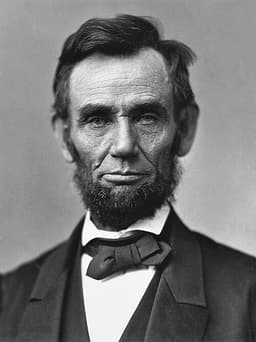
Abraham Lincoln
Politician · Modern
77.5Total

Ruhollah Khomeini
Politician · Modern
75.1Total
Basic Information
Born
1809
1902
Died
1865
1989
Era
Modern
Modern
Nationality
United States
Iran
Occupation
Politician
Politician
Civilization
Western
Middle Eastern
Score Comparison
Military (10%)
50.0
41.6
Political (20%)
88.0
65.0
Influence (20%)
80.0
85.0
Legacy (20%)
82.0
90.0
Leadership (15%)
85.0
80.0
Strategy (15%)
60.0
54.3
TOTAL
77.5
75.1
Abraham Lincoln — Complete Timeline
1861 AD
Suspension of Habeas CorpusPolitical Action◆ Major
Lincoln suspended the writ of habeas corpus in parts of the Union, allowing the military to arrest and detain suspected Confederate sympathizers without trial. This action was controversial and challenged civil liberties during wartime.
Habeas CorpusCivil LibertiesCivil War
Impact: nationaldestructive
1862 AD
Signing of the Homestead ActPolitical Action◆ Major
Lincoln signed the Homestead Act, granting 160 acres of public land to settlers for a small fee. This encouraged westward expansion and agricultural development, but also displaced Native American tribes.
Homestead ActWestward ExpansionLand Policy
Impact: nationalconstructive
1863 AD
Emancipation ProclamationPolitical Action
Lincoln issued the Emancipation Proclamation, declaring slaves in Confederate states free. This shifted the Civil War's focus to ending slavery and allowed African Americans to join the Union Army.
EmancipationCivil WarSlavery
Impact: globalprogressive
Gettysburg AddressCultural◆ Major
Lincoln delivered the Gettysburg Address at the dedication of the Soldiers' National Cemetery. The speech redefined the Civil War as a struggle for national unity and equality, and became one of the most famous speeches in US history.
Gettysburg AddressCivil WarOratory
Impact: nationalconstructive
1865 AD
Assassination by John Wilkes BoothOther
Lincoln was shot by John Wilkes Booth at Ford's Theatre in Washington, D.C., and died the next day. His assassination occurred just days after the Civil War ended, plunging the nation into mourning and affecting Reconstruction.
AssassinationCivil WarReconstruction
Impact: nationaltragic
Ruhollah Khomeini — Complete Timeline
1964 AD
Exile to Iraq and FrancePolitical Action◆ Major
Khomeini was exiled from Iran after criticizing the Shah's White Revolution and granting of diplomatic immunity to US personnel. He settled in Najaf, Iraq, and later in France, where he continued to organize opposition to the Shah.
ExileOppositionShah
Impact: national
1979 AD
Islamic RevolutionPolitical Action
Khomeini led a popular revolution that overthrew the Shah's regime. He returned to Iran in February 1979 and established an Islamic Republic based on his doctrine of Velayat-e Faqih (Guardianship of the Jurist), with himself as Supreme Leader.
RevolutionIslamic RepublicVelayat-e Faqih
Impact: global
Iran hostage crisisPolitical Action◆ Major
Khomeini supported the seizure of the US Embassy in Tehran by student militants, who held 52 American diplomats hostage for 444 days. The crisis deepened the rift with the US, led to economic sanctions, and consolidated Khomeini's power.
Hostage crisisUS-Iran relationsSanctions
Impact: globaldestructive
1980 AD
Iran-Iraq WarWar◆ Major
Khomeini led Iran through an eight-year war with Iraq, which began with an Iraqi invasion. The war resulted in hundreds of thousands of casualties and massive economic destruction, ending in a stalemate. Khomeini accepted a UN ceasefire in 1988.
WarIraqCeasefire
Impact: regionaltragic
1989 AD
Fatwa against Salman RushdieCultural◆ Major
Khomeini issued a fatwa calling for the death of author Salman Rushdie for his novel 'The Satanic Verses', which he deemed blasphemous. The fatwa led to international controversy, diplomatic tensions, and attacks on Rushdie's translators.
FatwaBlasphemyInternational controversy
Impact: globaldestructive
Expert Analysis
Origins
Abraham Lincoln was born in 1809 in a log cabin in Kentucky, embodying the American frontier spirit. His humble beginnings and self-education shaped his empathy for the common man. In contrast, Ruhollah Khomeini was born in 1902 in Khomeyn, Iran, into a religious family. His father, a cleric, was murdered when he was young, fostering a deep connection to Shia Islam and anti-establishment sentiments.
Rise to Power
Lincoln's rise was gradual, through law and politics. He served in the Illinois legislature and one term in Congress before gaining national attention through debates with Stephen Douglas. His election as president in 1860, on an anti-slavery platform, triggered secession. Khomeini's rise was more tumultuous. He became a prominent ayatollah, opposing the Shah's Westernization. Exiled in 1964, he returned in 1979 to lead the Islamic Revolution, overthrowing the monarchy.
Leadership & Governance
Lincoln governed during the Civil War, using executive power to suspend habeas corpus and issue the Emancipation Proclamation. He balanced military necessity with democratic ideals, famously articulating a vision of "government of the people, by the people, for the people." Khomeini established a theocratic system with himself as Supreme Leader, merging political and religious authority. His governance emphasized Islamic law, suppression of dissent, and anti-Western rhetoric.
Triumph & Tragedy
Lincoln's triumph was preserving the Union and ending slavery, but his tragedy was assassination days after the war's end. His death elevated him to martyrdom. Khomeini's triumph was the successful Islamic Revolution, which reshaped Iran. His tragedy included the Iran-Iraq War's devastation and the isolation of Iran internationally. The fatwa against Salman Rushdie also tarnished his legacy.
Character & Destiny
Lincoln was pragmatic, melancholic, and deeply moral, driven by a sense of duty. His destiny seemed tied to the nation's crisis. Khomeini was austere, charismatic, and uncompromising, viewing himself as a divine instrument. His destiny was to establish an Islamic state. Both men were shaped by their times and left indelible marks on history.
Legacy
Lincoln is revered as a champion of freedom and equality, with memorials and his image on currency. Khomeini is a polarizing figure—a hero to Shia Muslims and a symbol of clerical authoritarianism to others. His legacy includes Iran's theocratic government and export of revolutionary ideology.
Conclusion
Lincoln and Khomeini represent contrasting models of leadership: one democratic, the other theocratic. Lincoln's scores (M=50, P=88, I=80, L=82, D=85, S=60, T=78) reflect his political acumen and moral clarity. Khomeini's scores (M=42, P=65, I=85, L=90, D=80, S=54, T=75) highlight his ideological steadfastness. While Lincoln's impact on global democracy is profound, Khomeini's influence on modern political Islam is equally significant. Ultimately, Lincoln's legacy of emancipation and union-building has broader appeal in a democratic context, giving him a slight edge in overall influence.
Rankings
🥇
Abraham LincolnLeader
Mil: 50.0Pol: 88.0Inf: 80.0
77.5
🥈
Ruhollah Khomeini
Mil: 41.6Pol: 65.0Inf: 85.0
75.1
+2.4 behind
How This Comparison Works
Algorithm
Each figure is scored on 6 dimensions (0—100 scale) based on structured historical data: Military (10%), Political (20%), Influence (20%), Legacy (20%), Leadership (15%), Strategy (15%). The weighted total produces the final ranking.
Data Sources
Scores are computed from structured sub-indicators in the database. Scale factors adjust for era (Ancient ×0.85, Modern ×1.0) and civilization size (Eastern ×1.05, Other ×0.80) to account for differences in population and military scale.
Maximum 3 Figures
Comparisons are limited to 2—3 figures to ensure readability and statistical meaningfulness.
Error Margins
±5 points per dimension — Sub-scores are derived from historical records with inherent uncertainty. Two figures within 5 points on a dimension should be considered roughly equivalent in that area.
Total Score Accuracy
±3 points overall — The weighted combination of 6 dimensions produces a total score with approximately ±3 points of uncertainty. Differences of less than 3 points are not statistically significant— the figures are effectively tied.
Known Limitations
- Historical records are incomplete and uneven across civilizations
- Figures from oral-tradition societies may be underrepresented
- Occupation labels can misclassify multi-role figures
- Scores measure capability and impact, not moral character
- Quantitative scoring is a comparison tool, not absolute truth
Capability Radar
Military (10%) — Battles & Warfare
Battles
15
10
Win Rate
20
10
Expansion
0
10
Political (20%) — Governance & Reform
Reform
95
90
Diplomacy
80
75
Economy
70
40
Influence (20%) — Cultural & Global Reach
Cultural
85
85
Global
85
85
Legacy (20%) — Historical Impact
Historical
95
90
Longevity
90
80
Leadership (15%) — Power & Stability
Tenure
65
85
Stability
55
50
Strategy (15%) — Tactics & Innovation
Strategy
55
15
Tactics
10
10
Reform
60
20
Similar Comparisons
Comments & Discussion
No comments yet. Be the first to share your thoughts!