Loading...
This comparison has not been analyzed yet.
One-time AI generation (~1 minute). Scores and timeline are already available below.
Abdallahi ibn Muhammad vs William IX of Hesse-Kassel
William IX of Hesse-Kassel leads by 0.6 pts · 2 figures compared
…
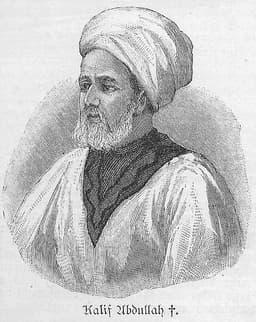
Abdallahi ibn Muhammad
Emperor · Modern
50.5Total

William IX of Hesse-Kassel
Emperor · Modern
51.1Total
Basic Information
Born
1846
1743
Died
1899
1821
Era
Modern
Modern
Nationality
Sudan
Hesse-Kassel
Occupation
Emperor
Emperor
Civilization
Other
Western
Score Comparison
Military (10%)
52.5
43.3
Political (20%)
43.7
61.3
Influence (20%)
52.5
50.2
Legacy (20%)
40.8
38.3
Leadership (15%)
62.2
67.0
Strategy (15%)
60.0
54.3
TOTAL
50.5
51.1
Abdallahi ibn Muhammad — Complete Timeline
1885 AD
Succession as KhalifaPolitical Action
Following Muhammad Ahmad's death, Abdallahi ibn Muhammad succeeded him as Khalifa (successor) of the Mahdist state. He consolidated power by eliminating rivals and establishing a military dictatorship based on his Ta'aisha tribe.
SuccessionMahdist StateConsolidation
Impact: regional
1898 AD
Battle of OmdurmanWar
Anglo-Egyptian forces under General Herbert Kitchener defeated the Mahdist army at Omdurman on September 2, 1898. The battle resulted in over 10,000 Mahdist casualties and effectively ended the Mahdist state's control over Sudan.
Battle of OmdurmanMahdist WarKitchener
Impact: regional
1899 AD
Death at the Battle of Umm DiwaykaratWar◆ Major
Abdallahi ibn Muhammad was killed in action at the Battle of Umm Diwaykarat on November 25, 1899. His death marked the final defeat of the Mahdist movement and the establishment of Anglo-Egyptian condominium rule over Sudan.
Final BattleMahdist DefeatAnglo-Egyptian Sudan
Impact: regionaltragic
William IX of Hesse-Kassel — Complete Timeline
1785 AD
Inherited Hesse-KasselPolitical Action◆ Major
William IX became Landgrave of Hesse-Kassel upon the death of his father Frederick II. He inherited a wealthy state due to the lucrative practice of hiring Hessian soldiers to foreign powers, particularly Britain during the American Revolution.
SuccessionMercenary Trade
Impact: regional
1803 AD
Elevated to ElectorPolitical Action◆ Major
As part of the Reichsdeputationshauptschluss, William IX was elevated to the title of Elector of Hesse-Kassel, becoming Elector William I. This increased his status within the Holy Roman Empire, though the title was largely symbolic.
Holy Roman EmpireTitle Elevation
Impact: regionalconstructive
1806 AD
Fled to DenmarkPolitical Action◆ Major
After the Battle of Jena-Auerstedt, Napoleon's forces occupied Hesse-Kassel. William I fled to Denmark, leaving his territories under French control. He remained in exile until after Napoleon's defeat.
Napoleonic WarsExile
Impact: regionaltragic
1813 AD
Returned as ElectorPolitical Action◆ Major
Following Napoleon's defeat at the Battle of Leipzig, William I returned to Hesse-Kassel and resumed his rule. He restored the old order, reversing many reforms introduced during the French occupation.
RestorationNapoleonic Wars
Impact: regional
This comparison has not been analyzed yet.
One-time AI generation (~1 minute). Scores and timeline are already available below.
Rankings
🥇
William IX of Hesse-KasselLeader
Mil: 43.3Pol: 61.3Inf: 50.2
51.1
🥈
Abdallahi ibn Muhammad
Mil: 52.5Pol: 43.7Inf: 52.5
50.5
+0.6 behind
How This Comparison Works
Algorithm
Each figure is scored on 6 dimensions (0—100 scale) based on structured historical data: Military (10%), Political (20%), Influence (20%), Legacy (20%), Leadership (15%), Strategy (15%). The weighted total produces the final ranking.
Data Sources
Scores are computed from structured sub-indicators in the database. Scale factors adjust for era (Ancient ×0.85, Modern ×1.0) and civilization size (Eastern ×1.05, Other ×0.80) to account for differences in population and military scale.
Maximum 3 Figures
Comparisons are limited to 2—3 figures to ensure readability and statistical meaningfulness.
Error Margins
±5 points per dimension — Sub-scores are derived from historical records with inherent uncertainty. Two figures within 5 points on a dimension should be considered roughly equivalent in that area.
Total Score Accuracy
±3 points overall — The weighted combination of 6 dimensions produces a total score with approximately ±3 points of uncertainty. Differences of less than 3 points are not statistically significant— the figures are effectively tied.
Known Limitations
- Historical records are incomplete and uneven across civilizations
- Figures from oral-tradition societies may be underrepresented
- Occupation labels can misclassify multi-role figures
- Scores measure capability and impact, not moral character
- Quantitative scoring is a comparison tool, not absolute truth
Capability Radar
Military (10%) — Battles & Warfare
Battles
60
5
Win Rate
55
5
Expansion
50
5
Political (20%) — Governance & Reform
Reform
35
30
Diplomacy
30
40
Economy
25
60
Influence (20%) — Cultural & Global Reach
Cultural
30
20
Global
25
20
Legacy (20%) — Historical Impact
Historical
35
20
Longevity
20
20
Leadership (15%) — Power & Stability
Tenure
40
40
Stability
20
30
Strategy (15%) — Tactics & Innovation
Strategy
45
5
Tactics
50
5
Reform
40
5
Similar Comparisons
Comments & Discussion
No comments yet. Be the first to share your thoughts!