Loading...
Nicholas I of Russia vs William IX of Hesse-Kassel
Nicholas I of Russia leads by 6.7 pts · 2 figures compared
…
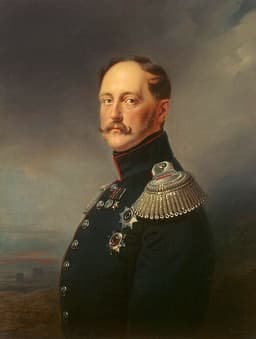
Nicholas I of Russia
Emperor · Modern
57.8Total
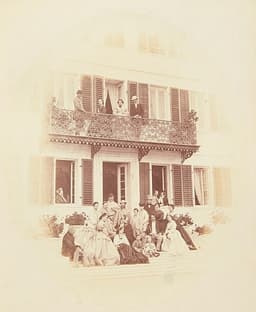
William IX of Hesse-Kassel
Emperor · Modern
51.1Total
Basic Information
Born
1796
1743
Died
1855
1821
Era
Modern
Modern
Nationality
Russia
Hesse-Kassel
Occupation
Emperor
Emperor
Civilization
Western
Western
Score Comparison
Military (10%)
50.0
43.3
Political (20%)
61.3
61.3
Influence (20%)
58.0
50.2
Legacy (20%)
49.2
38.3
Leadership (15%)
72.0
67.0
Strategy (15%)
60.0
54.3
TOTAL
57.8
51.1
Nicholas I of Russia — Complete Timeline
1825 AD
Suppression of the Decembrist RevoltPolitical Action
Upon ascending the throne, Nicholas I faced a revolt by army officers demanding constitutional reforms. He ordered artillery fire against the rebels in Senate Square, killing hundreds and arresting the leaders. This event set the repressive tone of his reign.
Decembrist RevoltRepressionAutocracy
Impact: nationaldestructive
1826 AD
Establishment of the Third SectionReform◆ Major
Nicholas I created the Third Section of His Imperial Majesty's Own Chancellery, a secret police force tasked with suppressing dissent and monitoring political subversion. This institution became a symbol of state surveillance and repression in Russia.
Secret PoliceRepressionAutocracy
Impact: nationaldestructive
1833 AD
Codification of Russian LawsReform◆ Major
Under Nicholas I, Mikhail Speransky completed the Full Collection of Laws of the Russian Empire, a 45-volume compilation. This codification systematized Russian law for the first time, providing a legal foundation for the autocratic state.
Legal ReformCodificationSperansky
Impact: nationalconstructive
1853 AD
Crimean WarWar
Nicholas I's aggressive expansionism led to war with the Ottoman Empire, Britain, France, and Sardinia. The conflict exposed Russia's military and technological backwardness, culminating in the Siege of Sevastopol and Russia's defeat. The war ended with the Treaty of Paris in 1856.
Crimean WarMilitary DefeatTreaty of Paris
Impact: globaldestructive
William IX of Hesse-Kassel — Complete Timeline
1785 AD
Inherited Hesse-KasselPolitical Action◆ Major
William IX became Landgrave of Hesse-Kassel upon the death of his father Frederick II. He inherited a wealthy state due to the lucrative practice of hiring Hessian soldiers to foreign powers, particularly Britain during the American Revolution.
SuccessionMercenary Trade
Impact: regional
1803 AD
Elevated to ElectorPolitical Action◆ Major
As part of the Reichsdeputationshauptschluss, William IX was elevated to the title of Elector of Hesse-Kassel, becoming Elector William I. This increased his status within the Holy Roman Empire, though the title was largely symbolic.
Holy Roman EmpireTitle Elevation
Impact: regionalconstructive
1806 AD
Fled to DenmarkPolitical Action◆ Major
After the Battle of Jena-Auerstedt, Napoleon's forces occupied Hesse-Kassel. William I fled to Denmark, leaving his territories under French control. He remained in exile until after Napoleon's defeat.
Napoleonic WarsExile
Impact: regionaltragic
1813 AD
Returned as ElectorPolitical Action◆ Major
Following Napoleon's defeat at the Battle of Leipzig, William I returned to Hesse-Kassel and resumed his rule. He restored the old order, reversing many reforms introduced during the French occupation.
RestorationNapoleonic Wars
Impact: regional
Expert Analysis
Origins
**Nicholas I of Russia** was born in 1796 at Tsarskoye Selo, the third son of Emperor Paul I. He received a military education, his upbringing shaped by the strict discipline of the Russian army. His father's assassination in 1801 and the subsequent reign of his brother Alexander I exposed him to court intrigues. Nicholas was not groomed for the throne until 1825 when his brother Constantine renounced succession, thrusting him into power unprepared.
**William IX of Hesse-Kassel** (born 1743) was the son of Landgrave Frederick II. He inherited a state whose wealth derived from renting troops to foreign powers, notably Britain during the American Revolution. William studied at the University of Geneva and traveled extensively, but his real education came from managing the lucrative mercenary trade. He became Landgrave in 1785, inheriting a well-filled treasury and a reputation for financial shrewdness.
Rise to Power
Nicholas I ascended the throne in December 1825 amid the Decembrist Revolt, a rebellion by army officers seeking constitutional reforms. He suppressed it ruthlessly, ordering artillery fire against the rebels in Senate Square, killing hundreds. This event defined his reign: he saw liberalism as a threat and committed to autocracy. His military background and distrust of reform drove his policies.
William IX rose to power through inheritance, becoming Landgrave in 1785. He expanded his wealth by continuing the practice of hiring out Hessian soldiers, amassing a fortune that made him one of Europe's richest princes. In 1803, as part of the Reichsdeputationshauptschluss, he was elevated to Elector of Hesse-Kassel, gaining greater status. His power was based on financial resources, not military conquest.
Leadership & Governance
Nicholas I ruled as an autocrat, centralizing control through the Third Section, a secret police established in 1826 to monitor dissent. He suppressed press freedom, universities, and any reformist ideas. His codification of Russian laws under Mikhail Speransky (1832) systematized the legal code but preserved serfdom. His governance scored 72.0 in leadership, but his rigidity alienated educated society.
William IX governed as an enlightened despot, but his primary focus was financial management. He maintained a mercenary army that generated revenue, but his rule was conservative. He reversed reforms introduced by his predecessor, restoring noble privileges. His leadership score of 67.0 reflects efficient administration but lack of vision. He fled to Denmark in 1806 after Napoleon's invasion, leaving his state occupied, and returned in 1813 to restore the old order.
Triumph & Tragedy
Nicholas I's triumph was the codification of laws and the construction of the first Russian railway (1837), which modernized infrastructure. However, his greatest tragedy was the Crimean War (1853-1856). His aggressive expansionism against the Ottoman Empire led to war with Britain, France, and Sardinia. Russia suffered heavy losses, with over 500,000 casualties, and the war exposed Russia's technological backwardness. Nicholas died in 1855 before the war ended, his policies in ruins.
William IX's triumph was his financial success: he left a treasury of 8 million thalers, making Hesse-Kassel one of the wealthiest German states. His tragedy was his exile and the occupation of his lands by Napoleon. After returning, he faced demands for reform but resisted, leading to unrest. His legacy is overshadowed by the mercenary trade, which tarnished his reputation.
Character & Destiny
Nicholas I was stubborn, militaristic, and suspicious of change. His character shaped his fate: he saw himself as the defender of autocracy, but his inflexibility led to disaster in Crimea. Historian Richard Pipes described him as "the quintessential authoritarian." His personality directly caused Russia's isolation and defeat.
William IX was pragmatic, frugal, and cautious. He prioritized stability over progress. His character allowed him to accumulate wealth but not to adapt to the Napoleonic era. He returned to a changed world but tried to restore the past, leading to irrelevance.
Legacy
Nicholas I left a legacy of reaction: his reign strengthened autocracy but stunted Russia's development. The Crimean War defeat spurred reforms under his son Alexander II. His scores: Military 50.0, Political 61.3, Influence 58.0, Legacy 49.2.
William IX's legacy is mixed: he is remembered as the "mercenary prince" who profited from selling soldiers. His wealth enabled cultural patronage, but his political influence was limited. His scores: Military 43.3, Political 61.3, Influence 50.2, Legacy 38.3.
Conclusion
Nicholas I had greater impact, with a total score of 57.8 versus William IX's 51.1. Despite his failures, Nicholas shaped Russia's trajectory for decades, while William's influence was confined to a small German state. Nicholas's autocratic model influenced later Russian rulers, whereas William's legacy is a footnote. The gap of 6.7 points reflects Nicholas's broader historical significance, even if his policies were ultimately disastrous.
Rankings
🥇
Nicholas I of RussiaLeader
Mil: 50.0Pol: 61.3Inf: 58.0
57.8
🥈
William IX of Hesse-Kassel
Mil: 43.3Pol: 61.3Inf: 50.2
51.1
+6.7 behind
How This Comparison Works
Algorithm
Each figure is scored on 6 dimensions (0—100 scale) based on structured historical data: Military (10%), Political (20%), Influence (20%), Legacy (20%), Leadership (15%), Strategy (15%). The weighted total produces the final ranking.
Data Sources
Scores are computed from structured sub-indicators in the database. Scale factors adjust for era (Ancient ×0.85, Modern ×1.0) and civilization size (Eastern ×1.05, Other ×0.80) to account for differences in population and military scale.
Maximum 3 Figures
Comparisons are limited to 2—3 figures to ensure readability and statistical meaningfulness.
Error Margins
±5 points per dimension — Sub-scores are derived from historical records with inherent uncertainty. Two figures within 5 points on a dimension should be considered roughly equivalent in that area.
Total Score Accuracy
±3 points overall — The weighted combination of 6 dimensions produces a total score with approximately ±3 points of uncertainty. Differences of less than 3 points are not statistically significant— the figures are effectively tied.
Known Limitations
- Historical records are incomplete and uneven across civilizations
- Figures from oral-tradition societies may be underrepresented
- Occupation labels can misclassify multi-role figures
- Scores measure capability and impact, not moral character
- Quantitative scoring is a comparison tool, not absolute truth
Capability Radar
Military (10%) — Battles & Warfare
Battles
55
5
Win Rate
50
5
Expansion
55
5
Political (20%) — Governance & Reform
Reform
30
30
Diplomacy
45
40
Economy
40
60
Influence (20%) — Cultural & Global Reach
Cultural
40
20
Global
50
20
Legacy (20%) — Historical Impact
Historical
55
20
Longevity
50
20
Leadership (15%) — Power & Stability
Tenure
70
40
Stability
50
30
Strategy (15%) — Tactics & Innovation
Strategy
45
5
Tactics
40
5
Reform
60
5
Similar Comparisons
Comments & Discussion
No comments yet. Be the first to share your thoughts!