Loading...
Abdallahi ibn Muhammad vs Julius Caesar
Julius Caesar leads by 32.3 pts · 2 figures compared
…
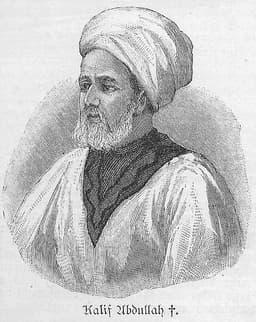
Abdallahi ibn Muhammad
Emperor · Modern
50.5Total

Julius Caesar
General · Ancient
82.8Total
Basic Information
Born
1846
-100
Died
1899
-44
Era
Modern
Ancient
Nationality
Sudan
Roman Republic
Occupation
Emperor
General
Civilization
Other
Western
Score Comparison
Military (10%)
52.5
88.0
Political (20%)
43.7
78.0
Influence (20%)
52.5
85.0
Legacy (20%)
40.8
82.0
Leadership (15%)
62.2
80.0
Strategy (15%)
60.0
85.0
TOTAL
50.5
82.8
Abdallahi ibn Muhammad — Complete Timeline
1885 AD
Succession as KhalifaPolitical Action
Following Muhammad Ahmad's death, Abdallahi ibn Muhammad succeeded him as Khalifa (successor) of the Mahdist state. He consolidated power by eliminating rivals and establishing a military dictatorship based on his Ta'aisha tribe.
SuccessionMahdist StateConsolidation
Impact: regional
1898 AD
Battle of OmdurmanWar
Anglo-Egyptian forces under General Herbert Kitchener defeated the Mahdist army at Omdurman on September 2, 1898. The battle resulted in over 10,000 Mahdist casualties and effectively ended the Mahdist state's control over Sudan.
Battle of OmdurmanMahdist WarKitchener
Impact: regional
1899 AD
Death at the Battle of Umm DiwaykaratWar◆ Major
Abdallahi ibn Muhammad was killed in action at the Battle of Umm Diwaykarat on November 25, 1899. His death marked the final defeat of the Mahdist movement and the establishment of Anglo-Egyptian condominium rule over Sudan.
Final BattleMahdist DefeatAnglo-Egyptian Sudan
Impact: regionaltragic
Julius Caesar — Complete Timeline
58 BC
Gallic WarsWar◆ Major
Caesar, as proconsul of Gaul, launched a series of campaigns that conquered all of Gaul (modern France, Belgium, and parts of Switzerland). He fought numerous battles, including against the Helvetii, the Belgae, and the Gallic chieftain Vercingetorix. The wars brought immense wealth and a loyal army to Caesar.
Gallic WarsConquestRoman Expansion
Impact: regional
49 BC
Crossing the RubiconPolitical Action◆ Major
Caesar led Legio XIII across the Rubicon River into Italy, defying the Roman Senate's order to disband his army. This act triggered a civil war against Pompey and the Optimates, ultimately leading to Caesar's dictatorship and the end of the Roman Republic.
Roman Civil WarEnd of RepublicPower Struggle
Impact: global
48 BC
Battle of PharsalusWar◆ Major
Caesar's outnumbered army defeated the larger forces of Pompey the Great at Pharsalus in Greece. Caesar's tactical use of a reserve line to counter Pompey's cavalry charge proved decisive. Pompey fled to Egypt, where he was assassinated, leaving Caesar as the undisputed master of the Roman world.
Roman Civil WarBattleDecisive Victory
Impact: regional
44 BC
Appointment as Dictator for LifePolitical Action◆ Major
The Roman Senate appointed Caesar dictator perpetuo (dictator for life), granting him unprecedented personal power. This move concentrated military, legislative, and judicial authority in one person, effectively ending the Roman Republic's traditional system of checks and balances and alarming many senators.
DictatorshipEnd of RepublicPower Consolidation
Impact: regionaldestructive
Assassination on the Ides of MarchPolitical Action◆ Major
A group of Roman senators, led by Marcus Junius Brutus and Gaius Cassius Longinus, stabbed Caesar to death at a meeting of the Senate in the Theatre of Pompey. The assassination was intended to restore the Republic, but instead triggered another civil war that led to the rise of the Roman Empire.
AssassinationRoman PoliticsEnd of Republic
Impact: globaldestructive
Expert Analysis
abdallahi-ibn-muhammad-vs-julius-caesar
# The Dictator and the Khalifa: Two Men Who Shaped Their Worlds
They died seventy-five years and a world apart. On the Ides of March, 44 BCE, Julius Caesar fell beneath twenty-three dagger blows in the Senate chamber of Rome, a death that would echo through millennia. On November 25, 1899, Abdallahi ibn Muhammad perished in the dust of the Battle of Umm Diwaykarat, a forgotten corner of Sudan where machine guns had mowed down his followers. Both men were warriors, rulers, and visionaries. Both saw their empires crumble. Yet one became a name carved into the foundation of Western civilization, while the other remains a footnote, remembered only by specialists. Why? The answer lies not in their deeds alone, but in the currents of history that carried them—and the worlds they tried to reshape.
Origins
Gaius Julius Caesar was born in 100 BCE into the patrician Julii clan, an ancient but politically diminished family. Rome was a Republic in crisis—its institutions groaning under the weight of empire, its Senate paralyzed by factionalism, its legions more loyal to generals than to the state. Caesar grew up amid civil wars and the bloody rivalry between populists and aristocrats. His uncle by marriage, Gaius Marius, had been a radical reformer; his other uncle, Sulla, a conservative dictator. From childhood, Caesar understood that politics in Rome was a knife fight—often literally.
Abdallahi ibn Muhammad was born in 1846 in Darfur, a region of what is now Sudan. He came from the Ta’aisha tribe, a nomadic people of the Sahel, far from the corridors of power. The Sudan of his youth was a land under Ottoman-Egyptian rule, corrupt and extractive, where foreign officials taxed the poor into starvation. Abdallahi was illiterate in the formal sense, but he knew the Quran by heart and understood the deep currents of messianic hope that ran through the Islamic world. His world was one of faith, clan loyalty, and the slow, grinding oppression of empire.
Rise to Power
Caesar’s path was that of a Roman aristocrat: military service, political office, and the careful cultivation of alliances. He served as a military tribune, then quaestor, then aedile—spending lavishly on games to win popularity. In 60 BCE, he forged the First Triumvirate with Pompey the Great and Crassus, two men more powerful than himself. It was a masterstroke of political engineering. Within a year, he was consul; within a decade, he had conquered Gaul—modern France, Belgium, and parts of Germany—in a series of campaigns that were brutal, brilliant, and self-financing.
Abdallahi’s rise was different. He did not climb a political ladder; he attached himself to a prophet. In the early 1880s, Muhammad Ahmad declared himself the Mahdi—the guided one, the Islamic messiah who would purify the faith and drive out the foreigners. Abdallahi became his most loyal and capable lieutenant. When the Mahdi died in 1885, just months after capturing Khartoum, Abdallahi claimed succession as Khalifa. He had no dynastic claim, no institutional support—only the loyalty of his Ta’aisha warriors and the fear he inspired in rivals. He consolidated power through marriage, execution, and sheer force of will.
Leadership & Governance
Caesar governed with a combination of clemency and calculation. He pardoned former enemies, extended Roman citizenship to provincial elites, reformed the calendar, and launched massive public works. His military genius lay in speed and logistics—he once marched his army forty miles in a single day. He wrote his own commentaries, shaping his image for posterity. But his rule was unstable. He centralized power, packed the Senate with his supporters, and accepted the title of dictator for life. He believed he could manage the resentment this bred. He was wrong.
Abdallahi governed a theocratic state in perpetual war. He imposed strict Islamic law, suppressed rival tribes, and mobilized the entire population for jihad. His administration was crude but effective: taxes were collected, armies were raised, and the state survived for fourteen years. Yet he lacked Caesar’s political subtlety. He could not build alliances with former enemies or co-opt potential rivals. His state was a war machine, and when the war machine failed, the state collapsed.
Triumph & Tragedy
Caesar’s greatest triumph was the conquest of Gaul—a feat that brought him wealth, glory, and an army that would carry him to supreme power. His greatest tragedy was that he could not stop. He crossed the Rubicon River in 49 BCE, igniting a civil war that would end the Republic. He defeated Pompey, pacified the Mediterranean, and stood alone atop the world. But he could not institutionalize his rule. His assassination on March 15, 44 BCE, was not just a personal tragedy—it was the failure of his political vision.
Abdallahi’s greatest triumph was surviving the Mahdi’s death and holding together a fractious, fanatical state against internal revolts and external threats. His greatest tragedy was the Battle of Omdurman on September 2, 1898. There, General Kitchener’s Anglo-Egyptian army—armed with Maxim guns, artillery, and rifles—massacred 10,000 of his followers while suffering fewer than 50 deaths. It was not a battle; it was an execution. Abdallahi fled, raised another army, and died fighting a year later. He never surrendered.
Character & Destiny
Caesar was ambitious, intelligent, and ruthlessly pragmatic. He gambled constantly—on his life, on his luck, on the loyalty of men he had defeated. He believed in his own star. This confidence made him great, but it also blinded him. He ignored warnings of the conspiracy against him. He dismissed the Senate’s hatred as the envy of lesser men. His character shaped his destiny: he rose because he dared, and he fell because he dared too far.
Abdallahi was devout, stubborn, and limited by his worldview. He believed God would deliver victory. When the guns of Omdurman proved otherwise, he had no answer. His faith gave him strength but also rigidity. He could not adapt because adaptation would mean doubting the divine plan. He died as he lived: a warrior for a cause that had already lost.
Legacy
Caesar’s legacy is immeasurable. His name became a title—Kaiser, Tsar, Caesar—for emperors across Europe. His writings are still read. His military campaigns are still studied. He did not found the Roman Empire, but he made it inevitable. His murder led to the rise of Augustus and two centuries of peace. He is remembered as the man who broke the Republic and built the world that followed.
Abdallahi’s legacy is local and fading. In Sudan, he is remembered as a leader who resisted colonialism, but also as a man who ruled through fear and failed to modernize. His state vanished within months of his death. He has no monuments, no devoted scholars, no enduring cultural footprint. His story is a cautionary tale: that even the most devout faith cannot stop a Maxim gun.
Conclusion
What separates these two men is not talent or courage. Abdallahi was as brave as Caesar, as determined, as commanding. But Caesar played on a larger stage, with more resources, and against an enemy—the Republic—that was already crumbling from within. Abdallahi faced the British Empire at its zenith, armed with industrial technology and global logistics. One man built an empire that lasted five hundred years; the other built one that lasted fourteen. The difference was not in the men, but in the worlds they inhabited. History does not remember the brave who lose; it remembers those who win, and then win again.
Rankings
🥇
Julius CaesarLeader
Mil: 88.0Pol: 78.0Inf: 85.0
82.8
🥈
Abdallahi ibn Muhammad
Mil: 52.5Pol: 43.7Inf: 52.5
50.5
+32.3 behind
How This Comparison Works
Algorithm
Each figure is scored on 6 dimensions (0—100 scale) based on structured historical data: Military (10%), Political (20%), Influence (20%), Legacy (20%), Leadership (15%), Strategy (15%). The weighted total produces the final ranking.
Data Sources
Scores are computed from structured sub-indicators in the database. Scale factors adjust for era (Ancient ×0.85, Modern ×1.0) and civilization size (Eastern ×1.05, Other ×0.80) to account for differences in population and military scale.
Maximum 3 Figures
Comparisons are limited to 2—3 figures to ensure readability and statistical meaningfulness.
Error Margins
±5 points per dimension — Sub-scores are derived from historical records with inherent uncertainty. Two figures within 5 points on a dimension should be considered roughly equivalent in that area.
Total Score Accuracy
±3 points overall — The weighted combination of 6 dimensions produces a total score with approximately ±3 points of uncertainty. Differences of less than 3 points are not statistically significant— the figures are effectively tied.
Known Limitations
- Historical records are incomplete and uneven across civilizations
- Figures from oral-tradition societies may be underrepresented
- Occupation labels can misclassify multi-role figures
- Scores measure capability and impact, not moral character
- Quantitative scoring is a comparison tool, not absolute truth
Capability Radar
Military (10%) — Battles & Warfare
Battles
60
95
Win Rate
55
92
Expansion
50
97
Political (20%) — Governance & Reform
Reform
35
90
Diplomacy
30
85
Economy
25
82
Influence (20%) — Cultural & Global Reach
Cultural
30
88
Global
25
94
Legacy (20%) — Historical Impact
Historical
35
95
Longevity
20
96
Leadership (15%) — Power & Stability
Tenure
40
75
Stability
20
60
Strategy (15%) — Tactics & Innovation
Strategy
45
94
Tactics
50
96
Reform
40
88
Similar Comparisons
Comments & Discussion
LegionLore6/17/2026
Caesar's assassination wasn't a fall from glory—it was a coup by aristocrats who feared his reforms. Abdallahi, by contrast, died fighting to the end, a true warrior-khalifa. Caesar was stabbed by his own Senate; Abdallahi fell to British machine guns while leading his men. One was betrayed, the other never surrendered. I'd rather follow a man who dies with his hands on a sword than one who gets knifed in a marble hall. Caesar's legacy is overrated—his Gaul campaigns were genocide dressed as tri
杜撰数据6/17/2026
把19世纪的苏丹领袖和古罗马独裁官放一起比较,本身就是历史谬误。Abdallahi统治的是一个前现代神权国家,靠宗教狂热维系统治,而凯撒领导的是高度组织化的地中海帝国。两人唯一的共同点只是都死了?请拿出GDP、军队规模或行政效率来对比,否则就是在做空洞的修辞练习。我喜欢具体数字,不是散文式的"世界之重塑"。
StoicScribe6/17/2026
Caesar's 'vision' was personal ambition masked as populism. He destroyed the Republic for his own glory, leaving a trail of civil wars. Abdallahi built a theocratic state based on Mahdist doctrine, uniting disparate Sudanese tribes under a single cause. Caesar died a dictator; Abdallahi died a martyr. The West mythologizes Caesar because his narrative fits a familiar arc—tyrant, assassination, legend. But his actual impact? Chaos and imperial collapse. Abdallahi's legacy, though obscure, was a c
中亚史徒6/17/2026
凯撒是罗马的"终结者",把元老院当橡皮图章用,而阿卜杜拉希是苏丹的"筑城者",在殖民浪潮中硬撑起一个本土政权。两人都败于内部算计——凯撒被元老捅刀,阿卜杜拉希被埃及-英国联军碾压。但注意细节:凯撒死前已大权独揽,阿卜杜拉希却是在马赫迪死后才接棒,从未真正统一过苏丹。前者是过于成功的独裁者,后者是勉强维持的继承者。历史书写的不平等,其实源于成败时机而非个人能力。