Loading...
Abdallahi ibn Muhammad vs Charles X of France
Abdallahi ibn Muhammad leads by 13.4 pts · 2 figures compared
…
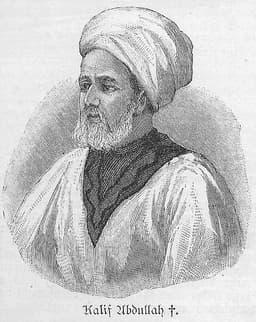
Abdallahi ibn Muhammad
Emperor · Modern
50.5Total

Charles X of France
Emperor · Modern
37.1Total
Basic Information
Born
1846
1757
Died
1899
1836
Era
Modern
Modern
Nationality
Sudan
France
Occupation
Emperor
Emperor
Civilization
Other
Western
Score Comparison
Military (10%)
52.5
21.1
Political (20%)
43.7
25.0
Influence (20%)
52.5
46.3
Legacy (20%)
40.8
35.8
Leadership (15%)
62.2
31.2
Strategy (15%)
60.0
60.0
TOTAL
50.5
37.1
Abdallahi ibn Muhammad — Complete Timeline
1885 AD
Succession as KhalifaPolitical Action
Following Muhammad Ahmad's death, Abdallahi ibn Muhammad succeeded him as Khalifa (successor) of the Mahdist state. He consolidated power by eliminating rivals and establishing a military dictatorship based on his Ta'aisha tribe.
SuccessionMahdist StateConsolidation
Impact: regional
1898 AD
Battle of OmdurmanWar
Anglo-Egyptian forces under General Herbert Kitchener defeated the Mahdist army at Omdurman on September 2, 1898. The battle resulted in over 10,000 Mahdist casualties and effectively ended the Mahdist state's control over Sudan.
Battle of OmdurmanMahdist WarKitchener
Impact: regional
1899 AD
Death at the Battle of Umm DiwaykaratWar◆ Major
Abdallahi ibn Muhammad was killed in action at the Battle of Umm Diwaykarat on November 25, 1899. His death marked the final defeat of the Mahdist movement and the establishment of Anglo-Egyptian condominium rule over Sudan.
Final BattleMahdist DefeatAnglo-Egyptian Sudan
Impact: regionaltragic
Charles X of France — Complete Timeline
1825 AD
Coronation of Charles XCultural◆ Major
Charles X was crowned at Reims Cathedral in a lavish ceremony that revived medieval traditions, including the use of the Holy Ampulla. The coronation emphasized divine right and traditionalist Catholicism, signaling his rejection of the constitutional principles of the Charter of 1814.
CoronationDivine RightTraditionalism
Impact: national
1830 AD
Invasion of Algiers (1830)War◆ Major
Charles X ordered a military expedition to invade Algiers, aiming to boost his popularity and distract from domestic unrest. The French captured Algiers in July 1830, beginning the colonization of Algeria. The victory came too late to save his throne, as the July Revolution erupted simultaneously.
Colonial WarAlgeriaDistraction
Impact: global
July Revolution (1830)Political Action
Charles X issued the July Ordinances, dissolving the Chamber of Deputies, restricting press freedom, and altering the electoral system. This sparked three days of street fighting in Paris (July 27-29, 1830). The revolution forced Charles to abdicate and flee to England, ending the Bourbon Restoration.
RevolutionAbdicationBourbon
Impact: nationaldestructive
July Ordinances (Ordonnances de Juillet)Political Action
On July 25, 1830, Charles X signed four ordinances that suspended the press, dissolved the newly elected Chamber, changed the electoral system to favor the aristocracy, and called for new elections. These authoritarian decrees directly triggered the July Revolution and his overthrow.
AuthoritarianismPress CensorshipRevolution
Impact: nationaldestructive
Exile of Charles XPolitical Action◆ Major
After abdicating in favor of his grandson, the Duke of Bordeaux, Charles X fled to England and later to Scotland and Prague. He lived in exile until his death in 1836, never returning to France. His exile marked the definitive end of the senior Bourbon line's rule.
ExileAbdicationBourbon
Impact: nationaltragic
Expert Analysis
Origins
Abdallahi ibn Muhammad was born around 1846 in the Kordofan region of Sudan, into the Ta'aisha branch of the Rizeigat tribe. His family were nomadic cattle herders, and he received a traditional Islamic education. He joined the Mahdist movement in the early 1880s, becoming a close disciple of Muhammad Ahmad, the self-proclaimed Mahdi.
Charles X of France was born on October 9, 1757, at the Palace of Versailles as Charles Philippe, Count of Artois. He was the youngest son of the Dauphin Louis and Maria Josepha of Saxony, and grandson of King Louis XV. He received a princely education and was known for his ultra-royalist views even before the French Revolution.
Rise to Power
Abdallahi ibn Muhammad rose to prominence as a loyal commander under the Mahdi. After Muhammad Ahmad's death in June 1885, Abdallahi succeeded him as Khalifa (successor) of the Mahdist state. He consolidated power by eliminating rivals, including the Mahdi's other deputies, and established a centralized administration in Omdurman.
Charles X ascended the throne on September 16, 1824, after the death of his brother Louis XVIII. He had spent much of his life in exile during the French Revolution and Napoleonic era. His reign marked a shift toward ultra-royalist policies, aiming to restore the absolute monarchy and the power of the Catholic Church.
Leadership & Governance
Abdallahi ibn Muhammad governed the Mahdist state with a combination of religious authority and military force. He maintained the Mahdi's policies, including the enforcement of Islamic law, and organized the state into a military theocracy. His leadership score of 62.2 reflects his ability to hold the state together despite internal divisions and external threats. However, his political score of 43.7 indicates limited success in building durable institutions.
Charles X pursued a reactionary agenda, passing laws to compensate émigrés for lands lost during the Revolution and strengthening the Church's influence. His political score of 25.0 reflects his inability to adapt to changing political realities. The July Ordinances of 1830, which dissolved the Chamber and restricted press freedom, sparked the July Revolution and led to his overthrow. His military score of 21.1 is low, as his only major military action was the invasion of Algiers in 1830, which succeeded but could not save his throne.
Triumph & Tragedy
Abdallahi ibn Muhammad's greatest success was maintaining the Mahdist state for over a decade after the Mahdi's death, resisting British and Egyptian forces. He also expanded the state's territory and managed a complex administrative system. His greatest failure was the Battle of Omdurman on September 2, 1898, where his army was decimated by Kitchener's forces, with over 10,000 Mahdists killed. He was killed in action at the Battle of Umm Diwaykarat on November 25, 1899, ending the Mahdist movement.
Charles X's triumph was the successful invasion of Algiers in 1830, which began French colonization of Algeria. His tragedy was the July Revolution of 1830, which forced him to abdicate and flee into exile. His ultra-royalist policies alienated the middle class and liberals, leading to widespread unrest. His legacy score of 35.8 reflects his failure to preserve the Bourbon monarchy.
Character & Destiny
Abdallahi ibn Muhammad was a pragmatic and determined leader, but his reliance on military force and inability to modernize the state contributed to his downfall. His strategy score of 60.0 indicates competent military planning, but his overall leadership was undermined by technological inferiority and British imperial power.
Charles X was stubborn and out of touch with the political currents of his time. His devotion to absolutism and the Church blinded him to the need for compromise. His character directly led to the July Revolution, as he refused to accept constitutional limits on his power.
Legacy
Abdallahi ibn Muhammad is remembered as the last ruler of the Mahdist state, a symbol of resistance against colonialism. His movement influenced later Sudanese nationalism. However, his legacy is largely negative in Western historiography, associated with the Mahdist War's brutality. His influence score of 52.5 reflects the lasting impact of the Mahdist movement in Sudan.
Charles X is remembered as the epitome of the reactionary Bourbon monarchy. His overthrow solidified the end of absolute monarchy in France and led to the July Monarchy under Louis-Philippe. The invasion of Algiers had long-term consequences for French colonialism. His legacy score of 35.8 indicates limited positive impact.
Conclusion
Abdallahi ibn Muhammad had a greater impact than Charles X, as evidenced by his higher total score of 50.5 compared to 37.1. Abdallahi successfully led a religious state for over a decade and resisted a global empire, while Charles X's reign lasted only six years and ended in revolution. Abdallahi's military and leadership scores (52.5 and 62.2) significantly exceed Charles X's (21.1 and 31.2), underscoring his more effective governance. Although both ultimately failed, Abdallahi's movement left a deeper mark on Sudanese history than Charles X's did on France.
Rankings
🥇
Abdallahi ibn MuhammadLeader
Mil: 52.5Pol: 43.7Inf: 52.5
50.5
🥈
Charles X of France
Mil: 21.1Pol: 25.0Inf: 46.3
37.1
+13.4 behind
How This Comparison Works
Algorithm
Each figure is scored on 6 dimensions (0—100 scale) based on structured historical data: Military (10%), Political (20%), Influence (20%), Legacy (20%), Leadership (15%), Strategy (15%). The weighted total produces the final ranking.
Data Sources
Scores are computed from structured sub-indicators in the database. Scale factors adjust for era (Ancient ×0.85, Modern ×1.0) and civilization size (Eastern ×1.05, Other ×0.80) to account for differences in population and military scale.
Maximum 3 Figures
Comparisons are limited to 2—3 figures to ensure readability and statistical meaningfulness.
Error Margins
±5 points per dimension — Sub-scores are derived from historical records with inherent uncertainty. Two figures within 5 points on a dimension should be considered roughly equivalent in that area.
Total Score Accuracy
±3 points overall — The weighted combination of 6 dimensions produces a total score with approximately ±3 points of uncertainty. Differences of less than 3 points are not statistically significant— the figures are effectively tied.
Known Limitations
- Historical records are incomplete and uneven across civilizations
- Figures from oral-tradition societies may be underrepresented
- Occupation labels can misclassify multi-role figures
- Scores measure capability and impact, not moral character
- Quantitative scoring is a comparison tool, not absolute truth
Capability Radar
Military (10%) — Battles & Warfare
Battles
60
38
Win Rate
55
37
Expansion
50
41
Political (20%) — Governance & Reform
Reform
35
5
Diplomacy
30
10
Economy
25
10
Influence (20%) — Cultural & Global Reach
Cultural
30
10
Global
25
5
Legacy (20%) — Historical Impact
Historical
35
15
Longevity
20
10
Leadership (15%) — Power & Stability
Tenure
40
10
Stability
20
5
Strategy (15%) — Tactics & Innovation
Strategy
45
47
Tactics
50
50
Reform
40
50
Similar Comparisons
Comments & Discussion
No comments yet. Be the first to share your thoughts!