Loading...
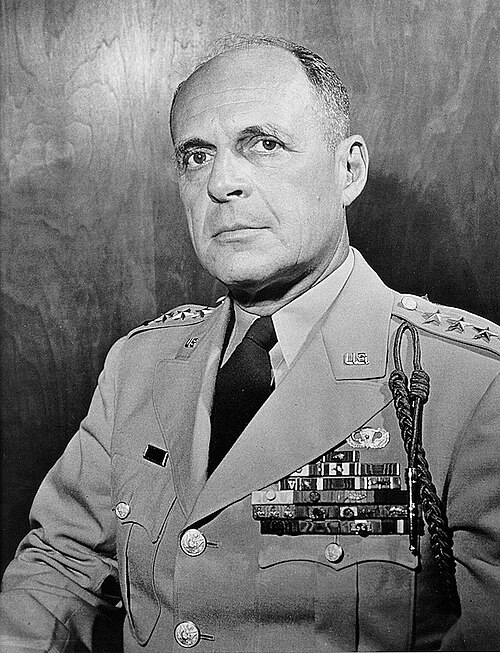
Matthew Ridgway
ModernGeneralUnited States1895 — 1993
US general who revived UN forces in the Korean War.
Compare Matthew Ridgway with another historical figure:
Quick Facts
Born
1895
Died
1993
Country
United States
Era
Modern
Occupation
General
Score Overview
Military (10%)82
Political (20%)47
Influence (20%)57
Legacy (20%)58
Leadership (15%)62
Strategy (15%)75
Total Score60.7
Matthew Ridgway — Complete Timeline
1942 AD
Appointed Commander of the 82nd Airborne DivisionOther◆ Major
Ridgway was appointed commander of the 82nd Airborne Division in August 1942, transforming it into the first American airborne division. He trained the division for parachute and glider operations, establishing airborne tactics and doctrine that would be used in World War II.
World War IIAirborneTraining
Impact: national
1943 AD
Led the 82nd Airborne in Operation HuskyOther◆ Major
Ridgway led the 82nd Airborne Division in the invasion of Sicily (Operation Husky) in July 1943. The division conducted parachute and glider landings, though the operation suffered from poor coordination and friendly fire incidents. Despite these problems, the division secured key objectives.
World War IISicilyAirborne Assault
Impact: regional
1944 AD
Commanded the 82nd Airborne in Operation OverlordOther◆ Major
Ridgway commanded the 82nd Airborne Division during the D-Day landings on June 6, 1944. Paratroopers landed behind German lines in Normandy, securing key bridges and causeways. The division suffered heavy casualties but successfully disrupted German defenses and supported the beach landings.
World War IID-DayAirborne Assault
Impact: globalconstructive
1950 AD
Appointed Commander of Eighth Army in KoreaOther◆ Major
Ridgway was appointed commander of the U.S. Eighth Army in Korea in December 1950, replacing General Walton Walker who had died. He took command during a period of retreat after Chinese intervention, and immediately began restoring morale and reorganizing defensive positions.
Korean WarCommandMorale
Impact: regional
1951 AD
Revived UN Forces in the Korean WarWar◆ Major
Ridgway launched a series of offensives in early 1951 that reversed the Chinese advance and recaptured Seoul. His aggressive tactics, including Operation Thunderbolt and Operation Ripper, pushed Chinese forces back across the 38th parallel, restoring the front line and stabilizing the war.
Korean WarOffensiveVictory
Impact: regionalconstructive
Appointed Supreme Commander of Allied Powers in JapanOther◆ Major
Ridgway was appointed Supreme Commander of Allied Powers in Japan in April 1951, replacing General Douglas MacArthur. He oversaw the occupation of Japan and the transition to the post-occupation period, including the signing of the Treaty of San Francisco in 1951.
Korean WarJapanOccupation
Impact: regional
1953 AD
Appointed Chief of Staff of the U.S. ArmyOther◆ Major
Ridgway was appointed Chief of Staff of the U.S. Army in August 1953, serving until 1955. He advocated for a strong conventional military force and opposed the Eisenhower administration's 'New Look' policy that emphasized nuclear weapons over ground forces, arguing it weakened the Army.
Post-WarMilitary PolicyLeadership
Impact: national
Detailed Scores
▶View all detailed scores
Military
Strategy
7
Tactics
7
Battles
7
Army Scale
7
War Impact
7
Political
Governance
7
Reform
7
Stability
7
Policy
8
Power
7
Influence
History
9
Global
9
Culture
9
Ideology
10
Legacy
9
People often compare with
See how Matthew Ridgway stacks up against other historical figures