Loading...
Matthew Ridgway vs Redvers Buller
Matthew Ridgway leads by 15.8 pts · 2 figures compared
…
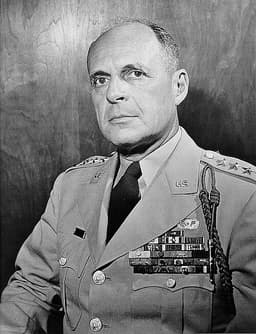
Matthew Ridgway
General · Modern
60.7Total

Redvers Buller
General · Modern
44.9Total
Basic Information
Born
1895
1839
Died
1993
1908
Era
Modern
Modern
Nationality
United States
Great Britain
Occupation
General
General
Civilization
Western
Western
Score Comparison
Military (10%)
82.0
38.3
Political (20%)
46.6
29.3
Influence (20%)
56.7
52.5
Legacy (20%)
58.0
44.2
Leadership (15%)
62.0
54.2
Strategy (15%)
75.0
43.3
TOTAL
60.7
44.9
Matthew Ridgway — Complete Timeline
1942 AD
Appointed Commander of the 82nd Airborne DivisionOther◆ Major
Ridgway was appointed commander of the 82nd Airborne Division in August 1942, transforming it into the first American airborne division. He trained the division for parachute and glider operations, establishing airborne tactics and doctrine that would be used in World War II.
World War IIAirborneTraining
Impact: national
1943 AD
Led the 82nd Airborne in Operation HuskyOther◆ Major
Ridgway led the 82nd Airborne Division in the invasion of Sicily (Operation Husky) in July 1943. The division conducted parachute and glider landings, though the operation suffered from poor coordination and friendly fire incidents. Despite these problems, the division secured key objectives.
World War IISicilyAirborne Assault
Impact: regional
1944 AD
Commanded the 82nd Airborne in Operation OverlordOther◆ Major
Ridgway commanded the 82nd Airborne Division during the D-Day landings on June 6, 1944. Paratroopers landed behind German lines in Normandy, securing key bridges and causeways. The division suffered heavy casualties but successfully disrupted German defenses and supported the beach landings.
World War IID-DayAirborne Assault
Impact: globalconstructive
1950 AD
Appointed Commander of Eighth Army in KoreaOther◆ Major
Ridgway was appointed commander of the U.S. Eighth Army in Korea in December 1950, replacing General Walton Walker who had died. He took command during a period of retreat after Chinese intervention, and immediately began restoring morale and reorganizing defensive positions.
Korean WarCommandMorale
Impact: regional
1951 AD
Revived UN Forces in the Korean WarWar◆ Major
Ridgway launched a series of offensives in early 1951 that reversed the Chinese advance and recaptured Seoul. His aggressive tactics, including Operation Thunderbolt and Operation Ripper, pushed Chinese forces back across the 38th parallel, restoring the front line and stabilizing the war.
Korean WarOffensiveVictory
Impact: regionalconstructive
Appointed Supreme Commander of Allied Powers in JapanOther◆ Major
Ridgway was appointed Supreme Commander of Allied Powers in Japan in April 1951, replacing General Douglas MacArthur. He oversaw the occupation of Japan and the transition to the post-occupation period, including the signing of the Treaty of San Francisco in 1951.
Korean WarJapanOccupation
Impact: regional
1953 AD
Appointed Chief of Staff of the U.S. ArmyOther◆ Major
Ridgway was appointed Chief of Staff of the U.S. Army in August 1953, serving until 1955. He advocated for a strong conventional military force and opposed the Eisenhower administration's 'New Look' policy that emphasized nuclear weapons over ground forces, arguing it weakened the Army.
Post-WarMilitary PolicyLeadership
Impact: national
Redvers Buller — Complete Timeline
1879 AD
Awarded the Victoria CrossOther◆ Major
Buller was awarded the Victoria Cross for his actions during the Anglo-Zulu War. He rescued two wounded soldiers under heavy fire at the Battle of Hlobane, demonstrating personal bravery.
Victoria CrossZulu WarBravery
Impact: nationalconstructive
1899 AD
Battle of ColensoWar◆ Major
Buller's forces were decisively defeated by the Boers at the Battle of Colenso. The defeat was part of 'Black Week' for the British and led to Buller's replacement as overall commander by Lord Roberts.
Boer WarDefeatBlack Week
Impact: regionaltragic
Appointed Commander-in-Chief in South AfricaPolitical Action◆ Major
Buller was appointed Commander-in-Chief of British forces in South Africa at the start of the Second Boer War. His leadership was marked by a series of defeats and failures.
Boer WarCommand
Impact: regional
1900 AD
Relief of LadysmithWar◆ Major
After several failed attempts, Buller's forces finally relieved the besieged town of Ladysmith. Despite the victory, his overall performance in the war was heavily criticized.
Boer WarSiegeRelief
Impact: regional
Expert Analysis
Origins
Matthew Ridgway was born on March 3, 1895, in Fort Monroe, Virginia, into a military family. His father, Thomas Ridgway, was a colonel in the U.S. Army. Ridgway attended the U.S. Military Academy at West Point, graduating in 1917. He served in various staff and command roles between the wars, developing expertise in logistics and planning.
Redvers Buller was born on December 7, 1839, in Crediton, Devon, England, into a wealthy landowning family. He was educated at Eton and purchased a commission in the 60th Rifles in 1858. Buller served in colonial campaigns, including the Red River Expedition (1870) and the Ashanti War (1873–1874), earning a reputation for bravery.
Rise to Power
Ridgway's rise accelerated during World War II. In August 1942, he was appointed commander of the 82nd Airborne Division, transforming it into the first American airborne division. He led the division in Operation Husky (July 1943) and Operation Overlord (June 1944), where his paratroopers secured vital objectives behind German lines. His performance earned him command of the XVIII Airborne Corps, which he led through the Battle of the Bulge and into Germany.
Buller's rise came through colonial service. He was awarded the Victoria Cross in 1879 for rescuing two wounded soldiers at the Battle of Hlobane during the Anglo-Zulu War. He later served as Adjutant-General and commanded the army corps in the Sudan. In 1899, at the outbreak of the Second Boer War, he was appointed Commander-in-Chief of British forces in South Africa, a position for which he was ill-prepared.
Leadership & Governance
Ridgway's leadership style was aggressive, hands-on, and focused on morale. In Korea, he took command of the Eighth Army in December 1950 after its previous commander died. The army was demoralized and retreating. Ridgway restored discipline by replacing ineffective officers, rotating troops, and emphasizing offensive action. He personally visited front-line units, earning respect. His strategy involved a series of offensives in early 1951 that recaptured Seoul and pushed Chinese forces back to the 38th parallel. He scored 62.0 in leadership and 75.0 in strategy.
Buller's leadership was cautious and indecisive. At Colenso (December 15, 1899), he ordered a frontal assault against entrenched Boer positions, resulting in heavy casualties and a humiliating defeat. He failed to adapt to Boer tactics of mobility and marksmanship. His attempts to relieve Ladysmith were marked by delays and miscommunication. Although he eventually succeeded in February 1900, his overall performance was poor, reflected in his leadership score of 54.2 and strategy score of 43.3.
Triumph & Tragedy
Ridgway's greatest triumph was reviving UN forces in Korea. Under his command, the Eighth Army went from retreat to offensive, retaking Seoul in March 1951. His success stabilized the front and set the stage for armistice negotiations. However, his later role as Supreme Allied Commander in Europe (1952–1953) was less notable; he struggled with NATO politics and was overshadowed by Eisenhower. He also faced criticism for failing to anticipate the Chinese intervention in the first place.
Buller's triumph was the eventual relief of Ladysmith on February 28, 1900. After three failed attempts, his forces broke through Boer lines, ending the 118-day siege. However, his tragedy was the series of defeats during 'Black Week' (December 10–17, 1899), including Colenso, which exposed British military incompetence. His failure to achieve a quick victory led to his replacement by Lord Roberts in January 1900.
Character & Destiny
Ridgway was known for his determination, physical toughness, and tactical acumen. He demanded high standards and led from the front. His character shaped his fate: his aggressive style revived a broken army but also led to high casualties. Historians praise his leadership in Korea, with some ranking him among America's top generals. His political score of 46.6 reflects his limited influence in Washington.
Buller was personally brave but lacked strategic vision. He was a poor communicator and often ignored intelligence. His character—stubborn and overly cautious—doomed him. After the Boer War, he was heavily criticized and effectively retired. His legacy was tarnished despite his earlier heroism.
Legacy
Ridgway's legacy is that of a general who saved the UN cause in Korea. His emphasis on morale and offensive operations influenced U.S. Army doctrine. He is remembered as a competent commander, though not in the top tier. His military score of 82.0 reflects his success in combat. His legacy score of 58.0 indicates moderate lasting impact.
Buller's legacy is largely negative. He is remembered as a symbol of British military failure in the Boer War. The term 'Bullerism' became synonymous with incompetence. However, his Victoria Cross and earlier service are still noted. His military score of 38.3 and legacy score of 44.2 reflect his poor performance.
Conclusion
Matthew Ridgway had a greater impact than Redvers Buller. Ridgway's military score of 82.0 far exceeds Buller's 38.3, and his leadership and strategy scores are higher. While both faced difficult circumstances, Ridgway succeeded in reviving a demoralized army and achieving strategic objectives, whereas Buller failed in his primary mission. Ridgway's influence on modern military leadership is more enduring. Buller's failures serve as a cautionary tale, but his overall contribution is overshadowed by his defeats. The data supports Ridgway as the superior commander.
Rankings
🥇
Matthew RidgwayLeader
Mil: 82.0Pol: 46.6Inf: 56.7
60.7
🥈
Redvers Buller
Mil: 38.3Pol: 29.3Inf: 52.5
44.9
+15.8 behind
How This Comparison Works
Algorithm
Each figure is scored on 6 dimensions (0—100 scale) based on structured historical data: Military (10%), Political (20%), Influence (20%), Legacy (20%), Leadership (15%), Strategy (15%). The weighted total produces the final ranking.
Data Sources
Scores are computed from structured sub-indicators in the database. Scale factors adjust for era (Ancient ×0.85, Modern ×1.0) and civilization size (Eastern ×1.05, Other ×0.80) to account for differences in population and military scale.
Maximum 3 Figures
Comparisons are limited to 2—3 figures to ensure readability and statistical meaningfulness.
Error Margins
±5 points per dimension — Sub-scores are derived from historical records with inherent uncertainty. Two figures within 5 points on a dimension should be considered roughly equivalent in that area.
Total Score Accuracy
±3 points overall — The weighted combination of 6 dimensions produces a total score with approximately ±3 points of uncertainty. Differences of less than 3 points are not statistically significant— the figures are effectively tied.
Known Limitations
- Historical records are incomplete and uneven across civilizations
- Figures from oral-tradition societies may be underrepresented
- Occupation labels can misclassify multi-role figures
- Scores measure capability and impact, not moral character
- Quantitative scoring is a comparison tool, not absolute truth
Capability Radar
Military (10%) — Battles & Warfare
Battles
75
45
Win Rate
80
30
Expansion
60
15
Political (20%) — Governance & Reform
Reform
30
10
Diplomacy
50
20
Economy
20
10
Influence (20%) — Cultural & Global Reach
Cultural
40
20
Global
55
25
Legacy (20%) — Historical Impact
Historical
65
35
Longevity
50
20
Leadership (15%) — Power & Stability
Tenure
40
40
Stability
45
15
Strategy (15%) — Tactics & Innovation
Strategy
90
25
Tactics
85
35
Reform
70
20
Similar Comparisons
Comments & Discussion
No comments yet. Be the first to share your thoughts!