Loading...
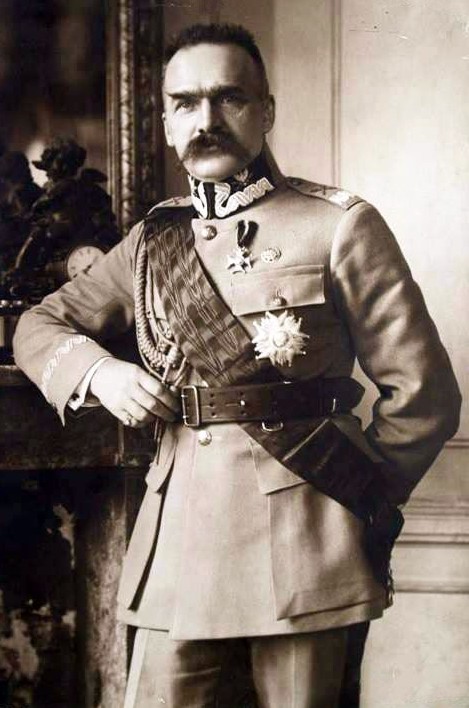
Jozef Pilsudski
ModernGeneralPoland1867 — 1935
Polish leader who restored independence after WWI.
Compare Jozef Pilsudski with another historical figure:
Quick Facts
Born
1867
Died
1935
Country
Poland
Era
Modern
Occupation
General
Score Overview
Military (10%)62
Political (20%)72
Influence (20%)72
Legacy (20%)55
Leadership (15%)68
Strategy (15%)68
Total Score65.7
Jozef Pilsudski — Complete Timeline
1914 AD
Founded the Polish LegionsOther◆ Major
At the outbreak of World War I, Pilsudski formed the Polish Legions, volunteer military units fighting alongside Austria-Hungary against Russia. The Legions aimed to create a core for a future Polish army and advance the cause of Polish independence from partitioning powers.
Polish IndependenceWorld War IMilitary Formation
Impact: national
1918 AD
Proclaimed Independence of PolandOther◆ Major
On November 11, 1918, Pilsudski was released from German internment and returned to Warsaw. He assumed command of Polish forces and proclaimed the independence of the Second Polish Republic, becoming the nation's first Chief of State after 123 years of partition.
Polish IndependenceStatehoodNational Founding
Impact: nationalconstructive
1920 AD
Led the Battle of Warsaw (Miracle on the Vistula)War◆ Major
During the Polish-Soviet War, Pilsudski personally planned and commanded the counteroffensive at the Battle of Warsaw in August 1920. Polish forces repelled the advancing Red Army, securing Polish independence and halting the spread of Bolshevism into Central Europe.
Polish-Soviet WarMilitary VictoryNational Survival
Impact: regionalconstructive
1926 AD
Executed the May Coup d'ÉtatPolitical Action◆ Major
In May 1926, Pilsudski led a military coup against the Polish government, marching loyal troops into Warsaw. After three days of fighting, President Wojciechowski resigned and Pilsudski assumed de facto dictatorial power, establishing the Sanacja regime that ruled Poland until 1939.
Coup d'ÉtatAuthoritarianismPolish Politics
Impact: nationaldestructive
1932 AD
Signed the Polish-Soviet Non-Aggression PactOther◆ Major
Pilsudski's government signed a non-aggression pact with the Soviet Union on July 25, 1932. The treaty normalized relations between the two countries for ten years, though it was later broken by the Soviet invasion of Poland in 1939.
DiplomacySoviet-Polish RelationsTreaty
Impact: regional
Detailed Scores
▶View all detailed scores
Military
Strategy
7
Tactics
7
Battles
7
Army Scale
7
War Impact
7
Political
Governance
7
Reform
7
Stability
7
Policy
8
Power
7
Influence
History
9
Global
8
Culture
9
Ideology
9
Legacy
9
People often compare with
See how Jozef Pilsudski stacks up against other historical figures
Popular Comparisons
Jozef Pilsudski vs Hugh Dowding
vs Hugh Dowding73
Jozef Pilsudski vs Napoleon Bonaparte
vs Napoleon Bonaparte71
Jozef Pilsudski vs Douglas Haig
vs Douglas Haig58
Jozef Pilsudski vs Michel Ney
vs Michel Ney55
Jozef Pilsudski vs Floriano Peixoto
vs Floriano Peixoto50
Jozef Pilsudski vs Mohammad Fahim
vs Mohammad Fahim50