Loading...
Jozef Pilsudski vs Napoleon Bonaparte
Napoleon Bonaparte leads by 5.2 pts · 2 figures compared
…
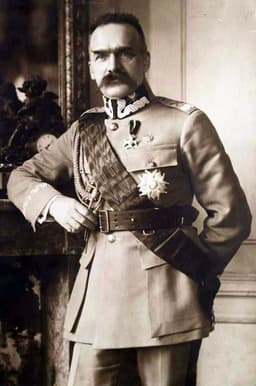
Jozef Pilsudski
General · Modern
65.7Total

Napoleon Bonaparte
General · Modern
70.9Total
Basic Information
Born
1867
1769
Died
1935
1821
Era
Modern
Modern
Nationality
Poland
France
Occupation
General
General
Civilization
Western
Western
Score Comparison
Military (10%)
61.7
94.0
Political (20%)
72.0
72.0
Influence (20%)
72.0
40.0
Legacy (20%)
55.0
80.0
Leadership (15%)
68.0
78.0
Strategy (15%)
68.0
90.0
TOTAL
65.7
70.9
Jozef Pilsudski — Complete Timeline
1914 AD
Founded the Polish LegionsOther◆ Major
At the outbreak of World War I, Pilsudski formed the Polish Legions, volunteer military units fighting alongside Austria-Hungary against Russia. The Legions aimed to create a core for a future Polish army and advance the cause of Polish independence from partitioning powers.
Polish IndependenceWorld War IMilitary Formation
Impact: national
1918 AD
Proclaimed Independence of PolandOther◆ Major
On November 11, 1918, Pilsudski was released from German internment and returned to Warsaw. He assumed command of Polish forces and proclaimed the independence of the Second Polish Republic, becoming the nation's first Chief of State after 123 years of partition.
Polish IndependenceStatehoodNational Founding
Impact: nationalconstructive
1920 AD
Led the Battle of Warsaw (Miracle on the Vistula)War◆ Major
During the Polish-Soviet War, Pilsudski personally planned and commanded the counteroffensive at the Battle of Warsaw in August 1920. Polish forces repelled the advancing Red Army, securing Polish independence and halting the spread of Bolshevism into Central Europe.
Polish-Soviet WarMilitary VictoryNational Survival
Impact: regionalconstructive
1926 AD
Executed the May Coup d'ÉtatPolitical Action◆ Major
In May 1926, Pilsudski led a military coup against the Polish government, marching loyal troops into Warsaw. After three days of fighting, President Wojciechowski resigned and Pilsudski assumed de facto dictatorial power, establishing the Sanacja regime that ruled Poland until 1939.
Coup d'ÉtatAuthoritarianismPolish Politics
Impact: nationaldestructive
1932 AD
Signed the Polish-Soviet Non-Aggression PactOther◆ Major
Pilsudski's government signed a non-aggression pact with the Soviet Union on July 25, 1932. The treaty normalized relations between the two countries for ten years, though it was later broken by the Soviet invasion of Poland in 1939.
DiplomacySoviet-Polish RelationsTreaty
Impact: regional
Napoleon Bonaparte — Complete Timeline
1799 AD
Coup of 18 BrumaireOther◆ Major
Napoleon Bonaparte, with support from his brother Lucien and key political figures, overthrew the Directory in a bloodless coup. He established the Consulate with himself as First Consul, effectively becoming the ruler of France. This event ended the French Revolution's most unstable period.
French RevolutionCoupRise to Power
Impact: regional
1804 AD
Promulgation of the Napoleonic CodeOther◆ Major
Napoleon enacted the Civil Code of the French, known as the Napoleonic Code, a comprehensive set of laws that replaced the fragmented feudal legal systems. The code established legal equality, protected property rights, and secularized law. It became the basis for legal systems in many European and world countries.
Legal ReformNapoleonic CodeCivil Law
Impact: globalconstructive
1805 AD
Battle of AusterlitzWar◆ Major
Napoleon's Grande Arm
Napoleonic WarsBattleDecisive Victory
Impact: global
1812 AD
Invasion of RussiaWar◆ Major
Napoleon led the Grande Arm
Napoleonic WarsInvasionDisaster
Impact: globaldestructive
1815 AD
Battle of WaterlooWar◆ Major
Napoleon's French army was defeated by the combined forces of the Duke of Wellington's Anglo-Allied army and Gebhard Leberecht von Bl
Napoleonic WarsBattleFinal Defeat
Impact: globaldestructive
Expert Analysis
jozef-pilsudski-vs-napoleon-bonaparte
# The Eagle and the Scepter: Two Paths to Power in Modern Europe
On a gray December morning in 1805, Napoleon Bonaparte stood in the frozen mud of Austerlitz, watching his Grande Armée crush the combined forces of Austria and Russia. Twenty-three years later, in a Warsaw prison cell, a young revolutionary named Józef Piłsudski scratched political manifestos onto scraps of paper, dreaming not of conquering Europe but of resurrecting a nation that had been erased from the map. Both men would reshape history—one through empire, the other through resurrection. But why did their journeys diverge so dramatically, and what drove one to a lonely Atlantic island and the other to the helm of a reborn state?
Origins
Napoleon was born in 1769 on Corsica, an island that had just passed from Italian to French control. His family belonged to the minor nobility, but they were poor, and young Napoleone Buonaparte grew up speaking Italian with a Corsican accent that would mark him as an outsider in French society. The French Revolution of 1789 shattered the old order and opened paths that birth alone could no longer block. For a brilliant, ambitious young artillery officer, it was a door to the world.
Piłsudski entered the world in 1867 on a different kind of frontier—the Russian partition of Poland, where Polish language and culture were systematically suppressed. His father had fought in the failed January Uprising of 1863, and the family estate was a quiet monument to defeat. Where Napoleon grew up in the chaos of revolution, Piłsudski grew up in the stillness of occupation. The question for him was not how to rise within an empire, but how to destroy the empires that had swallowed his homeland.
Rise to Power
Napoleon’s ascent was meteoric and unmistakably military. At 24, he captured Toulon from British forces. At 26, he put down a royalist revolt in Paris with a "whiff of grapeshot." By 30, he was First Consul of France. His Italian campaign of 1796-1797 was a masterpiece of speed and deception—he defeated larger Austrian armies not by overwhelming force but by moving faster than his enemies could think. Each victory fed the next, and by 1804 he crowned himself Emperor of the French.
Piłsudski’s path was slower and more shadowy. He began as a socialist revolutionary, printing underground newspapers and organizing strikes. In 1900, he was arrested and imprisoned in the Warsaw Citadel, where he feigned madness to avoid execution. After escaping, he turned to armed struggle, forming paramilitary units that fought alongside Austria-Hungary against Russia during World War I. His great gamble came in November 1918, when Germany’s collapse left Poland in a power vacuum. Piłsudski returned to Warsaw, declared independence, and was named head of state—not through conquest, but through sheer force of will and timing.
Leadership & Governance
Napoleon ruled as a military genius who happened to govern. His Napoleonic Code standardized French law, abolished feudal privileges, and established merit-based advancement. He built roads, founded banks, and reformed education. But his political wisdom was always subordinate to his strategic ambition. "I grew up on the field of battle," he once said, "and a man such as I cares little for the lives of a million men." His governance was brilliant but brittle—it depended entirely on his presence.
Piłsudski governed as a political pragmatist who happened to be a general. His military score of 65.2 reflects competence rather than genius, but his political score of 80.0 reveals a deeper talent. He understood that Poland’s survival required alliances, not conquest. In 1920, during the Miracle on the Vistula, he personally devised the counteroffensive that stopped the Soviet Red Army at the gates of Warsaw—saving not just Poland but potentially all of Europe from Bolshevik expansion. Yet afterward, he stepped back from power, only to return in 1926 in a coup d'état. His authoritarian rule was milder than many contemporaries—he banned no parties and executed no rivals—but it was still a betrayal of the democracy he had helped create.
Triumph & Tragedy
Napoleon’s greatest moment was Austerlitz in December 1805, where he destroyed a larger coalition army with a trap so perfect it is still studied in military academies. His greatest failure was the 1812 invasion of Russia, where he lost over 400,000 men not to battle but to the Russian winter and his own refusal to retreat. Exiled to Elba, he escaped, returned to France for a hundred days, and was finally crushed at Waterloo in 1815. He died six years later on Saint Helena, a prisoner of the British.
Piłsudski’s triumph was the Battle of Warsaw in August 1920, when he was 53 years old and his nation was barely two years old. His tragedy came later: his 1926 coup and the authoritarianism that followed, which weakened the democratic institutions he had fought to create. He died in 1935 at his desk, still working, still commanding. Within four years, Poland would be invaded by both Nazi Germany and the Soviet Union—the twin threats he had spent his life trying to forestall.
Character & Destiny
Napoleon was driven by an insatiable hunger for glory. "Impossible is a word to be found only in the dictionary of fools," he declared. His confidence was absolute, his energy inexhaustible, his ambition boundless. But that same ambition blinded him to limits—he could not stop conquering, could not consolidate, could not rest. His personality was a force of nature that ultimately consumed itself.
Piłsudski was driven by a different fire: the resurrection of Poland. "To be defeated and not submit, that is victory," he wrote. Where Napoleon sought to remake the world in his image, Piłsudski sought only to restore what had been taken. His temperament was melancholic, his health fragile, his methods often cynical. But his vision was clear and limited—he knew what he wanted, and he knew when to stop. That restraint, born of defeat and exile, was the quality Napoleon never learned.
Legacy
Napoleon’s legacy is written in law codes, national borders, and military doctrine. He reshaped Europe so profoundly that the 19th century is sometimes called the Age of Napoleon. His influence score of 82.0 reflects a man who changed how wars are fought, how states are organized, and how ambition is imagined. But his legacy is also a warning: the conqueror who built an empire that crumbled within a generation.
Piłsudski’s legacy is narrower but more intimate. His legacy score of 55.0 is modest by comparison, but that number fails to capture what he meant to Poland. He is remembered not as a world-historical figure but as the father of his country—the man who, against all odds, brought Poland back to life. His statue stands in Warsaw’s Piłsudski Square, where the Unknown Soldier’s tomb reminds visitors that nations, like men, are mortal.
Conclusion
Napoleon and Piłsudski both rose from the margins of Europe to seize history by the throat. One conquered an empire; the other resurrected a nation. Their scores—Napoleon’s total of 82.4 against Piłsudski’s 71.0—suggest a clear hierarchy, but numbers flatten the texture of lives. Napoleon’s ambition was a fire that burned across continents; Piłsudski’s was a candle that lit one room. Perhaps the deeper question is not who was greater, but what greatness means. For a Corsican artillery officer who became emperor, greatness meant reshaping the world. For a Polish revolutionary who became head of state, greatness meant restoring what the world had destroyed. Both succeeded. Both failed. And in the end, history judges not by the size of the stage but by the depth of the mark.
Rankings
🥇
Napoleon BonaparteLeader
Mil: 94.0Pol: 72.0Inf: 40.0
70.9
🥈
Jozef Pilsudski
Mil: 61.7Pol: 72.0Inf: 72.0
65.7
+5.2 behind
How This Comparison Works
Algorithm
Each figure is scored on 6 dimensions (0—100 scale) based on structured historical data: Military (10%), Political (20%), Influence (20%), Legacy (20%), Leadership (15%), Strategy (15%). The weighted total produces the final ranking.
Data Sources
Scores are computed from structured sub-indicators in the database. Scale factors adjust for era (Ancient ×0.85, Modern ×1.0) and civilization size (Eastern ×1.05, Other ×0.80) to account for differences in population and military scale.
Maximum 3 Figures
Comparisons are limited to 2—3 figures to ensure readability and statistical meaningfulness.
Error Margins
±5 points per dimension — Sub-scores are derived from historical records with inherent uncertainty. Two figures within 5 points on a dimension should be considered roughly equivalent in that area.
Total Score Accuracy
±3 points overall — The weighted combination of 6 dimensions produces a total score with approximately ±3 points of uncertainty. Differences of less than 3 points are not statistically significant— the figures are effectively tied.
Known Limitations
- Historical records are incomplete and uneven across civilizations
- Figures from oral-tradition societies may be underrepresented
- Occupation labels can misclassify multi-role figures
- Scores measure capability and impact, not moral character
- Quantitative scoring is a comparison tool, not absolute truth
Capability Radar
Military (10%) — Battles & Warfare
Battles
70
95
Win Rate
65
90
Expansion
60
95
Political (20%) — Governance & Reform
Reform
75
95
Diplomacy
80
80
Economy
55
85
Influence (20%) — Cultural & Global Reach
Cultural
65
85
Global
60
90
Legacy (20%) — Historical Impact
Historical
75
95
Longevity
60
90
Leadership (15%) — Power & Stability
Tenure
70
85
Stability
50
70
Strategy (15%) — Tactics & Innovation
Strategy
80
95
Tactics
75
98
Reform
85
92
Similar Comparisons
Comments & Discussion
NapoleonWarlord6/17/2026
Napoleon's Grande Armée at Austerlitz was a masterpiece of logistics and tactics, but Piłsudski's 1920 Miracle on the Vistula shows you don't need to conquer half of Europe to be a strategic genius. Napoleon winning battles only to lose the war, while Piłsudski, with a ragtag army, outmaneuvered the Red Army and secured Poland's independence. That's real impact, not just chasing eagles.
历史真相帝6/17/2026
拿破仑吹嘘自己解放了波兰,但实际上他只是利用波兰人当炮灰,建立华沙公国作为法国附庸。皮尔苏茨基才是真英雄,他领导波兰军队在1920年华沙战役中击退苏俄,这是欧洲历史转折点。拿破仑的帝国在滑铁卢崩溃,而皮尔苏茨基的波兰屹立了二十年。谁更厉害?用脚趾头想都知道。
DataSkepticSteve6/17/2026
Napoleon controlled over 70 million subjects at his peak, but Piłsudski's Poland had 27 million and a GDP per capita lower than France's before WWI. Yet, Piłsudski's state lasted 20 years; Napoleon's empire crumbled in 11. Happiness metric? Piłsudski's Poland had a democratically elected parliament, while Napoleon's was a dictatorship with plebiscites. Quality over quantity, folks.
古典学爱好者6/17/2026
拿破仑就像是法国版的凯撒,跨过卢比孔河成就大业,但最终被独裁欲望吞噬。皮尔苏茨基则更像雅典的地米斯托克利,在萨拉米斯海战中以弱胜强,拯救城邦。拿破仑的悲剧在于他无法放下皇冠,而皮尔苏茨基在1922年主动卸任,回归平民生活。这对比太鲜明了:一个为权力而生,一个为国家而死。
RevisionistCritic6/17/2026
Everyone praises Piłsudski for rebirthing Poland, but he ran a semi-authoritarian regime after the 1926 coup, imprisoning opponents at Bereza Kartuska. Napoleon at least gave France the Napoleonic Code, centralizing laws that Piłsudski's Poland couldn't even finalize until 1932. So, who's the real progressive? The Corsican who codified equality and the Polish marshal who suspended parliament. Uncomfortable truths.