Loading...
Jozef Pilsudski vs Michel Ney
Jozef Pilsudski leads by 10.8 pts · 2 figures compared
…
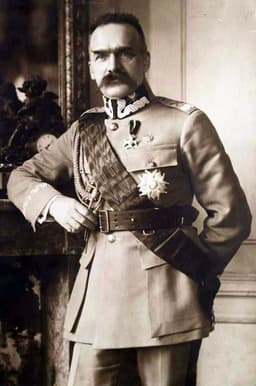
Jozef Pilsudski
General · Modern
65.7Total

Michel Ney
General · Modern
54.9Total
Basic Information
Born
1867
1769
Died
1935
1815
Era
Modern
Modern
Nationality
Poland
France
Occupation
General
General
Civilization
Western
Western
Score Comparison
Military (10%)
61.7
74.7
Political (20%)
72.0
35.1
Influence (20%)
72.0
58.3
Legacy (20%)
55.0
58.0
Leadership (15%)
68.0
54.2
Strategy (15%)
68.0
50.0
TOTAL
65.7
54.9
Jozef Pilsudski — Complete Timeline
1914 AD
Founded the Polish LegionsOther◆ Major
At the outbreak of World War I, Pilsudski formed the Polish Legions, volunteer military units fighting alongside Austria-Hungary against Russia. The Legions aimed to create a core for a future Polish army and advance the cause of Polish independence from partitioning powers.
Polish IndependenceWorld War IMilitary Formation
Impact: national
1918 AD
Proclaimed Independence of PolandOther◆ Major
On November 11, 1918, Pilsudski was released from German internment and returned to Warsaw. He assumed command of Polish forces and proclaimed the independence of the Second Polish Republic, becoming the nation's first Chief of State after 123 years of partition.
Polish IndependenceStatehoodNational Founding
Impact: nationalconstructive
1920 AD
Led the Battle of Warsaw (Miracle on the Vistula)War◆ Major
During the Polish-Soviet War, Pilsudski personally planned and commanded the counteroffensive at the Battle of Warsaw in August 1920. Polish forces repelled the advancing Red Army, securing Polish independence and halting the spread of Bolshevism into Central Europe.
Polish-Soviet WarMilitary VictoryNational Survival
Impact: regionalconstructive
1926 AD
Executed the May Coup d'ÉtatPolitical Action◆ Major
In May 1926, Pilsudski led a military coup against the Polish government, marching loyal troops into Warsaw. After three days of fighting, President Wojciechowski resigned and Pilsudski assumed de facto dictatorial power, establishing the Sanacja regime that ruled Poland until 1939.
Coup d'ÉtatAuthoritarianismPolish Politics
Impact: nationaldestructive
1932 AD
Signed the Polish-Soviet Non-Aggression PactOther◆ Major
Pilsudski's government signed a non-aggression pact with the Soviet Union on July 25, 1932. The treaty normalized relations between the two countries for ten years, though it was later broken by the Soviet invasion of Poland in 1939.
DiplomacySoviet-Polish RelationsTreaty
Impact: regional
Michel Ney — Complete Timeline
1805 AD
Battle of ElchingenWar◆ Major
Ney's corps stormed the abbey of Elchingen, capturing the Austrian bridgehead. This action trapped General Mack's army in Ulm, leading to the surrender of 30,000 Austrians. Ney was later made Duke of Elchingen for this victory.
Napoleonic WarsBattleUlm Campaign
Impact: regional
1812 AD
Battle of BorodinoWar◆ Major
Ney commanded the III Corps in the center, leading repeated assaults on the Russian fortifications. He was wounded but refused to leave the field. His corps suffered 50% casualties, but he held the line. This battle was the bloodiest of the Napoleonic Wars.
Napoleonic WarsBattleRussian Campaign
Impact: regional
Commanded the rearguard during the retreat from RussiaWar◆ Major
Ney commanded the rearguard of the Grande Arm
Napoleonic WarsRetreatHeroism
Impact: regional
1815 AD
Battle of WaterlooWar
Ney commanded the left wing of the French army at Waterloo. He led the cavalry charges against the British squares, losing thousands of men. His failure to capture Hougoumont and his premature cavalry attacks contributed to Napoleon's defeat. This was his final battle.
Napoleonic WarsBattleDefeat
Impact: global
Arrested and executed for treasonPolitical Action◆ Major
After Waterloo, Ney was arrested by the Bourbon government and tried for treason for joining Napoleon during the Hundred Days. He was convicted by the Chamber of Peers and executed by firing squad in the Luxembourg Garden. His execution made him a martyr for Bonapartists.
ExecutionTreasonHundred Days
Impact: nationaltragic
Expert Analysis
Origins
Jozef Pilsudski was born on December 5, 1867, in Zulow, then part of the Russian Empire, into a Polish noble family with patriotic traditions. His father, a participant in the January Uprising, instilled a deep sense of national duty. Educated in Vilnius, Pilsudski was arrested in 1887 for involvement in a plot to assassinate Tsar Alexander III, leading to five years of exile in Siberia. This formative experience radicalized him, shaping his lifelong commitment to Polish independence.
Michel Ney was born on January 10, 1769, in Saarlouis, then part of France, to a cooper father. He joined the French Army in 1787, rising through the ranks during the Revolutionary Wars. Ney had minimal formal education but gained practical military experience, earning a reputation for bravery. By 1796, he was a general, thanks to his battlefield prowess and loyalty to the revolutionary cause.
Rise to Power
Pilsudski's rise began with the founding of the Polish Socialist Party in 1893, where he advocated for independence. He led armed resistance in the 1905 Russian Revolution and, during World War I, formed the Polish Legions (1914) to fight alongside Austria-Hungary against Russia. His release from German internment on November 11, 1918, allowed him to proclaim Poland's independence and assume leadership as Chief of State.
Ney's rise was meteoric during the Napoleonic Wars. He distinguished himself at the Battle of Elchingen (1805), capturing the abbey and trapping the Austrian army at Ulm. Napoleon made him a Marshal of the Empire in 1804. His command at Borodino (1812) earned him the title "Bravest of the Brave," and he led the rearguard during the disastrous retreat from Russia, preserving what remained of the Grande Armée.
Leadership & Governance
Pilsudski's leadership style was autocratic yet pragmatic. As Chief of State, he centralized power, suppressed political opposition, and in 1926, executed the May Coup d'État to overthrow the government, establishing a regime known as the Sanacja. He prioritized national defense and signed the Polish-Soviet Non-Aggression Pact (1932) to stabilize relations. His governance scored 72.0 in political acumen, contrasting with Ney's 35.1.
Ney was a battlefield commander, not a politician. He led by example, inspiring troops through personal courage, but lacked strategic foresight. At Waterloo, he launched ill-timed cavalry charges against British squares, resulting in heavy losses. His leadership score of 54.2 reflects his tactical bravery but poor decision-making at critical moments.
Triumph & Tragedy
Pilsudski's greatest triumph was the Battle of Warsaw (1920), where his strategic plan—a counteroffensive from the south—crushed the Soviet forces, saving Poland from communist conquest. This "Miracle on the Vistula" earned him a military score of 61.7. His tragedy was the May Coup, which undermined Polish democracy and set a precedent for authoritarian rule, tarnishing his legacy.
Ney's triumph was his rearguard action during the retreat from Russia (1812), where he fought off pursuing Cossacks and kept his men together, earning Napoleon's admiration. His tragedy was Waterloo: his failure to capture Hougoumont and the cavalry charges contributed to defeat. After Napoleon's fall, Ney was arrested and executed by firing squad on December 7, 1815, for treason.
Character & Destiny
Pilsudski was determined, secretive, and charismatic. His exile in Siberia hardened his resolve, and he often worked through conspiracies and military force. His character drove him to restore Polish independence, but also to seize power, leading to a mixed legacy.
Ney was impulsive, loyal to Napoleon, and fearless. His courage made him a legendary figure, but his lack of political sense and strategic judgment led to his downfall. He could not adapt to the changing political landscape after Napoleon's abdication.
Legacy
Pilsudski's legacy is the independent Polish state, which he resurrected after 123 years of partition. He shaped Poland's borders and institutions, and his Sanacja regime influenced interwar politics. However, his authoritarian turn is criticized. His influence score of 72.0 reflects his impact on Polish national identity.
Ney's legacy is that of a heroic but tragic soldier. His name is etched on the Arc de Triomphe, and he is remembered as "the Bravest of the Brave." Yet his military failures at Waterloo are equally noted. His legacy score of 58.0 is lower than Pilsudski's 55.0, partly because his impact was limited to the Napoleonic era.
Conclusion
Pilsudski had greater overall impact. With a total score of 65.7 vs. Ney's 54.9, Pilsudski's achievements in state-building and national liberation outweigh Ney's battlefield valor. Pilsudski created a nation that endured, while Ney's heroism served a failing empire. History judges founders more generously than followers.
Rankings
🥇
Jozef PilsudskiLeader
Mil: 61.7Pol: 72.0Inf: 72.0
65.7
🥈
Michel Ney
Mil: 74.7Pol: 35.1Inf: 58.3
54.9
+10.8 behind
How This Comparison Works
Algorithm
Each figure is scored on 6 dimensions (0—100 scale) based on structured historical data: Military (10%), Political (20%), Influence (20%), Legacy (20%), Leadership (15%), Strategy (15%). The weighted total produces the final ranking.
Data Sources
Scores are computed from structured sub-indicators in the database. Scale factors adjust for era (Ancient ×0.85, Modern ×1.0) and civilization size (Eastern ×1.05, Other ×0.80) to account for differences in population and military scale.
Maximum 3 Figures
Comparisons are limited to 2—3 figures to ensure readability and statistical meaningfulness.
Error Margins
±5 points per dimension — Sub-scores are derived from historical records with inherent uncertainty. Two figures within 5 points on a dimension should be considered roughly equivalent in that area.
Total Score Accuracy
±3 points overall — The weighted combination of 6 dimensions produces a total score with approximately ±3 points of uncertainty. Differences of less than 3 points are not statistically significant— the figures are effectively tied.
Known Limitations
- Historical records are incomplete and uneven across civilizations
- Figures from oral-tradition societies may be underrepresented
- Occupation labels can misclassify multi-role figures
- Scores measure capability and impact, not moral character
- Quantitative scoring is a comparison tool, not absolute truth
Capability Radar
Military (10%) — Battles & Warfare
Battles
70
75
Win Rate
65
65
Expansion
60
70
Political (20%) — Governance & Reform
Reform
75
20
Diplomacy
80
30
Economy
55
10
Influence (20%) — Cultural & Global Reach
Cultural
65
55
Global
60
55
Legacy (20%) — Historical Impact
Historical
75
65
Longevity
60
50
Leadership (15%) — Power & Stability
Tenure
70
40
Stability
50
15
Strategy (15%) — Tactics & Innovation
Strategy
80
60
Tactics
75
80
Reform
85
30
Similar Comparisons
Comments & Discussion
No comments yet. Be the first to share your thoughts!