Loading...
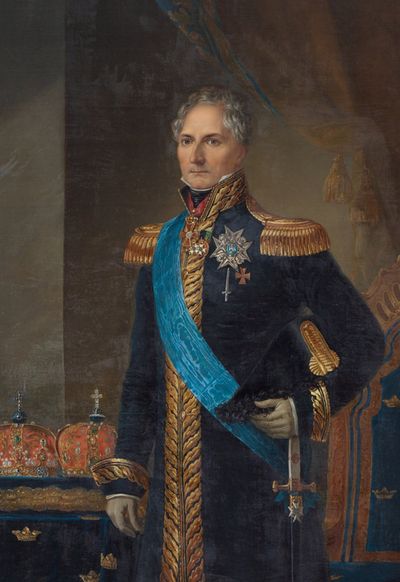
Jean-Baptiste Bernadotte
ModernGeneralFrance1763 — 1844
Marshal who became king of Sweden as Charles XIV John.
Compare Jean-Baptiste Bernadotte with another historical figure:
Quick Facts
Born
1763
Died
1844
Country
France
Era
Modern
Occupation
General
Score Overview
Military (10%)68
Political (20%)63
Influence (20%)55
Legacy (20%)52
Leadership (15%)80
Strategy (15%)61
Total Score61.0
Jean-Baptiste Bernadotte — Complete Timeline
1805 AD
Battle of AusterlitzWar◆ Major
Bernadotte commanded the I Corps at Austerlitz. His corps held the Allied left flank and participated in the encirclement of the Russian and Austrian forces, contributing to the French victory.
Napoleonic WarsBattleCorps Command
Impact: global
1809 AD
Battle of WagramWar◆ Major
Bernadotte commanded the Saxon IX Corps at Wagram. His corps was routed by Austrian forces, and he was criticized by Napoleon for his performance, leading to his dismissal from the Grande Arm
Napoleonic WarsBattleDefeatDismissal
Impact: regional
1810 AD
Elected Crown Prince of SwedenPolitical Action
The Swedish Riksdag elected Bernadotte as Crown Prince, due to his popularity and perceived ability to secure Norway. He converted to Lutheranism and was adopted by King Charles XIII, becoming heir to the throne.
SwedenSuccessionNapoleonic Era
Impact: nationalconstructive
1813 AD
Battle of LeipzigWar◆ Major
Bernadotte, now Crown Prince of Sweden, commanded the Swedish contingent and the Army of the North in the Allied coalition. His forces fought against Napoleon at Leipzig, contributing to the French defeat.
Napoleonic WarsBattleAllied Coalition
Impact: global
1814 AD
Treaty of KielPolitical Action◆ Major
Bernadotte negotiated the Treaty of Kiel with Denmark, which ceded Norway to Sweden. This fulfilled a key Swedish war aim and established the union between Sweden and Norway.
TreatySwedenNorwayDiplomacy
Impact: regionalconstructive
1818 AD
Reign as King of Sweden and NorwayReform◆ Major
As king, Bernadotte pursued a policy of neutrality and internal development. He improved infrastructure, reformed the legal system, and maintained peace, but faced opposition from liberal factions.
ReignReformsNeutrality
Impact: nationalconstructive
Accession as King Charles XIV JohnPolitical Action
Bernadotte ascended the Swedish throne as King Charles XIV John upon the death of Charles XIII. He founded the House of Bernadotte, which continues to reign in Sweden.
MonarchySwedenBernadotte Dynasty
Impact: nationalconstructive
Detailed Scores
▶View all detailed scores
Military
Strategy
7
Tactics
7
Battles
7
Army Scale
7
War Impact
7
Political
Governance
7
Reform
7
Stability
7
Policy
8
Power
8
Influence
History
9
Global
8
Culture
9
Ideology
9
Legacy
9
People often compare with
See how Jean-Baptiste Bernadotte stacks up against other historical figures
Popular Comparisons
Jean-Baptiste Bernadotte vs Napoleon Bonaparte
vs Napoleon Bonaparte71
Jean-Baptiste Bernadotte vs Yitzhak Rabin
vs Yitzhak Rabin66
Jean-Baptiste Bernadotte vs Gonzalo Jimenez de Quesada
vs Gonzalo Jimenez de Quesada59
Jean-Baptiste Bernadotte vs Hari Singh Nalwa
vs Hari Singh Nalwa58
Jean-Baptiste Bernadotte vs Alfred von Waldersee
vs Alfred von Waldersee48
Jean-Baptiste Bernadotte vs Julius Caesar
vs Julius Caesar83