Loading...
Jean-Baptiste Bernadotte vs Napoleon Bonaparte
Napoleon Bonaparte leads by 9.9 pts · 2 figures compared
…
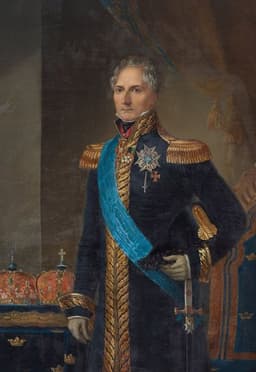
Jean-Baptiste Bernadotte
General · Modern
61.0Total

Napoleon Bonaparte
General · Modern
70.9Total
Basic Information
Born
1763
1769
Died
1844
1821
Era
Modern
Modern
Nationality
France
France
Occupation
General
General
Civilization
Western
Western
Score Comparison
Military (10%)
67.5
94.0
Political (20%)
62.7
72.0
Influence (20%)
55.0
40.0
Legacy (20%)
52.0
80.0
Leadership (15%)
80.0
78.0
Strategy (15%)
61.2
90.0
TOTAL
61.0
70.9
Jean-Baptiste Bernadotte — Complete Timeline
1805 AD
Battle of AusterlitzWar◆ Major
Bernadotte commanded the I Corps at Austerlitz. His corps held the Allied left flank and participated in the encirclement of the Russian and Austrian forces, contributing to the French victory.
Napoleonic WarsBattleCorps Command
Impact: global
1809 AD
Battle of WagramWar◆ Major
Bernadotte commanded the Saxon IX Corps at Wagram. His corps was routed by Austrian forces, and he was criticized by Napoleon for his performance, leading to his dismissal from the Grande Arm
Napoleonic WarsBattleDefeatDismissal
Impact: regional
1810 AD
Elected Crown Prince of SwedenPolitical Action
The Swedish Riksdag elected Bernadotte as Crown Prince, due to his popularity and perceived ability to secure Norway. He converted to Lutheranism and was adopted by King Charles XIII, becoming heir to the throne.
SwedenSuccessionNapoleonic Era
Impact: nationalconstructive
1813 AD
Battle of LeipzigWar◆ Major
Bernadotte, now Crown Prince of Sweden, commanded the Swedish contingent and the Army of the North in the Allied coalition. His forces fought against Napoleon at Leipzig, contributing to the French defeat.
Napoleonic WarsBattleAllied Coalition
Impact: global
1814 AD
Treaty of KielPolitical Action◆ Major
Bernadotte negotiated the Treaty of Kiel with Denmark, which ceded Norway to Sweden. This fulfilled a key Swedish war aim and established the union between Sweden and Norway.
TreatySwedenNorwayDiplomacy
Impact: regionalconstructive
1818 AD
Reign as King of Sweden and NorwayReform◆ Major
As king, Bernadotte pursued a policy of neutrality and internal development. He improved infrastructure, reformed the legal system, and maintained peace, but faced opposition from liberal factions.
ReignReformsNeutrality
Impact: nationalconstructive
Accession as King Charles XIV JohnPolitical Action
Bernadotte ascended the Swedish throne as King Charles XIV John upon the death of Charles XIII. He founded the House of Bernadotte, which continues to reign in Sweden.
MonarchySwedenBernadotte Dynasty
Impact: nationalconstructive
Napoleon Bonaparte — Complete Timeline
1799 AD
Coup of 18 BrumaireOther◆ Major
Napoleon Bonaparte, with support from his brother Lucien and key political figures, overthrew the Directory in a bloodless coup. He established the Consulate with himself as First Consul, effectively becoming the ruler of France. This event ended the French Revolution's most unstable period.
French RevolutionCoupRise to Power
Impact: regional
1804 AD
Promulgation of the Napoleonic CodeOther◆ Major
Napoleon enacted the Civil Code of the French, known as the Napoleonic Code, a comprehensive set of laws that replaced the fragmented feudal legal systems. The code established legal equality, protected property rights, and secularized law. It became the basis for legal systems in many European and world countries.
Legal ReformNapoleonic CodeCivil Law
Impact: globalconstructive
1805 AD
Battle of AusterlitzWar◆ Major
Napoleon's Grande Arm
Napoleonic WarsBattleDecisive Victory
Impact: global
1812 AD
Invasion of RussiaWar◆ Major
Napoleon led the Grande Arm
Napoleonic WarsInvasionDisaster
Impact: globaldestructive
1815 AD
Battle of WaterlooWar◆ Major
Napoleon's French army was defeated by the combined forces of the Duke of Wellington's Anglo-Allied army and Gebhard Leberecht von Bl
Napoleonic WarsBattleFinal Defeat
Impact: globaldestructive
Expert Analysis
jean-baptiste-bernadotte-vs-napoleon-bonaparte
# The Marshal Who Became King: Napoleon and Bernadotte's Divergent Destinies
In the winter of 1813, two Frenchmen faced each other across a battlefield in Saxony. One was the Emperor of France, master of Europe, whose name had become synonymous with conquest itself. The other was his former marshal, now Crown Prince of Sweden, commanding troops against his old sovereign. When Napoleon Bonaparte and Jean-Baptiste Bernadotte met at Leipzig, the Battle of Nations, their collision was not merely military but the culmination of two radically different paths from the same starting point—a contrast that would define the fate of a continent.
Origins
Both men were born into the dying embers of the old regime, yet their origins could hardly have been more different. Napoleon Bonaparte entered the world on August 15, 1769, in Ajaccio, Corsica, a recently annexed island where his family belonged to the minor nobility. His father's death when Napoleon was fifteen thrust him into early responsibility, and the young artillery officer carried the chip of a provincial outsider on his shoulder. He was short, intense, driven by a hunger to prove that a Corsican could outshine the aristocrats of Versailles.
Jean-Baptiste Bernadotte, born on January 26, 1763, in Pau, in the French Basque country, came from humbler stock. His father was a tailor, and Bernadotte grew up in the shadow of the Pyrenees, learning the practical arts of survival. Where Napoleon burned with ambition, Bernadotte cultivated a cool pragmatism. He joined the French army as a common soldier in 1780, rising through sheer competence rather than brilliance. The Revolution, which shattered the old hierarchies, was his great opportunity—as it was for Napoleon, but the two men seized it in different keys.
Rise to Power
Napoleon's ascent was meteoric, a blur of cannon fire and audacity. At twenty-four, he crushed the royalist insurrection in Paris with a "whiff of grapeshot" in 1795. By twenty-seven, he had conquered Italy and forced Austria to sue for peace. His Egyptian campaign of 1798, though ultimately a strategic failure, made him a legend. When he returned to France in 1799, he seized power in the coup of 18 Brumaire, becoming First Consul and, by 1804, Emperor. Every step was a gamble, a calculated risk that paid off because Napoleon was willing to stake everything on his own genius.
Bernadotte's rise was slower, more methodical, and marked by a quiet independence that would prove decisive. He distinguished himself in the Revolutionary Wars, becoming a general by 1794. But he never quite fit the Napoleonic mold. When Napoleon made him a Marshal of the Empire in 1804, Bernadotte accepted with reservations. He was a republican at heart, uncomfortable with the imperial pomp. At Austerlitz in 1805, his I Corps performed adequately, but without the flair that made Napoleon's victories legendary. At Wagram in 1809, his Saxon IX Corps was routed, and Napoleon publicly criticized him. The relationship soured into mutual suspicion.
Leadership & Governance
Napoleon ruled through sheer force of will. His military genius lay in speed, deception, and the crushing concentration of force at the decisive point. He reorganized France through the Napoleonic Code, a legal framework that enshrined equality before the law and property rights, but also centralized power in his own hands. He built roads, established the Bank of France, and created a modern bureaucracy. Yet his governance was ultimately autocratic: he tolerated no dissent, suppressed the press, and viewed every institution as an instrument of his will.
Bernadotte, as King Charles XIV John of Sweden and Norway from 1818, governed with a very different philosophy. He inherited a kingdom exhausted by war and facing internal tensions with Norway, which had been forced into union with Sweden in 1814. His approach was cautious, conciliatory, and pragmatic. He reformed the legal system, improved infrastructure, and—most importantly—established a policy of armed neutrality that would keep Sweden out of war for two centuries. Where Napoleon sought to dominate, Bernadotte sought to preserve.
Triumph & Tragedy
Napoleon's greatest triumph was Austerlitz, the "Battle of the Three Emperors" on December 2, 1805, where he destroyed the combined armies of Russia and Austria. His greatest tragedy was the invasion of Russia in 1812, a catastrophic miscalculation that cost half a million lives and shattered his Grand Army. The pattern was consistent: Napoleon could win battles but never consolidate peace. His ambition was a fire that consumed everything, including itself.
Bernadotte's triumph was more subtle but more enduring. The Treaty of Kiel in 1814, which secured Norway for Sweden, fulfilled a centuries-old Swedish ambition. His tragedy was personal: he never fully won the hearts of his Swedish subjects, who saw him as a foreign adventurer. Yet he founded a dynasty—the House of Bernadotte—that still sits on the Swedish throne today.
Character & Destiny
Napoleon was a creature of will, ego, and romantic fatalism. "Impossible is a word to be found only in the dictionary of fools," he said. He believed he could bend reality to his desires, and for a decade, he was right. But his character contained the seeds of his downfall: he could not stop, could not compromise, could not share power. His destiny was to burn bright and fast, leaving a scar on history.
Bernadotte was the opposite: calculating, patient, and supremely adaptable. He understood that survival often matters more than glory. When he switched sides in 1813 to join the coalition against Napoleon, it was not betrayal but a cold calculation of interests. He had no loyalty to the man who had humiliated him at Wagram; his loyalty was to his own future. His destiny was to outlast his former master, to build something that would endure.
Legacy
Napoleon's legacy is a paradox. He is remembered as a military genius who reshaped Europe, a reformer who spread revolutionary ideals, yet also a tyrant who drowned the continent in blood. His name evokes both admiration and horror. The Napoleonic Code influences legal systems worldwide, and his campaigns are studied in every military academy. But his empire crumbled within a decade of his death on Saint Helena in 1821.
Bernadotte's legacy is quieter but more tangible. He gave Sweden two centuries of peace and a dynasty that endures. His policy of neutrality allowed Sweden to avoid both World Wars, becoming a prosperous, stable democracy. He is remembered as a Frenchman who became a good Swedish king—not a conqueror, but a builder.
Conclusion
Standing at Leipzig in October 1813, watching his former marshal lead troops against him, Napoleon might have reflected on the strange turns of fortune. Both men had started as French soldiers in a revolutionary army. One became the master of Europe; the other, the father of modern Sweden. Their divergence was not merely a matter of talent but of character. Napoleon could not imagine a world he did not dominate; Bernadotte could imagine a world he did not have to conquer. In the end, the tailor's son from Pau outlasted the Corsican artillery officer—not by brilliance, but by knowing when to stop.
Rankings
🥇
Napoleon BonaparteLeader
Mil: 94.0Pol: 72.0Inf: 40.0
70.9
🥈
Jean-Baptiste Bernadotte
Mil: 67.5Pol: 62.7Inf: 55.0
61.0
+9.9 behind
How This Comparison Works
Algorithm
Each figure is scored on 6 dimensions (0—100 scale) based on structured historical data: Military (10%), Political (20%), Influence (20%), Legacy (20%), Leadership (15%), Strategy (15%). The weighted total produces the final ranking.
Data Sources
Scores are computed from structured sub-indicators in the database. Scale factors adjust for era (Ancient ×0.85, Modern ×1.0) and civilization size (Eastern ×1.05, Other ×0.80) to account for differences in population and military scale.
Maximum 3 Figures
Comparisons are limited to 2—3 figures to ensure readability and statistical meaningfulness.
Error Margins
±5 points per dimension — Sub-scores are derived from historical records with inherent uncertainty. Two figures within 5 points on a dimension should be considered roughly equivalent in that area.
Total Score Accuracy
±3 points overall — The weighted combination of 6 dimensions produces a total score with approximately ±3 points of uncertainty. Differences of less than 3 points are not statistically significant— the figures are effectively tied.
Known Limitations
- Historical records are incomplete and uneven across civilizations
- Figures from oral-tradition societies may be underrepresented
- Occupation labels can misclassify multi-role figures
- Scores measure capability and impact, not moral character
- Quantitative scoring is a comparison tool, not absolute truth
Capability Radar
Military (10%) — Battles & Warfare
Battles
65
95
Win Rate
60
90
Expansion
55
95
Political (20%) — Governance & Reform
Reform
70
95
Diplomacy
85
80
Economy
65
85
Influence (20%) — Cultural & Global Reach
Cultural
50
85
Global
55
90
Legacy (20%) — Historical Impact
Historical
65
95
Longevity
60
90
Leadership (15%) — Power & Stability
Tenure
80
85
Stability
75
70
Strategy (15%) — Tactics & Innovation
Strategy
75
95
Tactics
70
98
Reform
60
92
Similar Comparisons
Comments & Discussion
No comments yet. Be the first to share your thoughts!