Loading...
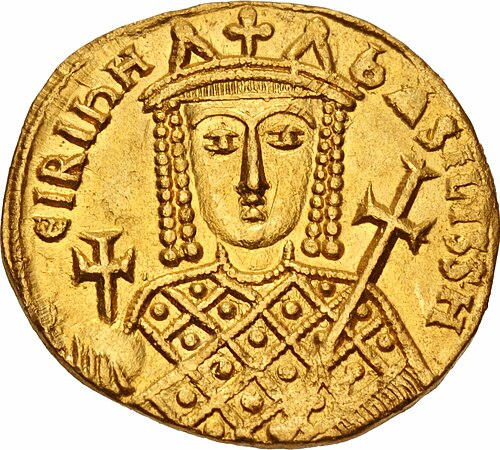
Irene of Athens
MedievalEmperorByzantine Empire752 — 803
First female Byzantine emperor, blinded her son.
Compare Irene of Athens with another historical figure:
Quick Facts
Born
752
Died
803
Country
Byzantine Empire
Era
Medieval
Occupation
Emperor
Score Overview
Military (10%)15
Political (20%)44
Influence (20%)55
Legacy (20%)49
Leadership (15%)62
Strategy (15%)45
Total Score47.9
Irene of Athens — Complete Timeline
780 AD
Regency for Constantine VI (780-790)Political Action◆ Major
After the death of Leo IV, Irene became regent for her 10-year-old son Constantine VI. She ruled the Byzantine Empire effectively, reversing iconoclast policies and restoring icon veneration at the Second Council of Nicaea in 787.
RegencyIconoclasmChurch Council
Impact: regionalconstructive
787 AD
Second Council of Nicaea (787)Political Action
Irene convened the Second Council of Nicaea, which condemned iconoclasm and restored the veneration of icons in the Byzantine Church. This council is considered the Seventh Ecumenical Council by the Eastern Orthodox Church.
Ecumenical CouncilIconoclasmReligious Policy
Impact: globalconstructive
797 AD
Blinding and Imprisonment of Constantine VI (797)Political Action◆ Major
Irene ordered the blinding of her son Constantine VI, who had attempted to assert his own rule. He was imprisoned and died shortly after. This act allowed Irene to become sole ruler, but it was widely condemned as tyrannical and unnatural.
UsurpationViolenceFamily
Impact: regionaltragic
Sole Rule as Empress (797-802)Political Action◆ Major
After blinding her son, Irene ruled as sole empress, the first woman to do so in Byzantine history. She used the title 'basileus' (emperor) rather than 'basilissa' (empress), asserting her authority as a male ruler.
Female RuleImperial Title
Impact: regional
802 AD
Overthrow and Exile (802)Political Action◆ Major
Irene was overthrown by a conspiracy led by Nikephoros, the logothete (finance minister). She was exiled to the island of Lesbos and forced to support herself by spinning wool. She died the following year.
CoupExile
Impact: regionaltragic
Detailed Scores
▶View all detailed scores
Military
Strategy
7
Tactics
7
Battles
7
Army Scale
6
War Impact
7
Political
Governance
6
Reform
7
Stability
6
Policy
7
Power
7
Influence
History
9
Global
8
Culture
8
Ideology
9
Legacy
8
People often compare with
See how Irene of Athens stacks up against other historical figures
Popular Comparisons
Irene of Athens vs Selim I
vs Selim I71
Irene of Athens vs Mircea the Elder
vs Mircea the Elder62
Irene of Athens vs Alfonso XI of Castile
vs Alfonso XI of Castile61
Irene of Athens vs Samsenethai
vs Samsenethai55
Irene of Athens vs Mari Djata II
vs Mari Djata II48
Irene of Athens vs James V of Scotland
vs James V of Scotland41