Loading...
This comparison has not been analyzed yet.
One-time AI generation (~1 minute). Scores and timeline are already available below.
Irene of Athens vs Selim I
Selim I leads by 22.7 pts · 2 figures compared
…
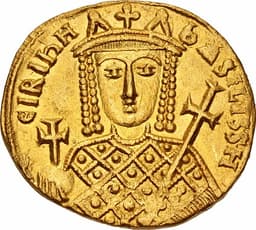
Irene of Athens
Emperor · Medieval
47.9Total
Selim I
Emperor · Medieval
70.6Total
Basic Information
Born
752
1470
Died
803
1520
Era
Medieval
Medieval
Nationality
Byzantine Empire
Ottoman Empire
Occupation
Emperor
Emperor
Civilization
Western
Middle Eastern
Score Comparison
Military (10%)
14.9
78.5
Political (20%)
43.7
70.3
Influence (20%)
54.9
65.0
Legacy (20%)
49.2
68.0
Leadership (15%)
62.2
80.0
Strategy (15%)
45.0
70.0
TOTAL
47.9
70.6
Irene of Athens — Complete Timeline
780 AD
Regency for Constantine VI (780-790)Political Action◆ Major
After the death of Leo IV, Irene became regent for her 10-year-old son Constantine VI. She ruled the Byzantine Empire effectively, reversing iconoclast policies and restoring icon veneration at the Second Council of Nicaea in 787.
RegencyIconoclasmChurch Council
Impact: regionalconstructive
787 AD
Second Council of Nicaea (787)Political Action
Irene convened the Second Council of Nicaea, which condemned iconoclasm and restored the veneration of icons in the Byzantine Church. This council is considered the Seventh Ecumenical Council by the Eastern Orthodox Church.
Ecumenical CouncilIconoclasmReligious Policy
Impact: globalconstructive
797 AD
Blinding and Imprisonment of Constantine VI (797)Political Action◆ Major
Irene ordered the blinding of her son Constantine VI, who had attempted to assert his own rule. He was imprisoned and died shortly after. This act allowed Irene to become sole ruler, but it was widely condemned as tyrannical and unnatural.
UsurpationViolenceFamily
Impact: regionaltragic
Sole Rule as Empress (797-802)Political Action◆ Major
After blinding her son, Irene ruled as sole empress, the first woman to do so in Byzantine history. She used the title 'basileus' (emperor) rather than 'basilissa' (empress), asserting her authority as a male ruler.
Female RuleImperial Title
Impact: regional
802 AD
Overthrow and Exile (802)Political Action◆ Major
Irene was overthrown by a conspiracy led by Nikephoros, the logothete (finance minister). She was exiled to the island of Lesbos and forced to support herself by spinning wool. She died the following year.
CoupExile
Impact: regionaltragic
Selim I — Complete Timeline
1513 AD
Execution of Prince Mustafa and Prince KorkutPolitical Action
To secure his succession, Selim I ordered the execution of his brothers, Prince Mustafa and Prince Korkut, who were potential rivals for the throne. This act followed the Ottoman practice of fratricide to prevent civil war. It eliminated internal opposition and consolidated Selim's rule.
FratricideSuccessionOttoman Politics
Impact: nationaldestructive
1514 AD
Battle of ChaldiranWar
Selim I led the Ottoman army against the Safavid Empire under Shah Ismail I at Chaldiran in eastern Anatolia. The Ottomans, using superior artillery and gunpowder tactics, decisively defeated the Safavids. This victory secured Ottoman control over eastern Anatolia and prevented Safavid expansion westward.
BattleSafavid WarOttoman Victory
Impact: regional
1517 AD
Conquest of Egypt and the HejazWar
Selim I led a campaign against the Mamluk Sultanate, defeating them at the Battle of Marj Dabiq and the Battle of Ridaniya. He conquered Cairo and the Hejaz, including the holy cities of Mecca and Medina. This brought the Islamic caliphate under Ottoman control and expanded Ottoman territory into North Africa and Arabia.
ConquestMamluk SultanateCaliphate
Impact: global
Assumption of the CaliphatePolitical Action◆ Major
After conquering Cairo, Selim I received the keys to the Kaaba and the relics of the Prophet Muhammad from the last Abbasid caliph, Al-Mutawakkil III. Selim I assumed the title of Caliph, claiming spiritual leadership of the Islamic world. This transfer established the Ottoman sultans as caliphs until 1924.
CaliphateIslamic LeadershipOttoman Empire
Impact: global
This comparison has not been analyzed yet.
One-time AI generation (~1 minute). Scores and timeline are already available below.
Rankings
🥇
Selim ILeader
Mil: 78.5Pol: 70.3Inf: 65.0
70.6
🥈
Irene of Athens
Mil: 14.9Pol: 43.7Inf: 54.9
47.9
+22.7 behind
How This Comparison Works
Algorithm
Each figure is scored on 6 dimensions (0—100 scale) based on structured historical data: Military (10%), Political (20%), Influence (20%), Legacy (20%), Leadership (15%), Strategy (15%). The weighted total produces the final ranking.
Data Sources
Scores are computed from structured sub-indicators in the database. Scale factors adjust for era (Ancient ×0.85, Modern ×1.0) and civilization size (Eastern ×1.05, Other ×0.80) to account for differences in population and military scale.
Maximum 3 Figures
Comparisons are limited to 2—3 figures to ensure readability and statistical meaningfulness.
Error Margins
±5 points per dimension — Sub-scores are derived from historical records with inherent uncertainty. Two figures within 5 points on a dimension should be considered roughly equivalent in that area.
Total Score Accuracy
±3 points overall — The weighted combination of 6 dimensions produces a total score with approximately ±3 points of uncertainty. Differences of less than 3 points are not statistically significant— the figures are effectively tied.
Known Limitations
- Historical records are incomplete and uneven across civilizations
- Figures from oral-tradition societies may be underrepresented
- Occupation labels can misclassify multi-role figures
- Scores measure capability and impact, not moral character
- Quantitative scoring is a comparison tool, not absolute truth
Capability Radar
Military (10%) — Battles & Warfare
Battles
10
85
Win Rate
5
90
Expansion
5
90
Political (20%) — Governance & Reform
Reform
40
75
Diplomacy
50
80
Economy
30
70
Influence (20%) — Cultural & Global Reach
Cultural
40
60
Global
30
75
Legacy (20%) — Historical Impact
Historical
55
80
Longevity
40
70
Leadership (15%) — Power & Stability
Tenure
60
70
Stability
20
65
Strategy (15%) — Tactics & Innovation
Strategy
5
85
Tactics
5
80
Reform
5
70
Similar Comparisons
Comments & Discussion
No comments yet. Be the first to share your thoughts!