Loading...
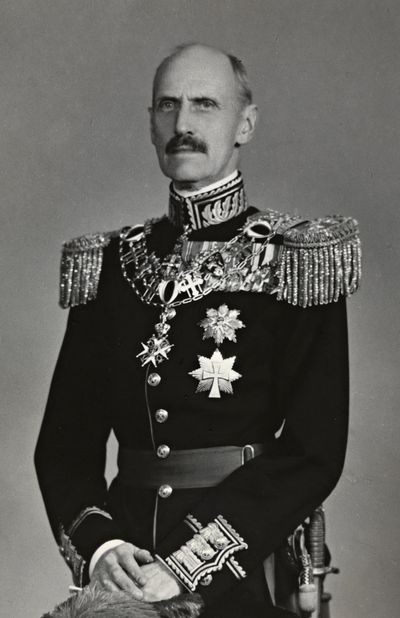
Haakon VII of Norway
ModernEmperorNorway1872 — 1957
First king of independent Norway, symbol of Norwegian resistance in WWII.
Compare Haakon VII of Norway with another historical figure:
Quick Facts
Born
1872
Died
1957
Country
Norway
Era
Modern
Occupation
Emperor
Score Overview
Military (10%)18
Political (20%)70
Influence (20%)58
Legacy (20%)52
Leadership (15%)72
Strategy (15%)58
Total Score56.4
Haakon VII of Norway — Complete Timeline
1905 AD
Election as King of NorwayPolitical Action
Following the dissolution of the union with Sweden, the Norwegian parliament elected Prince Carl of Denmark as King Haakon VII. He accepted the throne after a referendum confirmed the monarchy. This established the modern, independent Kingdom of Norway with a constitutional monarch.
NorwayIndependenceMonarchyReferendum
Impact: nationalconstructive
1940 AD
Refusal to appoint Quisling as Prime MinisterPolitical Action
After the German invasion of Norway, Nazi Germany demanded that Haakon VII appoint Vidkun Quisling as prime minister. Haakon VII refused, stating he would abdicate rather than accept a government led by Quisling. This act of defiance made him a symbol of Norwegian resistance.
NorwayWorld War IIResistanceQuisling
Impact: nationalconstructive
Leadership of the Norwegian government-in-exilePolitical Action◆ Major
Haakon VII fled Norway after the German invasion and established a government-in-exile in London. He became a central figure in the Allied war effort, broadcasting radio messages to occupied Norway and maintaining the legitimacy of the Norwegian state throughout World War II.
NorwayWorld War IIExileGovernment
Impact: globalconstructive
1945 AD
Return to Norway after World War IIPolitical Action◆ Major
Haakon VII returned to Norway on June 7, 1945, exactly five years after he had fled. His return was a moment of national celebration and unity. He was greeted by massive crowds, symbolizing the restoration of Norwegian sovereignty and the end of the Nazi occupation.
NorwayWorld War IILiberationMonarchy
Impact: nationalconstructive
Detailed Scores
▶View all detailed scores
Military
Strategy
7
Tactics
7
Battles
7
Army Scale
6
War Impact
7
Political
Governance
7
Reform
7
Stability
7
Policy
8
Power
8
Influence
History
9
Global
8
Culture
8
Ideology
9
Legacy
8
People often compare with
See how Haakon VII of Norway stacks up against other historical figures
Popular Comparisons
Haakon VII of Norway vs George VI
vs George VI56
Haakon VII of Norway vs Udai Singh II
vs Udai Singh II52
Haakon VII of Norway vs Hans-Adam II
vs Hans-Adam II50
Haakon VII of Norway vs William II of Wurttemberg
vs William II of Wurttemberg42
Haakon VII of Norway vs Frederick William of Hesse
vs Frederick William of Hesse40
Haakon VII of Norway vs Napoleon Bonaparte
vs Napoleon Bonaparte71