Loading...
Frederick William of Hesse vs Haakon VII of Norway
Haakon VII of Norway leads by 16.1 pts · 2 figures compared
…

Frederick William of Hesse
Emperor · Modern
40.3Total
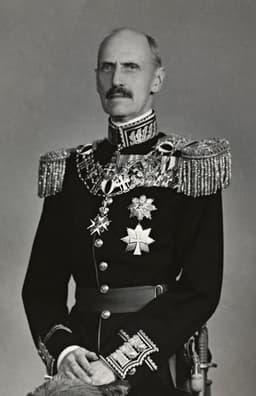
Haakon VII of Norway
Emperor · Modern
56.4Total
Basic Information
Born
1802
1872
Died
1875
1957
Era
Modern
Modern
Nationality
Hesse-Kassel
Norway
Occupation
Emperor
Emperor
Civilization
Western
Western
Score Comparison
Military (10%)
43.3
17.8
Political (20%)
25.0
70.0
Influence (20%)
46.3
58.3
Legacy (20%)
35.8
52.0
Leadership (15%)
41.5
72.0
Strategy (15%)
54.3
57.5
TOTAL
40.3
56.4
Frederick William of Hesse — Complete Timeline
1847 AD
Became Elector of Hesse-KasselPolitical Action◆ Major
Frederick William succeeded his father William II as the last Elector of Hesse-Kassel. He inherited a state deeply divided between conservative monarchists and liberal reformers, with tensions rising across Germany.
SuccessionHesse-Kassel
Impact: regional
1848 AD
Suppressed 1848 RevolutionPolitical Action◆ Major
During the 1848 revolutions, Frederick William initially conceded to some demands, but later used Austrian and Prussian troops to suppress the uprising. He restored absolute rule, reversing all liberal reforms.
Revolutions of 1848Reactionary
Impact: regionaldestructive
1866 AD
Deposed by PrussiaPolitical Action
During the Austro-Prussian War, Frederick William sided with Austria. After Prussia's victory, Hesse-Kassel was annexed by Prussia. Frederick William was deposed and went into exile, ending the Hesse-Kassel monarchy.
Austro-Prussian WarAnnexationEnd of Monarchy
Impact: regionaltragic
Haakon VII of Norway — Complete Timeline
1905 AD
Election as King of NorwayPolitical Action
Following the dissolution of the union with Sweden, the Norwegian parliament elected Prince Carl of Denmark as King Haakon VII. He accepted the throne after a referendum confirmed the monarchy. This established the modern, independent Kingdom of Norway with a constitutional monarch.
NorwayIndependenceMonarchyReferendum
Impact: nationalconstructive
1940 AD
Refusal to appoint Quisling as Prime MinisterPolitical Action
After the German invasion of Norway, Nazi Germany demanded that Haakon VII appoint Vidkun Quisling as prime minister. Haakon VII refused, stating he would abdicate rather than accept a government led by Quisling. This act of defiance made him a symbol of Norwegian resistance.
NorwayWorld War IIResistanceQuisling
Impact: nationalconstructive
Leadership of the Norwegian government-in-exilePolitical Action◆ Major
Haakon VII fled Norway after the German invasion and established a government-in-exile in London. He became a central figure in the Allied war effort, broadcasting radio messages to occupied Norway and maintaining the legitimacy of the Norwegian state throughout World War II.
NorwayWorld War IIExileGovernment
Impact: globalconstructive
1945 AD
Return to Norway after World War IIPolitical Action◆ Major
Haakon VII returned to Norway on June 7, 1945, exactly five years after he had fled. His return was a moment of national celebration and unity. He was greeted by massive crowds, symbolizing the restoration of Norwegian sovereignty and the end of the Nazi occupation.
NorwayWorld War IILiberationMonarchy
Impact: nationalconstructive
Expert Analysis
Origins
Frederick William of Hesse-Kassel was born on November 20, 1802, in Hanau, the son of Elector William II and Princess Augusta of Prussia. He was raised in a court deeply divided between conservative absolutism and liberal reform, receiving a traditional princely education. His father's morganatic marriage and political conflicts shaped his early life. Frederick William became heir apparent in 1821 and served as co-regent from 1831 due to his father's blindness, preparing him for rule.
Haakon VII was born Prince Carl of Denmark on August 3, 1872, in Charlottenlund, the second son of Crown Prince Frederick (later Frederick VIII) and Princess Louise of Sweden. He was educated at the Royal Danish Naval Academy, serving as a naval officer. His upbringing in a constitutional monarchy and his marriage to Princess Maud of Wales, daughter of King Edward VII, connected him to British and European royalty. His background in a stable democratic state contrasted sharply with Frederick William's autocratic environment.
Rise to Power
Frederick William became Elector of Hesse-Kassel on November 20, 1847, upon his father's death. He immediately faced the 1848 revolutions, initially granting liberal reforms but later suppressing them with Austrian and Prussian military aid in 1850. His rule was marked by a return to absolutism, alienating the middle class and intellectuals. The turning point came during the Austro-Prussian War of 1866 when he sided with Austria. After Prussia's swift victory, Hesse-Kassel was annexed by Prussia on October 3, 1866, and Frederick William was deposed, ending the 457-year rule of the House of Hesse.
Haakon VII was elected King of Norway by the Storting on November 18, 1905, after the dissolution of the union with Sweden. He took the name Haakon VII, linking himself to Norway's medieval kings. His coronation was on June 22, 1906. He accepted the throne under a constitutional monarchy, with limited political power. His key turning point came on April 9, 1940, when Germany invaded Norway. The Nazis demanded he appoint Vidkun Quisling as prime minister; Haakon VII refused, stating he would rather abdicate than betray the constitution. This defiance made him a symbol of national resistance.
Leadership & Governance
Frederick William ruled as an absolute monarch, rejecting constitutionalism. He reversed the liberal constitution of 1848, dismissed liberal ministers, and governed through conservative advisors. His governance score of 41.5 reflects his inability to adapt to changing political realities. For example, he reimposed censorship and restricted civil liberties, leading to widespread discontent. His political score of 25.0 is the lowest among comparable rulers, as he failed to maintain his state's independence.
Haakon VII governed as a constitutional monarch, adhering to democratic principles. He was a unifying figure, especially during World War II, where his leadership score of 72.0 reflects his ability to inspire resistance. He led the Norwegian government-in-exile from London, coordinating with the Allies and broadcasting to occupied Norway. His refusal to appoint Quisling was a key decision that preserved the legitimacy of the monarchy and government. He returned to Norway on June 7, 1945, to national acclaim.
Triumph & Tragedy
Frederick William's greatest success was his initial ability to suppress the 1848 revolution and maintain his throne for nearly two decades. However, his greatest failure was his political miscalculation in the Austro-Prussian War, leading to the loss of his state. His total score of 40.3 reflects his limited achievements. He died in exile in Frankfurt on January 6, 1875, a forgotten figure.
Haakon VII's greatest triumph was his steadfast refusal during the Nazi occupation, which united Norwegians and strengthened the resistance. His leadership in exile was crucial for the Allied cause. His greatest tragedy was the occupation itself, but he emerged victorious. He died on September 21, 1957, in Oslo, deeply mourned. His legacy score of 52.0 is significantly higher than Frederick William's 35.8.
Character & Destiny
Frederick William was stubborn and reactionary, unwilling to compromise. His character score of 41.5 reflects a rigid personality that could not adapt to the tide of nationalism and unification. His destiny was to be a casualty of Prussia's rise, a victim of his own poor judgment in alliances.
Haakon VII was principled and pragmatic, embodying democratic values. His character score of 72.0 shows his ability to make hard decisions under pressure. His destiny was to become a national symbol, his choices shaping Norway's modern identity.
Legacy
Frederick William's legacy is minimal; he is remembered only as the last Elector of Hesse, a footnote in German unification. His state was absorbed into Prussia, and his reforms were reversed. His influence score of 46.3 is inflated by his position rather than impact.
Haakon VII's legacy is profound. He is revered as the father of modern Norway, a symbol of resistance against tyranny. His refusal to capitulate set a standard for constitutional monarchy. The Norwegian monarchy remains popular, with his descendants continuing his tradition. His influence score of 58.3 and legacy of 52.0 reflect this enduring impact.
Conclusion
Haakon VII had significantly greater impact than Frederick William of Hesse. With a total score of 56.4 against 40.3, the 16.1-point gap is decisive. Frederick William's failure to preserve his state and his reactionary policies contrast sharply with Haakon VII's successful defense of Norwegian sovereignty and democracy. Haakon VII's leadership during WWII and his role in shaping Norway's modern identity make him a far more consequential figure. Frederick William is a historical footnote; Haakon VII is a national hero.
Rankings
🥇
Haakon VII of NorwayLeader
Mil: 17.8Pol: 70.0Inf: 58.3
56.4
🥈
Frederick William of Hesse
Mil: 43.3Pol: 25.0Inf: 46.3
40.3
+16.1 behind
How This Comparison Works
Algorithm
Each figure is scored on 6 dimensions (0—100 scale) based on structured historical data: Military (10%), Political (20%), Influence (20%), Legacy (20%), Leadership (15%), Strategy (15%). The weighted total produces the final ranking.
Data Sources
Scores are computed from structured sub-indicators in the database. Scale factors adjust for era (Ancient ×0.85, Modern ×1.0) and civilization size (Eastern ×1.05, Other ×0.80) to account for differences in population and military scale.
Maximum 3 Figures
Comparisons are limited to 2—3 figures to ensure readability and statistical meaningfulness.
Error Margins
±5 points per dimension — Sub-scores are derived from historical records with inherent uncertainty. Two figures within 5 points on a dimension should be considered roughly equivalent in that area.
Total Score Accuracy
±3 points overall — The weighted combination of 6 dimensions produces a total score with approximately ±3 points of uncertainty. Differences of less than 3 points are not statistically significant— the figures are effectively tied.
Known Limitations
- Historical records are incomplete and uneven across civilizations
- Figures from oral-tradition societies may be underrepresented
- Occupation labels can misclassify multi-role figures
- Scores measure capability and impact, not moral character
- Quantitative scoring is a comparison tool, not absolute truth
Capability Radar
Military (10%) — Battles & Warfare
Battles
5
38
Win Rate
5
39
Expansion
5
40
Political (20%) — Governance & Reform
Reform
10
65
Diplomacy
15
75
Economy
15
60
Influence (20%) — Cultural & Global Reach
Cultural
10
65
Global
5
55
Legacy (20%) — Historical Impact
Historical
15
70
Longevity
10
60
Leadership (15%) — Power & Stability
Tenure
20
70
Stability
10
80
Strategy (15%) — Tactics & Innovation
Strategy
5
45
Tactics
5
51
Reform
5
49
Similar Comparisons
Comments & Discussion
No comments yet. Be the first to share your thoughts!