Loading...
Haakon VII of Norway vs Hans-Adam II
Haakon VII of Norway leads by 6.6 pts · 2 figures compared
…
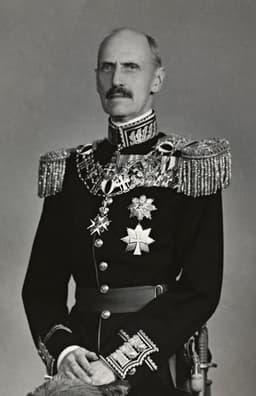
Haakon VII of Norway
Emperor · Modern
56.4Total

Hans-Adam II
Emperor · Modern
49.8Total
Basic Information
Born
1872
1945
Died
1957
—
Era
Modern
Modern
Nationality
Norway
Liechtenstein
Occupation
Emperor
Emperor
Civilization
Western
Western
Score Comparison
Military (10%)
17.8
48.7
Political (20%)
70.0
46.6
Influence (20%)
58.3
47.9
Legacy (20%)
52.0
37.5
Leadership (15%)
72.0
74.0
Strategy (15%)
57.5
54.6
TOTAL
56.4
49.8
Haakon VII of Norway — Complete Timeline
1905 AD
Election as King of NorwayPolitical Action
Following the dissolution of the union with Sweden, the Norwegian parliament elected Prince Carl of Denmark as King Haakon VII. He accepted the throne after a referendum confirmed the monarchy. This established the modern, independent Kingdom of Norway with a constitutional monarch.
NorwayIndependenceMonarchyReferendum
Impact: nationalconstructive
1940 AD
Refusal to appoint Quisling as Prime MinisterPolitical Action
After the German invasion of Norway, Nazi Germany demanded that Haakon VII appoint Vidkun Quisling as prime minister. Haakon VII refused, stating he would abdicate rather than accept a government led by Quisling. This act of defiance made him a symbol of Norwegian resistance.
NorwayWorld War IIResistanceQuisling
Impact: nationalconstructive
Leadership of the Norwegian government-in-exilePolitical Action◆ Major
Haakon VII fled Norway after the German invasion and established a government-in-exile in London. He became a central figure in the Allied war effort, broadcasting radio messages to occupied Norway and maintaining the legitimacy of the Norwegian state throughout World War II.
NorwayWorld War IIExileGovernment
Impact: globalconstructive
1945 AD
Return to Norway after World War IIPolitical Action◆ Major
Haakon VII returned to Norway on June 7, 1945, exactly five years after he had fled. His return was a moment of national celebration and unity. He was greeted by massive crowds, symbolizing the restoration of Norwegian sovereignty and the end of the Nazi occupation.
NorwayWorld War IILiberationMonarchy
Impact: nationalconstructive
Hans-Adam II — Complete Timeline
1989 AD
Accession as Prince of LiechtensteinPolitical Action◆ Major
Hans-Adam II became Prince of Liechtenstein upon the death of his father, Franz Joseph II. He inherited a constitutional monarchy with significant powers, which he would later seek to expand through constitutional reforms.
SuccessionMonarchy
Impact: national
1990 AD
Liechtenstein Joins the United NationsPolitical Action◆ Major
Under Hans-Adam II's reign, Liechtenstein became a member of the United Nations, ending its long-standing policy of neutrality in international organizations. This move increased the principality's global diplomatic engagement.
DiplomacyUN MembershipNeutrality
Impact: globalconstructive
1992 AD
Threat to Move to ViennaPolitical Action
Hans-Adam II threatened to relocate the princely family to Vienna if the government did not grant him more powers. This ultimatum led to negotiations that eventually resulted in the 2003 constitutional reforms, highlighting tensions between the prince and the elected government.
Political CrisisMonarchy vs Government
Impact: national
1995 AD
Liechtenstein Joins the European Economic AreaPolitical Action◆ Major
Hans-Adam II oversaw Liechtenstein's accession to the European Economic Area, integrating the principality into the EU's single market while maintaining its customs union with Switzerland. This decision boosted the economy but required compromises on sovereignty.
European IntegrationEconomic Policy
Impact: regionalconstructive
2003 AD
Constitutional Reform of 2003Reform◆ Major
Hans-Adam II pushed through a constitutional referendum that granted the prince sweeping powers, including the ability to veto legislation, dismiss the government, and appoint judges. The reform passed with 64% voter approval, centralizing authority in the monarchy.
Constitutional ChangeMonarchyReferendum
Impact: nationalconstructive
Expert Analysis
Origins
Haakon VII was born Prince Carl of Denmark on August 3, 1872, in Charlottenlund, Denmark, the second son of Crown Prince Frederick (later King Frederick VIII) and Princess Louise of Sweden. He was raised in the Danish royal court and educated at the Royal Danish Naval Academy, serving as a naval officer. His formative years were marked by a sense of duty and a deep understanding of Scandinavian politics. In 1905, Norway dissolved its union with Sweden and sought a new king. Prince Carl was chosen due to his descent from Norwegian kings and his marriage to Princess Maud, daughter of King Edward VII of the United Kingdom, which ensured British support.
Hans-Adam II was born on February 14, 1945, in Zurich, Switzerland, the eldest son of Prince Franz Joseph II of Liechtenstein and Countess Gina von Wilczek. He grew up in Vaduz Castle and studied at the University of St. Gallen, earning a degree in economics. His education focused on business and law, preparing him for his future role. In 1967, he married Countess Marie Kinsky von Wchinitz und Tettau. Unlike Haakon, Hans-Adam was born into a reigning princely family and was groomed from birth to rule.
Rise to Power
Haakon VII's rise began with the Norwegian plebiscite of 1905, where 79% of voters favored monarchy over republic. Prince Carl accepted the throne on condition that the Norwegian people confirmed their choice in a referendum, which they did. He adopted the name Haakon VII, a name associated with medieval Norwegian kings, to emphasize continuity. He arrived in Norway on November 25, 1905, and was crowned in Nidaros Cathedral. His legitimacy stemmed from popular consent, not divine right.
Hans-Adam II acceded to the throne on November 13, 1989, upon the death of his father. He inherited a constitutional monarchy where the prince held significant powers, including the ability to appoint judges and veto legislation. Unlike Haakon, Hans-Adam did not face a democratic test; his position was hereditary and entrenched. His early reign focused on modernizing Liechtenstein's economy and international integration.
Leadership & Governance
Haakon VII defined constitutional monarchy in Norway. He refused to appoint Vidkun Quisling as prime minister during the German invasion in 1940, stating he would rather abdicate than violate democratic principles. This act, which scored 70.0 in political leadership, cemented his role as a symbol of resistance. During exile in London, he led the Norwegian government-in-exile, broadcasting to occupied Norway. After the war, he returned on June 7, 1945, to a hero's welcome.
Hans-Adam II pursued a different path. In 2003, he pushed through a constitutional reform that expanded princely powers: he can now dismiss the government, veto legislation, and appoint judges. This referendum passed with 64% support, but critics call it a step toward absolutism. His leadership style is hands-on, even threatening to move to Vienna if his powers were curtailed. He scored 74.0 in leadership, reflecting his effectiveness in consolidating power, but his political score of 46.6 indicates controversy.
Triumph & Tragedy
Haakon VII's triumph was his unwavering stance against Nazism, preserving Norway's democratic institutions. His greatest failure was perhaps his inability to prevent the German occupation, though his resistance was symbolic. He died on September 21, 1957, after a long illness, universally mourned.
Hans-Adam II's triumph is the economic prosperity of Liechtenstein, which has one of the highest GDP per capita globally. He also oversaw its entry into the UN and EEA. However, his tragedy is the erosion of democratic norms; his constitutional reforms centralized power in the monarchy, leading to tensions with the government. In 2011, a referendum on limiting princely veto powers failed, but support for reform remains.
Character & Destiny
Haakon VII was modest, principled, and deeply committed to democracy. His character—calm under pressure—shaped his destiny as a unifying figure. Historians rate his influence at 58.3, reflecting his role beyond Norway's borders as a symbol of free Europe.
Hans-Adam II is pragmatic, assertive, and unafraid of controversy. His character drove him to expand princely powers, securing his family's influence in a modern world. His legacy score of 37.5 is lower because his actions remain contested.
Legacy
Haakon VII's legacy is the preservation of Norwegian democracy and his role as a national icon. He ranks high in legacy (52.0) for his wartime leadership. Today, Norway's monarchy is among the most popular in the world.
Hans-Adam II's legacy is mixed: he modernized Liechtenstein's economy but concentrated power. His influence score of 47.9 reflects his impact on small-state governance. The 2003 reforms may be reversed, but he has left a mark on constitutional theory.
Conclusion
Haakon VII of Norway achieved greater impact, scoring 56.4 total versus Hans-Adam II's 49.8. Haakon's leadership during WWII (72.0) and his commitment to democratic principles set a standard for constitutional monarchy. Hans-Adam II's political score of 46.6 and legacy of 37.5 show his achievements are more parochial and contested. While Hans-Adam II effectively governed a small principality, Haakon VII shaped the destiny of a nation in crisis, earning a place in global history. Thus, Haakon VII is the more significant figure.
Rankings
🥇
Haakon VII of NorwayLeader
Mil: 17.8Pol: 70.0Inf: 58.3
56.4
🥈
Hans-Adam II
Mil: 48.7Pol: 46.6Inf: 47.9
49.8
+6.6 behind
How This Comparison Works
Algorithm
Each figure is scored on 6 dimensions (0—100 scale) based on structured historical data: Military (10%), Political (20%), Influence (20%), Legacy (20%), Leadership (15%), Strategy (15%). The weighted total produces the final ranking.
Data Sources
Scores are computed from structured sub-indicators in the database. Scale factors adjust for era (Ancient ×0.85, Modern ×1.0) and civilization size (Eastern ×1.05, Other ×0.80) to account for differences in population and military scale.
Maximum 3 Figures
Comparisons are limited to 2—3 figures to ensure readability and statistical meaningfulness.
Error Margins
±5 points per dimension — Sub-scores are derived from historical records with inherent uncertainty. Two figures within 5 points on a dimension should be considered roughly equivalent in that area.
Total Score Accuracy
±3 points overall — The weighted combination of 6 dimensions produces a total score with approximately ±3 points of uncertainty. Differences of less than 3 points are not statistically significant— the figures are effectively tied.
Known Limitations
- Historical records are incomplete and uneven across civilizations
- Figures from oral-tradition societies may be underrepresented
- Occupation labels can misclassify multi-role figures
- Scores measure capability and impact, not moral character
- Quantitative scoring is a comparison tool, not absolute truth
Capability Radar
Military (10%) — Battles & Warfare
Battles
38
23
Win Rate
39
27
Expansion
40
27
Political (20%) — Governance & Reform
Reform
65
30
Diplomacy
75
40
Economy
60
45
Influence (20%) — Cultural & Global Reach
Cultural
65
15
Global
55
10
Legacy (20%) — Historical Impact
Historical
70
15
Longevity
60
20
Leadership (15%) — Power & Stability
Tenure
70
35
Stability
80
50
Strategy (15%) — Tactics & Innovation
Strategy
45
35
Tactics
51
34
Reform
49
39
Similar Comparisons
Comments & Discussion
No comments yet. Be the first to share your thoughts!