Loading...
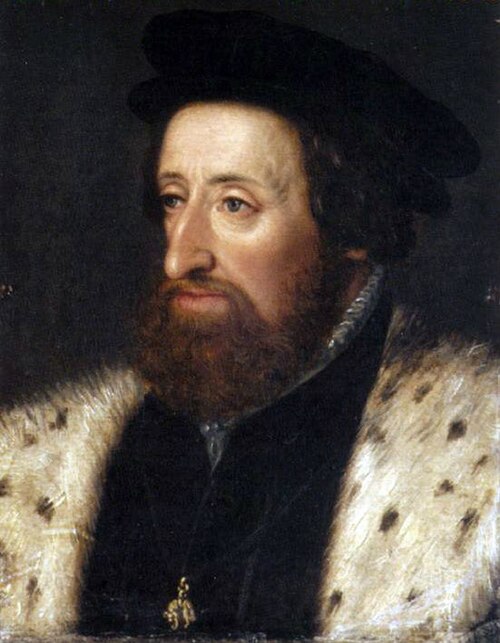
Ferdinand I
ModernEmperorHoly Roman Empire1503 — 1564
Brother of Charles V who became emperor after his abdication.
Compare Ferdinand I with another historical figure:
Quick Facts
Born
1503
Died
1564
Country
Holy Roman Empire
Era
Modern
Occupation
Emperor
Score Overview
Military (10%)25
Political (20%)70
Influence (20%)56
Legacy (20%)48
Leadership (15%)72
Strategy (15%)60
Total Score55.8
Ferdinand I — Complete Timeline
1555 AD
Peace of AugsburgPolitical Action
Ferdinand I played a key role in negotiating the Peace of Augsburg, which ended the religious wars between Catholics and Lutherans in the Holy Roman Empire. The treaty established the principle of 'cuius regio, eius religio' (whose realm, his religion), allowing princes to choose the religion of their territories. This was a landmark in religious tolerance.
Peace of AugsburgReligious ToleranceReformation
Impact: globalconstructive
1556 AD
Abdication of Charles VPolitical Action
Ferdinand I's brother, Emperor Charles V, abdicated the throne, dividing the Habsburg empire. Charles gave Spain and the Netherlands to his son Philip II, while Ferdinand received the Austrian lands and the title of Holy Roman Emperor. This formalized the split between the Spanish and Austrian branches of the Habsburgs.
AbdicationHabsburg DivisionImperial Succession
Impact: global
1558 AD
Coronation as Holy Roman EmperorPolitical Action◆ Major
Ferdinand I was crowned Holy Roman Emperor in Frankfurt, following the abdication of Charles V. His coronation marked the formal transfer of the imperial title to the Austrian branch of the Habsburgs. Ferdinand's reign focused on consolidating imperial authority and managing religious tensions.
CoronationImperial AuthorityHabsburg Dynasty
Impact: globalconstructive
Detailed Scores
▶View all detailed scores
Military
Strategy
7
Tactics
7
Battles
7
Army Scale
6
War Impact
7
Political
Governance
7
Reform
7
Stability
7
Policy
8
Power
8
Influence
History
8
Global
8
Culture
8
Ideology
9
Legacy
8
People often compare with
See how Ferdinand I stacks up against other historical figures
Popular Comparisons
Ferdinand I vs Sultan Agung of Mataram
vs Sultan Agung of Mataram69
Ferdinand I vs Bayinnaung
vs Bayinnaung69
Ferdinand I vs Frederick William I of Prussia
vs Frederick William I of Prussia62
Ferdinand I vs Bodawpaya
vs Bodawpaya60
Ferdinand I vs Chithira Thirunal
vs Chithira Thirunal58
Ferdinand I vs Kabarega of Bunyoro
vs Kabarega of Bunyoro57