Loading...
Ferdinand I vs Frederick William I of Prussia
Frederick William I of Prussia leads by 5.9 pts · 2 figures compared
…
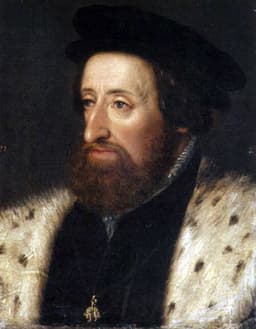
Ferdinand I
Emperor · Modern
55.8Total

Frederick William I of Prussia
Emperor · Modern
61.7Total
Basic Information
Born
1503
1688
Died
1564
1740
Era
Modern
Modern
Nationality
Holy Roman Empire
Prussia
Occupation
Emperor
Emperor
Civilization
Western
Western
Score Comparison
Military (10%)
25.0
40.0
Political (20%)
70.0
72.0
Influence (20%)
56.4
57.2
Legacy (20%)
47.5
58.0
Leadership (15%)
72.0
80.0
Strategy (15%)
60.0
60.7
TOTAL
55.8
61.7
Ferdinand I — Complete Timeline
1555 AD
Peace of AugsburgPolitical Action
Ferdinand I played a key role in negotiating the Peace of Augsburg, which ended the religious wars between Catholics and Lutherans in the Holy Roman Empire. The treaty established the principle of 'cuius regio, eius religio' (whose realm, his religion), allowing princes to choose the religion of their territories. This was a landmark in religious tolerance.
Peace of AugsburgReligious ToleranceReformation
Impact: globalconstructive
1556 AD
Abdication of Charles VPolitical Action
Ferdinand I's brother, Emperor Charles V, abdicated the throne, dividing the Habsburg empire. Charles gave Spain and the Netherlands to his son Philip II, while Ferdinand received the Austrian lands and the title of Holy Roman Emperor. This formalized the split between the Spanish and Austrian branches of the Habsburgs.
AbdicationHabsburg DivisionImperial Succession
Impact: global
1558 AD
Coronation as Holy Roman EmperorPolitical Action◆ Major
Ferdinand I was crowned Holy Roman Emperor in Frankfurt, following the abdication of Charles V. His coronation marked the formal transfer of the imperial title to the Austrian branch of the Habsburgs. Ferdinand's reign focused on consolidating imperial authority and managing religious tensions.
CoronationImperial AuthorityHabsburg Dynasty
Impact: globalconstructive
Frederick William I of Prussia — Complete Timeline
1713 AD
Reduction of court expenditure and state financesReform◆ Major
Upon ascending the throne, Frederick William I drastically cut court spending, selling off royal luxuries and reducing the court staff. He redirected the savings to the military and state administration. This fiscal austerity created a large treasury surplus and made Prussia financially independent.
PrussiaFinanceAusterityReform
Impact: nationalconstructive
1717 AD
Introduction of compulsory primary educationReform◆ Major
Frederick William I issued a decree making primary education compulsory for all children in Prussia. This was one of the first state-mandated education systems in Europe. While implementation was uneven, it laid the foundation for Prussia's high literacy rates and later educational excellence.
PrussiaEducationReformLiteracy
Impact: nationalprogressive
1723 AD
Creation of the Prussian General DirectoryReform◆ Major
Frederick William I established the General Directory (Generaldirektorium), a centralized administrative body that managed the state's finances, military, and economy. This reform created an efficient, bureaucratic state apparatus that became the model for Prussian governance and enabled the maintenance of a large standing army.
PrussiaAdministrationReformBureaucracy
Impact: nationalconstructive
1740 AD
Expansion of the Prussian army to 80,000 menReform◆ Major
Frederick William I expanded the Prussian army from 38,000 to 80,000 men, making it the fourth-largest army in Europe despite Prussia being the tenth-largest state by population. He introduced the canton system of conscription and drilled the army to a high standard of discipline, earning him the nickname 'The Soldier King'.
PrussiaArmyMilitaryConscription
Impact: regionalconstructive
Expert Analysis
Origins
Ferdinand I was born in 1503 in Alcalá de Henares, Spain, as the younger brother of Charles V. He was raised in the Spanish court and received a thorough education in statecraft and religion. In 1521, he was sent to govern the Habsburg hereditary lands in Austria, which became his power base. Frederick William I was born in 1688 in Berlin, the son of Elector Frederick III (later King Frederick I) and Sophia Charlotte of Hanover. He grew up in a court known for its lavishness, which he came to despise. His education emphasized military and administrative skills, and he was deeply influenced by his grandfather, the Great Elector Frederick William.
Rise to Power
Ferdinand I's rise was tied to his brother's abdication. In 1555, Charles V, exhausted by religious conflicts, decided to divide the Habsburg empire. Ferdinand, who had already been King of the Romans since 1531, was given the imperial crown and the Austrian lands, while Charles's son Philip II received Spain and the Netherlands. Ferdinand was crowned Holy Roman Emperor in 1558. Frederick William I became King in Prussia in 1713 upon his father's death. He immediately set about reforming the state, cutting court expenditures from 300,000 thalers to 55,000 and redirecting funds to the army. His rise was marked by a rejection of his father's artistic and luxurious court, focusing instead on military and administrative efficiency.
Leadership & Governance
Ferdinand I's leadership was characterized by diplomatic pragmatism. He negotiated the Peace of Augsburg in 1555, which established the principle of cuius regio, eius religio (whose realm, his religion), allowing princes to choose Catholicism or Lutheranism for their territories. This ended decades of religious war in the Holy Roman Empire. He also centralized Habsburg administration in Austria and Hungary, creating a more efficient bureaucracy. Frederick William I, known as the "Soldier King," ruled with a frugal and militaristic style. He created the General Directory in 1723, a centralized administrative body that managed state finances, military, and domains. He expanded the Prussian army from 38,000 to 80,000 men, making it the fourth-largest in Europe despite Prussia being only the tenth-largest in population. He also introduced compulsory primary education in 1717, one of the first state-mandated education systems.
Triumph & Tragedy
Ferdinand I's greatest triumph was the Peace of Augsburg, which brought stability to the empire and allowed him to focus on defending against the Ottoman Empire. He secured a peace treaty with Sultan Suleiman the Magnificent in 1562, recognizing Habsburg control over parts of Hungary. His tragedy was the ongoing religious division; the peace did not include Calvinists, leading to future conflicts. Additionally, his inability to fully centralize the empire left it fragmented. Frederick William I's triumph was building a powerful military and efficient state that became the foundation for Prussia's rise. His tragedy was his strained relationship with his son, Frederick the Great, whom he harshly disciplined, even forcing him to witness the execution of his friend Hans Hermann von Katte in 1730. This left Frederick with psychological scars.
Character & Destiny
Ferdinand I was a cautious, diplomatic figure, more inclined to negotiation than war. His political score of 70.0 reflects his skill in managing the empire's complex politics. He was deeply religious but tolerant enough to accept Lutheranism in the peace. His character shaped a destiny of maintaining stability rather than expansion. Frederick William I was a stern, frugal, and militaristic ruler. He drilled his soldiers personally and enforced strict discipline. His leadership score of 80.0 indicates his effectiveness in building institutions. His character set the stage for Prussia's militarism, but his harshness alienated his heir, who would later pursue a different path.
Legacy
Ferdinand I's legacy is the Peace of Augsburg, which established a framework for religious coexistence in the Holy Roman Empire until the Thirty Years' War. He also strengthened the Habsburg hold on Hungary and Bohemia. His legacy score of 47.5 reflects his role as a transitional figure. Frederick William I's legacy is more tangible: the Prussian army and administrative system that enabled his son Frederick the Great to conquer Silesia and make Prussia a great power. His compulsory education decree laid the groundwork for high literacy rates. His legacy score of 58.0 acknowledges his foundational role in Prussia's rise.
Conclusion
While Ferdinand I achieved a crucial religious peace, his impact was limited by the empire's decentralized structure. Frederick William I, with a total score of 61.7 vs Ferdinand's 55.8, created the institutional and military base that propelled Prussia to European power. His reforms had lasting effects on state-building and education. Therefore, Frederick William I had greater impact on European history.
Rankings
🥇
Frederick William I of PrussiaLeader
Mil: 40.0Pol: 72.0Inf: 57.2
61.7
🥈
Ferdinand I
Mil: 25.0Pol: 70.0Inf: 56.4
55.8
+5.9 behind
How This Comparison Works
Algorithm
Each figure is scored on 6 dimensions (0—100 scale) based on structured historical data: Military (10%), Political (20%), Influence (20%), Legacy (20%), Leadership (15%), Strategy (15%). The weighted total produces the final ranking.
Data Sources
Scores are computed from structured sub-indicators in the database. Scale factors adjust for era (Ancient ×0.85, Modern ×1.0) and civilization size (Eastern ×1.05, Other ×0.80) to account for differences in population and military scale.
Maximum 3 Figures
Comparisons are limited to 2—3 figures to ensure readability and statistical meaningfulness.
Error Margins
±5 points per dimension — Sub-scores are derived from historical records with inherent uncertainty. Two figures within 5 points on a dimension should be considered roughly equivalent in that area.
Total Score Accuracy
±3 points overall — The weighted combination of 6 dimensions produces a total score with approximately ±3 points of uncertainty. Differences of less than 3 points are not statistically significant— the figures are effectively tied.
Known Limitations
- Historical records are incomplete and uneven across civilizations
- Figures from oral-tradition societies may be underrepresented
- Occupation labels can misclassify multi-role figures
- Scores measure capability and impact, not moral character
- Quantitative scoring is a comparison tool, not absolute truth
Capability Radar
Military (10%) — Battles & Warfare
Battles
35
30
Win Rate
40
40
Expansion
40
40
Political (20%) — Governance & Reform
Reform
65
85
Diplomacy
75
45
Economy
60
80
Influence (20%) — Cultural & Global Reach
Cultural
40
30
Global
40
55
Legacy (20%) — Historical Impact
Historical
50
70
Longevity
45
65
Leadership (15%) — Power & Stability
Tenure
70
60
Stability
55
75
Strategy (15%) — Tactics & Innovation
Strategy
45
50
Tactics
30
35
Reform
50
95
Similar Comparisons
Comments & Discussion
No comments yet. Be the first to share your thoughts!