Loading...
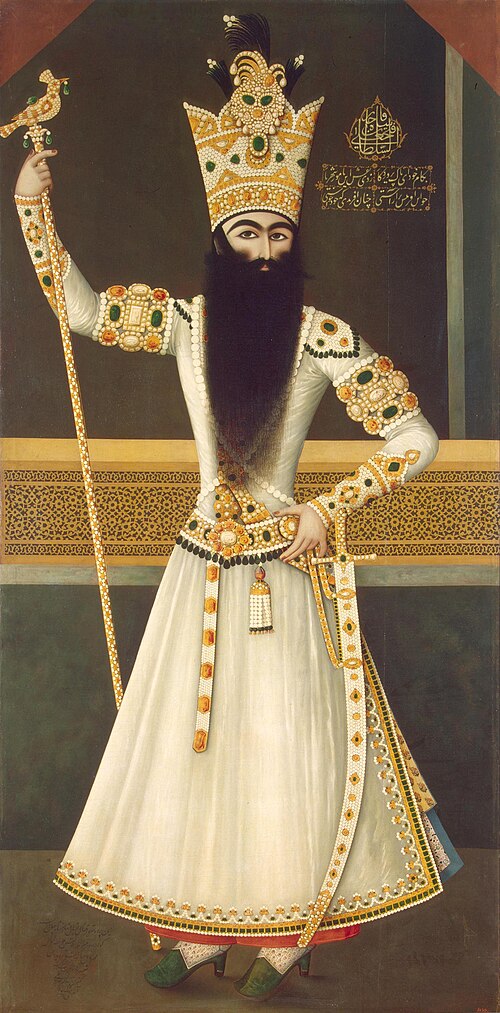
Fath-Ali Shah
ModernEmperorPersia1772 — 1834
Qajar shah who fought two wars with Russia.
Compare Fath-Ali Shah with another historical figure:
Quick Facts
Born
1772
Died
1834
Country
Persia
Era
Modern
Occupation
Emperor
Score Overview
Military (10%)35
Political (20%)32
Influence (20%)53
Legacy (20%)42
Leadership (15%)53
Strategy (15%)50
Total Score45.1
Fath-Ali Shah — Complete Timeline
1800 AD
Patronized the Arts and ArchitectureCultural
Fath-Ali Shah was a major patron of Persian art, commissioning numerous paintings, manuscripts, and architectural projects. He ordered the construction of the Marble Palace (Kakh-e Marmar) in Tehran and supported the revival of Persian miniature painting, leaving a lasting cultural legacy.
PatronageArtArchitecture
Impact: nationalconstructive
1813 AD
Treaty of GulistanWar
Fath-Ali Shah signed the Treaty of Gulistan with Russia, ending the first Russo-Persian War (1804-1813). Persia ceded territories in the Caucasus, including Georgia, Dagestan, and parts of Armenia, marking a significant territorial loss and the beginning of Russian dominance in the region.
TreatyTerritorial LossRusso-Persian War
Impact: regionaltragic
1821 AD
War with the Ottoman Empire (1821-1823)War
Fath-Ali Shah launched a war against the Ottoman Empire, initially gaining victories in eastern Anatolia. However, the war ended inconclusively with the Treaty of Erzurum in 1823, which reaffirmed existing borders without significant territorial changes.
Ottoman WarTreaty of Erzurum
Impact: regional
1828 AD
Treaty of TurkmenchayWar
Fath-Ali Shah signed the Treaty of Turkmenchay with Russia, ending the second Russo-Persian War (1826-1828). Persia ceded the remaining Caucasian territories, including Yerevan and Nakhchivan, and paid a large indemnity. The treaty also granted extraterritorial rights to Russians in Persia.
TreatyTerritorial LossRusso-Persian War
Impact: regionaltragic
Detailed Scores
▶View all detailed scores
Military
Strategy
7
Tactics
7
Battles
7
Army Scale
6
War Impact
7
Political
Governance
7
Reform
7
Stability
7
Policy
7
Power
8
Influence
History
9
Global
8
Culture
9
Ideology
9
Legacy
8
People often compare with
See how Fath-Ali Shah stacks up against other historical figures
Popular Comparisons
Fath-Ali Shah vs Louis XIII of France
vs Louis XIII of France62
Fath-Ali Shah vs Frederick Augustus II of Saxony
vs Frederick Augustus II of Saxony55
Fath-Ali Shah vs Kigeli II Nyamuheshera
vs Kigeli II Nyamuheshera53
Fath-Ali Shah vs Ferdinand I of Romania
vs Ferdinand I of Romania52
Fath-Ali Shah vs Maria I of Portugal
vs Maria I of Portugal46
Fath-Ali Shah vs Julius Caesar
vs Julius Caesar83