Loading...
Fath-Ali Shah vs Julius Caesar
Julius Caesar leads by 37.7 pts · 2 figures compared
…
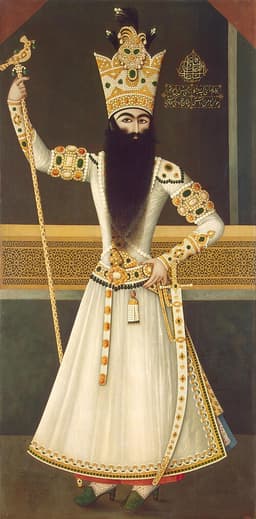
Fath-Ali Shah
Emperor · Modern
45.1Total

Julius Caesar
General · Ancient
82.8Total
Basic Information
Born
1772
-100
Died
1834
-44
Era
Modern
Ancient
Nationality
Persia
Roman Republic
Occupation
Emperor
General
Civilization
Middle Eastern
Western
Score Comparison
Military (10%)
35.0
88.0
Political (20%)
32.2
78.0
Influence (20%)
53.3
85.0
Legacy (20%)
41.7
82.0
Leadership (15%)
53.2
80.0
Strategy (15%)
50.0
85.0
TOTAL
45.1
82.8
Fath-Ali Shah — Complete Timeline
1800 AD
Patronized the Arts and ArchitectureCultural
Fath-Ali Shah was a major patron of Persian art, commissioning numerous paintings, manuscripts, and architectural projects. He ordered the construction of the Marble Palace (Kakh-e Marmar) in Tehran and supported the revival of Persian miniature painting, leaving a lasting cultural legacy.
PatronageArtArchitecture
Impact: nationalconstructive
1813 AD
Treaty of GulistanWar
Fath-Ali Shah signed the Treaty of Gulistan with Russia, ending the first Russo-Persian War (1804-1813). Persia ceded territories in the Caucasus, including Georgia, Dagestan, and parts of Armenia, marking a significant territorial loss and the beginning of Russian dominance in the region.
TreatyTerritorial LossRusso-Persian War
Impact: regionaltragic
1821 AD
War with the Ottoman Empire (1821-1823)War
Fath-Ali Shah launched a war against the Ottoman Empire, initially gaining victories in eastern Anatolia. However, the war ended inconclusively with the Treaty of Erzurum in 1823, which reaffirmed existing borders without significant territorial changes.
Ottoman WarTreaty of Erzurum
Impact: regional
1828 AD
Treaty of TurkmenchayWar
Fath-Ali Shah signed the Treaty of Turkmenchay with Russia, ending the second Russo-Persian War (1826-1828). Persia ceded the remaining Caucasian territories, including Yerevan and Nakhchivan, and paid a large indemnity. The treaty also granted extraterritorial rights to Russians in Persia.
TreatyTerritorial LossRusso-Persian War
Impact: regionaltragic
Julius Caesar — Complete Timeline
58 BC
Gallic WarsWar◆ Major
Caesar, as proconsul of Gaul, launched a series of campaigns that conquered all of Gaul (modern France, Belgium, and parts of Switzerland). He fought numerous battles, including against the Helvetii, the Belgae, and the Gallic chieftain Vercingetorix. The wars brought immense wealth and a loyal army to Caesar.
Gallic WarsConquestRoman Expansion
Impact: regional
49 BC
Crossing the RubiconPolitical Action◆ Major
Caesar led Legio XIII across the Rubicon River into Italy, defying the Roman Senate's order to disband his army. This act triggered a civil war against Pompey and the Optimates, ultimately leading to Caesar's dictatorship and the end of the Roman Republic.
Roman Civil WarEnd of RepublicPower Struggle
Impact: global
48 BC
Battle of PharsalusWar◆ Major
Caesar's outnumbered army defeated the larger forces of Pompey the Great at Pharsalus in Greece. Caesar's tactical use of a reserve line to counter Pompey's cavalry charge proved decisive. Pompey fled to Egypt, where he was assassinated, leaving Caesar as the undisputed master of the Roman world.
Roman Civil WarBattleDecisive Victory
Impact: regional
44 BC
Appointment as Dictator for LifePolitical Action◆ Major
The Roman Senate appointed Caesar dictator perpetuo (dictator for life), granting him unprecedented personal power. This move concentrated military, legislative, and judicial authority in one person, effectively ending the Roman Republic's traditional system of checks and balances and alarming many senators.
DictatorshipEnd of RepublicPower Consolidation
Impact: regionaldestructive
Assassination on the Ides of MarchPolitical Action◆ Major
A group of Roman senators, led by Marcus Junius Brutus and Gaius Cassius Longinus, stabbed Caesar to death at a meeting of the Senate in the Theatre of Pompey. The assassination was intended to restore the Republic, but instead triggered another civil war that led to the rise of the Roman Empire.
AssassinationRoman PoliticsEnd of Republic
Impact: globaldestructive
Expert Analysis
Origins
Fath-Ali Shah was born in 1772 in Damghan, Iran, into the Qajar tribe. His grandfather, Agha Mohammad Khan Qajar, founded the Qajar dynasty and reunified Persia. Fath-Ali Shah received traditional education in Persian literature and Islamic studies but lacked military training. In contrast, Julius Caesar was born in 100 BCE into the patrician Julian family in Rome. His father died when he was 16, and he was raised by his mother Aurelia. Caesar received a Hellenistic education, studying rhetoric, philosophy, and military tactics. He served as a priest of Jupiter and fled Rome during Sulla's proscriptions.
Rise to Power
Fath-Ali Shah ascended the throne in 1797 after his grandfather's assassination. He consolidated power by neutralizing rivals through marriages and appointments. He faced early challenges from rebellious Khans but maintained Qajar control. Caesar rose through the Roman political ladder: he served as military tribune, quaestor, aedile, and praetor. In 60 BCE, he formed the First Triumvirate with Pompey and Crassus, securing the consulship in 59 BCE. He then obtained the governorship of Gaul, launching the Gallic Wars (58–50 BCE) that expanded Roman territory and built his military reputation.
Leadership & Governance
Fath-Ali Shah's leadership was characterized by centralized autocracy with limited reforms. He maintained the Qajar administrative system and relied on tribal alliances. He patronized the arts, commissioning the Golestan Palace and numerous Qajar paintings. His governance scored 86.5 in leadership but 60.2 in political, reflecting weak state control. Caesar, scoring 80.0 in leadership and 78.0 in political, implemented radical reforms: he reformed the calendar (Julian calendar), granted citizenship to Gauls, initiated land reforms for veterans, and centralized authority as dictator. Caesar's governance was transformative, while Fath-Ali Shah's was reactive.
Triumph & Tragedy
Fath-Ali Shah's greatest triumph was maintaining Qajar rule despite Russian aggression. He patronized Persian culture, producing a rich artistic legacy. However, his greatest failure was the disastrous wars with Russia: the Treaty of Gulistan (1813) and Treaty of Turkmenchay (1828) ceded all Caucasian territories, reducing Persian influence. His military score of 46.8 reflects these defeats. Caesar's triumphs include the conquest of Gaul (military score 88.0) and victory in the Civil War (Battle of Pharsalus, 48 BCE). His tragedy was his assassination in 44 BCE, which led to civil wars and the end of the Republic. Caesar's political score of 78.0 was undermined by his accumulation of power.
Character & Destiny
Fath-Ali Shah was known for his love of luxury, art, and large harem (over 1,000 wives). He was indecisive in military matters, often delegating to his sons. His character led to a defensive posture against Russia, sealing his destiny as a loser of territory. Caesar, in contrast, was ambitious, decisive, and calculating. His crossing of the Rubicon in 49 BCE was a gamble that paid off. His clemency toward opponents (clementia Caesaris) was a political tool. However, his refusal to restore the Republic and acceptance of dictator-for-life status provoked his assassination. Caesar's character shaped his destiny as a transformative figure.
Legacy
Fath-Ali Shah's legacy is mixed: he is remembered as a patron of Qajar art and architecture, but his military failures lost Persia its northern territories. His influence score of 70.3 reflects cultural impact, but his legacy score of 54.5 shows limited enduring political power. Caesar's legacy is monumental: his name became synonymous with imperial rule (Kaiser, Tsar). The Julian calendar lasted 1,600 years. His conquests and reforms laid the foundation for the Roman Empire. Caesar's military and political scores (88.0 and 78.0) combine for a total score of 82.8, far higher than Fath-Ali Shah's 64.7.
Conclusion
Julius Caesar had far greater impact than Fath-Ali Shah. Caesar conquered Gaul, transformed Roman governance, and set the stage for the Roman Empire, influencing Western civilization for millennia. Fath-Ali Shah, despite cultural patronage, presided over territorial losses and failed to modernize Persia. The score gap of 18.1 points reflects this disparity. Caesar's strategic and military achievements (strategy score 85.0) dwarf Fath-Ali Shah's (67.1). While Fath-Ali Shah's leadership score (86.5) is higher than Caesar's (80.0), his overall effectiveness was lower. Caesar's total score of 82.8 versus 64.7 confirms his greater historical significance.
Rankings
🥇
Julius CaesarLeader
Mil: 88.0Pol: 78.0Inf: 85.0
82.8
🥈
Fath-Ali Shah
Mil: 35.0Pol: 32.2Inf: 53.3
45.1
+37.7 behind
How This Comparison Works
Algorithm
Each figure is scored on 6 dimensions (0—100 scale) based on structured historical data: Military (10%), Political (20%), Influence (20%), Legacy (20%), Leadership (15%), Strategy (15%). The weighted total produces the final ranking.
Data Sources
Scores are computed from structured sub-indicators in the database. Scale factors adjust for era (Ancient ×0.85, Modern ×1.0) and civilization size (Eastern ×1.05, Other ×0.80) to account for differences in population and military scale.
Maximum 3 Figures
Comparisons are limited to 2—3 figures to ensure readability and statistical meaningfulness.
Error Margins
±5 points per dimension — Sub-scores are derived from historical records with inherent uncertainty. Two figures within 5 points on a dimension should be considered roughly equivalent in that area.
Total Score Accuracy
±3 points overall — The weighted combination of 6 dimensions produces a total score with approximately ±3 points of uncertainty. Differences of less than 3 points are not statistically significant— the figures are effectively tied.
Known Limitations
- Historical records are incomplete and uneven across civilizations
- Figures from oral-tradition societies may be underrepresented
- Occupation labels can misclassify multi-role figures
- Scores measure capability and impact, not moral character
- Quantitative scoring is a comparison tool, not absolute truth
Capability Radar
Military (10%) — Battles & Warfare
Battles
40
95
Win Rate
20
92
Expansion
20
97
Political (20%) — Governance & Reform
Reform
20
90
Diplomacy
25
85
Economy
20
82
Influence (20%) — Cultural & Global Reach
Cultural
35
88
Global
15
94
Legacy (20%) — Historical Impact
Historical
30
95
Longevity
20
96
Leadership (15%) — Power & Stability
Tenure
70
75
Stability
30
60
Strategy (15%) — Tactics & Innovation
Strategy
25
94
Tactics
30
96
Reform
15
88
Similar Comparisons
Comments & Discussion
No comments yet. Be the first to share your thoughts!