Loading...
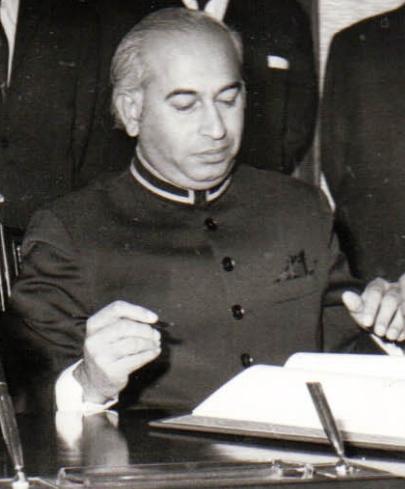
Bhutto Zulfikar Ali
ModernPoliticianPakistan1928 — ?
President and prime minister of Pakistan, founder of the PPP.
Compare Bhutto Zulfikar Ali with another historical figure:
Quick Facts
Born
1928
Country
Pakistan
Era
Modern
Occupation
Politician
Score Overview
Military (10%)46
Political (20%)55
Influence (20%)58
Legacy (20%)52
Leadership (15%)40
Strategy (15%)60
Total Score52.4
Bhutto Zulfikar Ali — Complete Timeline
1967 AD
Founding of the Pakistan People's PartyPolitical Action◆ Major
Bhutto founded the Pakistan People's Party (PPP) with a socialist and populist platform. The party quickly gained mass support, especially in West Pakistan, challenging the military regime of Ayub Khan.
PPPSocialismPolitical party
Impact: nationalconstructive
1970 AD
1970 general election victoryPolitical Action
Bhutto's PPP won a majority of seats in West Pakistan in the 1970 general election, while the Awami League won in East Pakistan. The refusal to transfer power to the Awami League led to the Bangladesh Liberation War.
ElectionBangladesh Liberation WarPolitical crisis
Impact: nationaldestructive
1972 AD
Nationalization of industriesReform◆ Major
Bhutto's government nationalized major industries, including steel, banking, and oil. This policy aimed to reduce economic inequality but led to inefficiencies, reduced foreign investment, and long-term economic challenges.
NationalizationEconomic reformSocialism
Impact: national
Simla AgreementPolitical Action◆ Major
Bhutto signed the Simla Agreement with Indian Prime Minister Indira Gandhi, normalizing relations after the 1971 war. The agreement established the Line of Control in Kashmir and committed both countries to bilateral resolution of disputes.
India-Pakistan relationsKashmirPeace treaty
Impact: regionalconstructive
1979 AD
Execution by Zia-ul-HaqPolitical Action
Bhutto was executed by hanging after a controversial murder trial under General Zia-ul-Haq's military regime. His death sparked international outrage and made him a martyr for the PPP, shaping Pakistani politics for decades.
ExecutionMartyrdomMilitary regime
Impact: nationaltragic
Detailed Scores
▶View all detailed scores
Military
Strategy
6
Tactics
5
Battles
6
Army Scale
5
War Impact
6
Political
Governance
7
Reform
7
Stability
7
Policy
8
Power
8
Influence
History
9
Global
8
Culture
9
Ideology
9
Legacy
8
People often compare with
See how Bhutto Zulfikar Ali stacks up against other historical figures
Popular Comparisons
Bhutto Zulfikar Ali vs John F. Kennedy
vs John F. Kennedy63
Bhutto Zulfikar Ali vs Obafemi Awolowo
vs Obafemi Awolowo57
Bhutto Zulfikar Ali vs Mauno Koivisto
vs Mauno Koivisto55
Bhutto Zulfikar Ali vs Charles Njonjo
vs Charles Njonjo53
Bhutto Zulfikar Ali vs Ion Iliescu
vs Ion Iliescu52
Bhutto Zulfikar Ali vs Giuliano Amato
vs Giuliano Amato51