Loading...
Bhutto Zulfikar Ali vs Obafemi Awolowo
Obafemi Awolowo leads by 4.4 pts · 2 figures compared
…
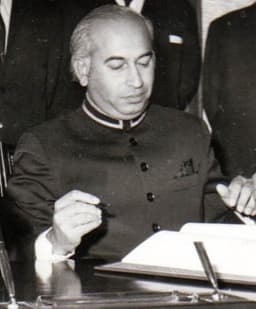
Bhutto Zulfikar Ali
Politician · Modern
52.4Total

Obafemi Awolowo
Politician · Modern
56.8Total
Basic Information
Born
1928
1909
Died
—
1987
Era
Modern
Modern
Nationality
Pakistan
Nigeria
Occupation
Politician
Politician
Civilization
Indian
Other
Score Comparison
Military (10%)
45.7
37.5
Political (20%)
55.0
62.7
Influence (20%)
58.3
56.7
Legacy (20%)
52.0
58.0
Leadership (15%)
40.0
72.0
Strategy (15%)
60.0
42.1
TOTAL
52.4
56.8
Bhutto Zulfikar Ali — Complete Timeline
1967 AD
Founding of the Pakistan People's PartyPolitical Action◆ Major
Bhutto founded the Pakistan People's Party (PPP) with a socialist and populist platform. The party quickly gained mass support, especially in West Pakistan, challenging the military regime of Ayub Khan.
PPPSocialismPolitical party
Impact: nationalconstructive
1970 AD
1970 general election victoryPolitical Action
Bhutto's PPP won a majority of seats in West Pakistan in the 1970 general election, while the Awami League won in East Pakistan. The refusal to transfer power to the Awami League led to the Bangladesh Liberation War.
ElectionBangladesh Liberation WarPolitical crisis
Impact: nationaldestructive
1972 AD
Nationalization of industriesReform◆ Major
Bhutto's government nationalized major industries, including steel, banking, and oil. This policy aimed to reduce economic inequality but led to inefficiencies, reduced foreign investment, and long-term economic challenges.
NationalizationEconomic reformSocialism
Impact: national
Simla AgreementPolitical Action◆ Major
Bhutto signed the Simla Agreement with Indian Prime Minister Indira Gandhi, normalizing relations after the 1971 war. The agreement established the Line of Control in Kashmir and committed both countries to bilateral resolution of disputes.
India-Pakistan relationsKashmirPeace treaty
Impact: regionalconstructive
1979 AD
Execution by Zia-ul-HaqPolitical Action
Bhutto was executed by hanging after a controversial murder trial under General Zia-ul-Haq's military regime. His death sparked international outrage and made him a martyr for the PPP, shaping Pakistani politics for decades.
ExecutionMartyrdomMilitary regime
Impact: nationaltragic
Obafemi Awolowo — Complete Timeline
1951 AD
Founded the Action GroupPolitical Action◆ Major
Awolowo founded the Action Group political party, which became the dominant party in the Western Region. The party advocated for federalism, social democracy, and rapid development, and it played a key role in Nigeria's independence movement.
Political PartyIndependenceFederalism
Impact: nationalconstructive
1955 AD
Introduced Free Primary Education in Western RegionReform◆ Major
As Premier of the Western Region, Awolowo implemented a free primary education program, the first of its kind in Nigeria. This policy significantly increased school enrollment and literacy rates in the region, setting a precedent for educational development in other parts of the country.
EducationWestern RegionSocial Reform
Impact: regionalconstructive
1963 AD
Imprisoned for TreasonPolitical Action◆ Major
Awolowo was convicted of conspiring to overthrow the Nigerian federal government and sentenced to ten years in prison. The trial was politically charged, and his imprisonment removed him from active politics during a critical period, contributing to regional tensions.
Treason TrialPolitical CrisisFirst Republic
Impact: nationaldestructive
1967 AD
Served as Federal Commissioner for FinancePolitical Action◆ Major
During the Nigerian Civil War, Awolowo was appointed Federal Commissioner for Finance. He implemented austerity measures and managed the war economy, including the controversial currency change that affected the secessionist Biafran region.
Civil WarFinanceBiafra
Impact: national
1979 AD
Contested Presidential ElectionsPolitical Action
Awolowo ran for president under the Unity Party of Nigeria but lost to Shehu Shagari. The election was disputed, with Awolowo alleging irregularities. His defeat marked the end of his presidential ambitions, though he remained a key opposition figure.
ElectionSecond RepublicOpposition
Impact: national
Expert Analysis
Origins
Zulfikar Ali Bhutto was born on January 5, 1928, in Larkana, Sindh, into a wealthy landowning family. His father, Sir Shah Nawaz Bhutto, was a prominent politician and close aide to Muhammad Ali Jinnah. Bhutto studied at the University of Southern California and the University of California, Berkeley, before earning a law degree from Christ Church, Oxford. His early exposure to feudal politics and Western education shaped his ambition and elitist yet populist outlook.
Obafemi Awolowo was born on March 6, 1909, in Ikenne, Western Nigeria, into a modest Yoruba family. Orphaned young, he worked various odd jobs to fund his education, eventually studying at the University of London and qualifying as a barrister. His humble beginnings fueled a lifelong commitment to social welfare and education. Awolowo's early career included journalism and trade unionism, giving him grassroots experience that contrasted with Bhutto's aristocratic path.
Rise to Power
Bhutto rose quickly through Pakistan's political ranks. In 1958, he became the youngest cabinet minister in Pakistan's history under President Iskander Mirza, later serving as Foreign Minister under Ayub Khan. He gained international fame for his fiery speech at the UN Security Council in 1964 and for negotiating the Tashkent Agreement in 1966. However, differences with Ayub Khan led him to resign and found the Pakistan People's Party (PPP) in 1967. The PPP's socialist platform resonated with the masses, and in the 1970 general election, it won a majority in West Pakistan, while the Awami League swept East Pakistan. The refusal to transfer power to the Awami League triggered the Bangladesh Liberation War, leading to Pakistan's defeat in 1971. Bhutto then assumed power as President and later Prime Minister, capitalizing on the national trauma.
Awolowo's rise was rooted in Nigerian nationalism. He founded the Action Group in 1950, which became the dominant party in the Western Region. As Premier of the Western Region from 1954 to 1960, he implemented progressive policies that made him a national figure. He played a key role in Nigeria's independence negotiations, advocating for federalism. However, his ambition for national leadership was thwarted. In 1962, he was tried and convicted for treasonable felony, sentenced to ten years in prison, which many saw as politically motivated by the ruling Northern People's Congress. He was released in 1966 after a coup and later served as Federal Commissioner for Finance during the Civil War (1967-1970), managing the war economy.
Leadership & Governance
Bhutto's leadership was charismatic and authoritarian. He nationalized major industries, banks, and oil companies, aiming to reduce inequality. His land reforms redistributed some land but were poorly implemented. He also pursued a nuclear weapons program, famously declaring Pakistan would eat grass if necessary to build the bomb. However, his government became increasingly repressive, cracking down on opposition and curtailing press freedom. His political score of 55.0 reflects his mixed record: populist appeal but flawed governance.
Awolowo's governance was systematic and reform-oriented. As Premier of the Western Region, he introduced free primary education, which increased enrollment from 457,000 in 1954 to 1.2 million by 1960. He also established the Western Nigeria Television Service, the first in Africa, and invested in infrastructure. His leadership style was technocratic and disciplined, earning him a leadership score of 72.0. However, his federalist vision often clashed with the central government, and his political maneuvering was less effective nationally.
Triumph & Tragedy
Bhutto's greatest triumph was the Simla Agreement with India in 1972, which secured the release of 90,000 Pakistani prisoners of war and normalized relations. He also initiated Pakistan's nuclear program. His greatest tragedy was his execution by General Zia-ul-Haq in 1979 after a controversial murder trial, which many viewed as judicial murder. The nationalization policies, while popular initially, led to economic inefficiency and a decline in private investment.
Awolowo's greatest achievement was the free primary education program, which transformed the Western Region into the most literate part of Nigeria. His management of the war economy during the Civil War was also praised. However, his greatest tragedy was his failure to become president. He contested the 1979 and 1983 elections but lost, alleging irregularities. His imprisonment for treason in the 1960s also tarnished his reputation, though it later enhanced his martyrdom.
Character & Destiny
Bhutto was charismatic, ambitious, and ruthless. His ability to connect with the masses was unmatched, but his authoritarian tendencies and unwillingness to compromise led to his downfall. He often made decisions based on instinct rather than consensus, alienating allies. His destiny was a tragic arc: from popular savior to executed prisoner. His total score of 52.4 reflects a leader who achieved much but whose flaws were costly.
Awolowo was disciplined, intellectual, and principled. He was known for his meticulous planning and moral rectitude. However, he was often perceived as aloof and rigid, which limited his national appeal. His destiny was one of near-misses: a great regional leader who could not translate success to the national stage. His total score of 56.8 reflects his effective governance but limited political reach.
Legacy
Bhutto's legacy is deeply polarizing in Pakistan. He is revered by supporters as a champion of the poor and the father of Pakistan's nuclear program. Critics blame him for economic mismanagement and the breakup of Pakistan. The PPP remains a major political force, and his daughter Benazir Bhutto became Prime Minister. His influence score of 58.3 reflects his enduring impact on Pakistani politics.
Awolowo's legacy is more uniformly positive in Nigeria, especially in the Yoruba-dominated Southwest. His free education policy created a generation of educated Nigerians. His advocacy for federalism and fiscal responsibility remains influential. He is often cited as a role model for good governance. His legacy score of 58.0 underscores his lasting contributions to Nigerian development.
Conclusion
Comparing Bhutto and Awolowo reveals two distinct models of leadership: Bhutto the populist transformer who reshaped Pakistan's political landscape but left a mixed legacy of nationalism and authoritarianism; Awolowo the institutional builder who created lasting social infrastructure but failed to achieve national leadership. While Awolowo's total score (56.8) edges Bhutto's (52.4), their impact must be weighed differently. Bhutto's decisions led to the creation of a nuclear power and the breakup of a nation, while Awolowo's policies improved millions of lives but within a regional framework. In terms of sheer historical impact, Bhutto's actions had more profound and often tragic consequences for a nation of 200 million. Awolowo's legacy is more localized but more constructive. Taking a stance, Awolowo's governance reforms and educational advancements arguably had a more positive and enduring impact on human development, scoring higher in leadership (72.0 vs 40.0) and legacy (58.0 vs 52.0). However, Bhutto's political influence and strategic decisions (strategy score 60.0) shaped the fate of a nuclear-armed state. Ultimately, if impact is measured by the scale of change, Bhutto's score of 58.3 in influence reflects his broader reach, but Awolowo's 56.8 total score suggests a more effective leader. The data supports Awolowo as the more effective governor, but Bhutto as the more consequential figure.
Rankings
🥇
Obafemi AwolowoLeader
Mil: 37.5Pol: 62.7Inf: 56.7
56.8
🥈
Bhutto Zulfikar Ali
Mil: 45.7Pol: 55.0Inf: 58.3
52.4
+4.4 behind
How This Comparison Works
Algorithm
Each figure is scored on 6 dimensions (0—100 scale) based on structured historical data: Military (10%), Political (20%), Influence (20%), Legacy (20%), Leadership (15%), Strategy (15%). The weighted total produces the final ranking.
Data Sources
Scores are computed from structured sub-indicators in the database. Scale factors adjust for era (Ancient ×0.85, Modern ×1.0) and civilization size (Eastern ×1.05, Other ×0.80) to account for differences in population and military scale.
Maximum 3 Figures
Comparisons are limited to 2—3 figures to ensure readability and statistical meaningfulness.
Error Margins
±5 points per dimension — Sub-scores are derived from historical records with inherent uncertainty. Two figures within 5 points on a dimension should be considered roughly equivalent in that area.
Total Score Accuracy
±3 points overall — The weighted combination of 6 dimensions produces a total score with approximately ±3 points of uncertainty. Differences of less than 3 points are not statistically significant— the figures are effectively tied.
Known Limitations
- Historical records are incomplete and uneven across civilizations
- Figures from oral-tradition societies may be underrepresented
- Occupation labels can misclassify multi-role figures
- Scores measure capability and impact, not moral character
- Quantitative scoring is a comparison tool, not absolute truth
Capability Radar
Military (10%) — Battles & Warfare
Battles
42
20
Win Rate
45
23
Expansion
51
29
Political (20%) — Governance & Reform
Reform
70
85
Diplomacy
60
70
Economy
55
80
Influence (20%) — Cultural & Global Reach
Cultural
55
60
Global
55
55
Legacy (20%) — Historical Impact
Historical
60
70
Longevity
50
55
Leadership (15%) — Power & Stability
Tenure
65
65
Stability
30
55
Strategy (15%) — Tactics & Innovation
Strategy
52
32
Tactics
57
32
Reform
60
38
Similar Comparisons
Comments & Discussion
No comments yet. Be the first to share your thoughts!