Loading...
Bhutto Zulfikar Ali vs Mauno Koivisto
Mauno Koivisto leads by 2.3 pts · 2 figures compared
…
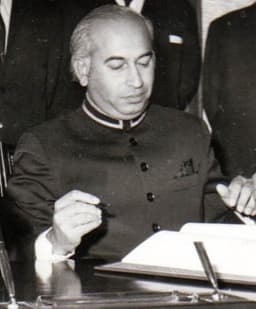
Bhutto Zulfikar Ali
Politician · Modern
52.4Total

Mauno Koivisto
Politician · Modern
54.7Total
Basic Information
Born
1928
1923
Died
—
—
Era
Modern
Modern
Nationality
Pakistan
Finland
Occupation
Politician
Politician
Civilization
Indian
Western
Score Comparison
Military (10%)
45.7
50.0
Political (20%)
55.0
55.0
Influence (20%)
58.3
57.2
Legacy (20%)
52.0
48.3
Leadership (15%)
40.0
72.0
Strategy (15%)
60.0
42.3
TOTAL
52.4
54.7
Bhutto Zulfikar Ali — Complete Timeline
1967 AD
Founding of the Pakistan People's PartyPolitical Action◆ Major
Bhutto founded the Pakistan People's Party (PPP) with a socialist and populist platform. The party quickly gained mass support, especially in West Pakistan, challenging the military regime of Ayub Khan.
PPPSocialismPolitical party
Impact: nationalconstructive
1970 AD
1970 general election victoryPolitical Action
Bhutto's PPP won a majority of seats in West Pakistan in the 1970 general election, while the Awami League won in East Pakistan. The refusal to transfer power to the Awami League led to the Bangladesh Liberation War.
ElectionBangladesh Liberation WarPolitical crisis
Impact: nationaldestructive
1972 AD
Nationalization of industriesReform◆ Major
Bhutto's government nationalized major industries, including steel, banking, and oil. This policy aimed to reduce economic inequality but led to inefficiencies, reduced foreign investment, and long-term economic challenges.
NationalizationEconomic reformSocialism
Impact: national
Simla AgreementPolitical Action◆ Major
Bhutto signed the Simla Agreement with Indian Prime Minister Indira Gandhi, normalizing relations after the 1971 war. The agreement established the Line of Control in Kashmir and committed both countries to bilateral resolution of disputes.
India-Pakistan relationsKashmirPeace treaty
Impact: regionalconstructive
1979 AD
Execution by Zia-ul-HaqPolitical Action
Bhutto was executed by hanging after a controversial murder trial under General Zia-ul-Haq's military regime. His death sparked international outrage and made him a martyr for the PPP, shaping Pakistani politics for decades.
ExecutionMartyrdomMilitary regime
Impact: nationaltragic
Mauno Koivisto — Complete Timeline
1979 AD
Served as Prime Minister of FinlandPolitical Action◆ Major
Koivisto served as Prime Minister from 1979 to 1982, leading a coalition government. He implemented economic policies to combat inflation and unemployment, and his government faced the 1980s recession.
Prime MinisterEconomyCoalition
Impact: national
1982 AD
Elected President of FinlandPolitical Action◆ Major
Mauno Koivisto was elected as the 9th President of Finland, succeeding Urho Kekkonen. His election marked a shift from Kekkonen's long era, with Koivisto emphasizing economic reform and a more cautious foreign policy.
PresidencyElectionFinland
Impact: nationalconstructive
1991 AD
Managed the collapse of the Soviet Union and Finnish-Soviet relationsPolitical Action◆ Major
Koivisto navigated Finland's relationship with the Soviet Union during its dissolution, maintaining stability and avoiding conflict. He renegotiated the 1948 Finno-Soviet Treaty, allowing Finland to pursue EU membership.
Soviet UnionForeign PolicyCold War
Impact: nationalconstructive
1994 AD
Resigned from the presidencyPolitical Action
Koivisto did not seek re-election in 1994, ending his presidency after two terms. He was succeeded by Martti Ahtisaari, and his departure marked the end of an era of Social Democratic dominance.
ResignationPresidencyTransition
Impact: national
1995 AD
Oversaw Finland's accession to the European UnionPolitical Action◆ Major
As president, Koivisto supported Finland's application to join the European Union, which was approved in a 1994 referendum. Finland became a member on January 1, 1995, ending its policy of neutrality.
European UnionForeign PolicyIntegration
Impact: nationalconstructive
Expert Analysis
Origins
Zulfikar Ali Bhutto was born on January 5, 1928, in Larkana, Sindh, into a wealthy landowning family. His father, Sir Shah Nawaz Bhutto, was a prominent politician. Bhutto studied at the University of Southern California and the University of California, Berkeley, then earned a law degree from Christ Church, Oxford. Mauno Koivisto was born on November 25, 1923, in Turku, Finland, into a working-class family. His father was a carpenter. Koivisto worked various jobs before studying sociology and history at the University of Turku, earning a PhD in 1956. Their backgrounds shaped their approaches: Bhutto aristocratic and internationally educated, Koivisto self-made and academic.
Rise to Power
Bhutto rose through Pakistan's political elite, serving as Foreign Minister under President Ayub Khan from 1963 to 1966. He broke with Ayub over the Tashkent Agreement and founded the Pakistan People's Party (PPP) in 1967, advocating socialism and democracy. In the 1970 general election, the PPP won a majority in West Pakistan, while the Awami League won in East Pakistan. The refusal to transfer power led to civil war and the creation of Bangladesh in 1971. Bhutto became President and later Prime Minister. Koivisto entered politics through the Social Democratic Party and became Prime Minister in 1979, leading a coalition. He was elected President in 1982, succeeding Urho Kekkonen, and was re-elected in 1988.
Leadership & Governance
Bhutto's leadership was charismatic and authoritarian. He nationalized major industries, banks, and oil companies, aiming to reduce inequality but causing inefficiency. He also pursued nuclear weapons development, which enhanced Pakistan's strategic position but strained relations with the West. His governance was marked by suppression of political opponents, including the arrest of opposition leader Wali Khan. Koivisto's leadership was pragmatic and consensus-building. He managed Finland's economy with austerity measures to curb inflation, and navigated the collapse of the Soviet Union, renegotiating trade agreements and maintaining stability. He oversaw Finland's accession to the European Union, with a 1994 referendum approving membership. Koivisto scored 72.0 in leadership, compared to Bhutto's 40.0.
Triumph & Tragedy
Bhutto's greatest triumph was the Simla Agreement of 1972 with India, which normalized relations and established the Line of Control in Kashmir. His nuclear program laid the foundation for Pakistan's eventual nuclear capability. His greatest tragedy was the loss of East Pakistan in 1971, which he inherited but could not prevent. His downfall came from his authoritarianism: he was overthrown by General Zia-ul-Haq in 1977 and executed in 1979 after a controversial murder trial. Koivisto's triumph was steering Finland into the EU, securing its place in Western Europe. He also managed the end of the Cold War without conflict. His tragedy was perhaps his lack of charisma; he was seen as dull and failed to inspire, but this ensured stability. He left office in 1994 with high approval ratings.
Character & Destiny
Bhutto was brilliant and ambitious, but also arrogant and vengeful. His character led him to overreach, alienating the military and opposition. His execution made him a martyr for his supporters. Koivisto was cautious, analytical, and unassuming. His character suited Finland's need for a steady hand during turbulent times. He avoided dramatic gestures and focused on practical results. Bhutto's total score is 52.4, with political 55.0 and strategy 60.0. Koivisto's total is 54.7, with leadership 72.0 and influence 57.2. Koivisto's higher leadership score reflects his effective governance.
Legacy
Bhutto's legacy is mixed. He is revered by the PPP as a martyr and champion of the poor, but his nationalization policies damaged the economy. His nuclear program is celebrated but controversial. He set a precedent for military intervention in politics. Koivisto's legacy is more positive: he is remembered as a successful president who modernized Finland's foreign policy and economy. He is not a cult figure but respected for his competence. Finland's EU membership and stable democracy are part of his legacy.
Conclusion
Mauno Koivisto had a greater impact on his country than Bhutto, despite Bhutto's higher profile. Koivisto's leadership score of 72.0 against Bhutto's 40.0 reflects his effective governance. While Bhutto's dramatic actions led to tragedy, Koivisto's steady hand ensured Finland's prosperity and stability. Koivisto's legacy is enduring and positive, while Bhutto's is divisive and partially reversed. Therefore, Koivisto is the more successful leader.
Rankings
🥇
Mauno KoivistoLeader
Mil: 50.0Pol: 55.0Inf: 57.2
54.7
🥈
Bhutto Zulfikar Ali
Mil: 45.7Pol: 55.0Inf: 58.3
52.4
+2.3 behind
How This Comparison Works
Algorithm
Each figure is scored on 6 dimensions (0—100 scale) based on structured historical data: Military (10%), Political (20%), Influence (20%), Legacy (20%), Leadership (15%), Strategy (15%). The weighted total produces the final ranking.
Data Sources
Scores are computed from structured sub-indicators in the database. Scale factors adjust for era (Ancient ×0.85, Modern ×1.0) and civilization size (Eastern ×1.05, Other ×0.80) to account for differences in population and military scale.
Maximum 3 Figures
Comparisons are limited to 2—3 figures to ensure readability and statistical meaningfulness.
Error Margins
±5 points per dimension — Sub-scores are derived from historical records with inherent uncertainty. Two figures within 5 points on a dimension should be considered roughly equivalent in that area.
Total Score Accuracy
±3 points overall — The weighted combination of 6 dimensions produces a total score with approximately ±3 points of uncertainty. Differences of less than 3 points are not statistically significant— the figures are effectively tied.
Known Limitations
- Historical records are incomplete and uneven across civilizations
- Figures from oral-tradition societies may be underrepresented
- Occupation labels can misclassify multi-role figures
- Scores measure capability and impact, not moral character
- Quantitative scoring is a comparison tool, not absolute truth
Capability Radar
Military (10%) — Battles & Warfare
Battles
42
30
Win Rate
45
30
Expansion
51
35
Political (20%) — Governance & Reform
Reform
70
60
Diplomacy
60
75
Economy
55
65
Influence (20%) — Cultural & Global Reach
Cultural
55
30
Global
55
55
Legacy (20%) — Historical Impact
Historical
60
50
Longevity
50
40
Leadership (15%) — Power & Stability
Tenure
65
70
Stability
30
80
Strategy (15%) — Tactics & Innovation
Strategy
52
40
Tactics
57
41
Reform
60
41
Similar Comparisons
Comments & Discussion
No comments yet. Be the first to share your thoughts!