Loading...
Bhutto Zulfikar Ali vs Giuliano Amato
Bhutto Zulfikar Ali leads by 1.0 pts · 2 figures compared
…
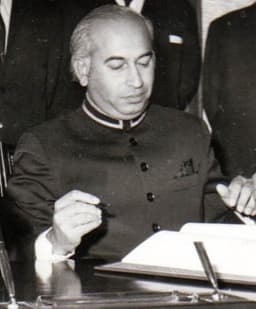
Bhutto Zulfikar Ali
Politician · Modern
52.4Total

Giuliano Amato
Politician · Modern
51.4Total
Basic Information
Born
1928
1938
Died
—
—
Era
Modern
Modern
Nationality
Pakistan
Italy
Occupation
Politician
Politician
Civilization
Indian
Western
Score Comparison
Military (10%)
45.7
15.1
Political (20%)
55.0
62.7
Influence (20%)
58.3
56.4
Legacy (20%)
52.0
45.0
Leadership (15%)
40.0
72.0
Strategy (15%)
60.0
43.3
TOTAL
52.4
51.4
Bhutto Zulfikar Ali — Complete Timeline
1967 AD
Founding of the Pakistan People's PartyPolitical Action◆ Major
Bhutto founded the Pakistan People's Party (PPP) with a socialist and populist platform. The party quickly gained mass support, especially in West Pakistan, challenging the military regime of Ayub Khan.
PPPSocialismPolitical party
Impact: nationalconstructive
1970 AD
1970 general election victoryPolitical Action
Bhutto's PPP won a majority of seats in West Pakistan in the 1970 general election, while the Awami League won in East Pakistan. The refusal to transfer power to the Awami League led to the Bangladesh Liberation War.
ElectionBangladesh Liberation WarPolitical crisis
Impact: nationaldestructive
1972 AD
Nationalization of industriesReform◆ Major
Bhutto's government nationalized major industries, including steel, banking, and oil. This policy aimed to reduce economic inequality but led to inefficiencies, reduced foreign investment, and long-term economic challenges.
NationalizationEconomic reformSocialism
Impact: national
Simla AgreementPolitical Action◆ Major
Bhutto signed the Simla Agreement with Indian Prime Minister Indira Gandhi, normalizing relations after the 1971 war. The agreement established the Line of Control in Kashmir and committed both countries to bilateral resolution of disputes.
India-Pakistan relationsKashmirPeace treaty
Impact: regionalconstructive
1979 AD
Execution by Zia-ul-HaqPolitical Action
Bhutto was executed by hanging after a controversial murder trial under General Zia-ul-Haq's military regime. His death sparked international outrage and made him a martyr for the PPP, shaping Pakistani politics for decades.
ExecutionMartyrdomMilitary regime
Impact: nationaltragic
Giuliano Amato — Complete Timeline
1992 AD
Implementation of the 1992 Budget (Austerity Measures)Reform◆ Major
Amato's government passed a drastic austerity budget to reduce Italy's public debt and meet EU convergence criteria. The measures included spending cuts, tax increases, and pension reforms, sparking widespread protests.
AusterityBudgetEU Convergence
Impact: nationalconstructive
First Appointment as Prime Minister of ItalyPolitical Action◆ Major
Giuliano Amato became Prime Minister of Italy for the first time, leading a coalition government during a period of political crisis and the Tangentopoli corruption scandal. His government focused on economic austerity and anti-corruption measures.
Prime MinisterTangentopoliAusterity
Impact: nationalconstructive
2000 AD
Second Appointment as Prime Minister of ItalyPolitical Action◆ Major
Amato became Prime Minister for a second time, leading a center-left coalition government. His term focused on economic reforms, European integration, and preparing Italy for the euro adoption.
Prime MinisterCenter-LeftEuro
Impact: nationalconstructive
2006 AD
Appointment as Minister of the InteriorPolitical Action
Amato served as Minister of the Interior in the Prodi government. He oversaw internal security and immigration policy, including measures to combat organized crime and manage migrant flows.
Minister of InteriorSecurityImmigration
Impact: nationalconstructive
Expert Analysis
Origins
**Zulfikar Ali Bhutto** was born on January 5, 1928, in Larkana, Sindh, into a wealthy landowning family. His father, Sir Shah Nawaz Bhutto, was a prominent politician and landowner. Bhutto studied at the University of Southern California and the University of California, Berkeley, earning a degree in political science, and later obtained an LLB from Christ Church, Oxford. He was called to the bar at Lincoln's Inn. His early career included teaching law and entering politics through the Muslim League.
**Giuliano Amato** was born on May 13, 1938, in Turin, Piedmont, Italy. His father was a magistrate. Amato studied law at the University of Pisa, graduating with honors, and later earned a master's in comparative law from the University of Pisa. He began his academic career as a professor of constitutional law. His early political involvement came through the Italian Socialist Party (PSI), where he became a close advisor to party leader Bettino Craxi.
Rise to Power
Bhutto's rise began in 1958 when he joined President Ayub Khan's cabinet as Minister of Commerce, later becoming Foreign Minister. He gained prominence for his stance on the Kashmir issue and close ties with China. In 1967, he founded the Pakistan People's Party (PPP) on a socialist and populist platform, attracting mass support. The turning point came in the 1970 general election, where the PPP won a majority of seats in West Pakistan while the Awami League swept East Pakistan. After the secession of Bangladesh in 1971, Bhutto took over as President and later Prime Minister, consolidating power.
Amato's rise was more gradual. He entered parliament in 1972 as a deputy for the PSI. He held various ministerial posts, including Minister of the Treasury (1987-1989). In 1992, amid the Tangentopoli corruption scandal that decimated the traditional parties, Amato was appointed Prime Minister for the first time, leading a coalition government. His technocratic reputation helped him navigate the crisis. He returned as Prime Minister in 2000-2001, heading a center-left coalition.
Leadership & Governance
Bhutto's leadership style was charismatic and authoritarian. He implemented sweeping socialist reforms, nationalizing major industries (steel, banking, oil) in 1972-1974. He also introduced land reforms, but these were limited by landlord opposition. His government drafted and passed the 1973 Constitution, establishing a parliamentary system. However, he increasingly centralized power, curbing civil liberties and suppressing dissent. His handling of the 1971 defeat and the Simla Agreement with India (1972) stabilized relations but was criticized for not resolving the Kashmir dispute.
Amato's leadership was pragmatic and crisis-driven. His first government (1992-1993) focused on severe austerity measures to reduce Italy's public debt and meet Maastricht criteria. He slashed spending, raised taxes, and introduced a controversial property tax. His second term (2000-2001) emphasized economic reforms, privatization, and European integration. Amato was a consensus-builder, but his technocratic approach lacked popular appeal. He scored 72.0 in leadership, reflecting his crisis management, while Bhutto scored 40.0 due to his authoritarian tendencies.
Triumph & Tragedy
Bhutto's greatest triumph was the 1973 Constitution, which remains Pakistan's framework. He also strengthened Pakistan's nuclear program and forged ties with China and the Islamic world. His Simla Agreement normalized relations with India. However, his nationalization policies led to economic inefficiency and alienated the business elite. His suppression of the Baloch insurgency (1973-1977) and human rights abuses tarnished his legacy. The ultimate tragedy was his execution by General Zia-ul-Haq in 1979 after a controversial murder trial, which sparked international outrage.
Amato's triumph was steering Italy through the 1992 financial crisis and preparing the country for the euro. His austerity measures, though painful, reduced inflation and stabilized public finances. He also passed important reforms in pensions and privatization. However, his policies contributed to a recession and high unemployment. His second term saw limited progress due to coalition infighting. He failed to address structural issues like the North-South divide. Amato's legacy is mixed: respected as a reformer but criticized for lacking transformative vision.
Character & Destiny
Bhutto was charismatic, ambitious, and confrontational. His populist rhetoric mobilized the masses but also created enemies. He was unwilling to share power, leading to the alienation of allies and the military. His decision to rig the 1977 elections triggered protests and a military coup, sealing his fate. Historians note his arrogance and poor strategic choices, scoring 60.0 in strategy but low in leadership.
Amato was intellectual, cautious, and consensus-oriented. He thrived in crisis but lacked boldness. His technocratic style earned him respect but not popularity. He was a survivor in Italian politics, serving in various roles, but his inability to build a lasting political movement limited his impact. His destiny was shaped by the Tangentopoli crisis, which both elevated and constrained him.
Legacy
Bhutto's legacy is profound in Pakistan. He founded the PPP, which remains a major party. His socialist rhetoric and anti-imperialist stance continue to influence Pakistani politics. The 1973 Constitution endures. However, his authoritarianism and economic failures are criticized. He is revered by supporters as a martyr, while others see him as a flawed leader. His total score is 52.4, with political influence at 55.0 and legacy at 52.0.
Amato's legacy is more institutional. He is remembered for fiscal discipline and European integration. His austerity measures paved the way for Italy's euro membership. However, his reforms were incomplete, and Italy's economic problems persist. He is a respected figure in European circles but not widely known outside Italy. His total score is 51.4, with strong leadership (72.0) but lower legacy (45.0).
Conclusion
Both leaders faced crises and implemented significant policies, but Bhutto had a greater impact on his nation's trajectory. His founding of the PPP, the 1973 Constitution, and his execution created a lasting political and cultural legacy in Pakistan. Amato's reforms were crucial but more incremental and less transformative. Bhutto's total score of 52.4 edges Amato's 51.4, reflecting his broader influence despite lower leadership. Therefore, Bhutto had greater impact.
Rankings
🥇
Bhutto Zulfikar AliLeader
Mil: 45.7Pol: 55.0Inf: 58.3
52.4
🥈
Giuliano Amato
Mil: 15.1Pol: 62.7Inf: 56.4
51.4
+1.0 behind
How This Comparison Works
Algorithm
Each figure is scored on 6 dimensions (0—100 scale) based on structured historical data: Military (10%), Political (20%), Influence (20%), Legacy (20%), Leadership (15%), Strategy (15%). The weighted total produces the final ranking.
Data Sources
Scores are computed from structured sub-indicators in the database. Scale factors adjust for era (Ancient ×0.85, Modern ×1.0) and civilization size (Eastern ×1.05, Other ×0.80) to account for differences in population and military scale.
Maximum 3 Figures
Comparisons are limited to 2—3 figures to ensure readability and statistical meaningfulness.
Error Margins
±5 points per dimension — Sub-scores are derived from historical records with inherent uncertainty. Two figures within 5 points on a dimension should be considered roughly equivalent in that area.
Total Score Accuracy
±3 points overall — The weighted combination of 6 dimensions produces a total score with approximately ±3 points of uncertainty. Differences of less than 3 points are not statistically significant— the figures are effectively tied.
Known Limitations
- Historical records are incomplete and uneven across civilizations
- Figures from oral-tradition societies may be underrepresented
- Occupation labels can misclassify multi-role figures
- Scores measure capability and impact, not moral character
- Quantitative scoring is a comparison tool, not absolute truth
Capability Radar
Military (10%) — Battles & Warfare
Battles
42
25
Win Rate
45
25
Expansion
51
28
Political (20%) — Governance & Reform
Reform
70
55
Diplomacy
60
60
Economy
55
55
Influence (20%) — Cultural & Global Reach
Cultural
55
30
Global
55
40
Legacy (20%) — Historical Impact
Historical
60
40
Longevity
50
30
Leadership (15%) — Power & Stability
Tenure
65
60
Stability
30
50
Strategy (15%) — Tactics & Innovation
Strategy
52
32
Tactics
57
32
Reform
60
37
Similar Comparisons
Comments & Discussion
No comments yet. Be the first to share your thoughts!