Loading...
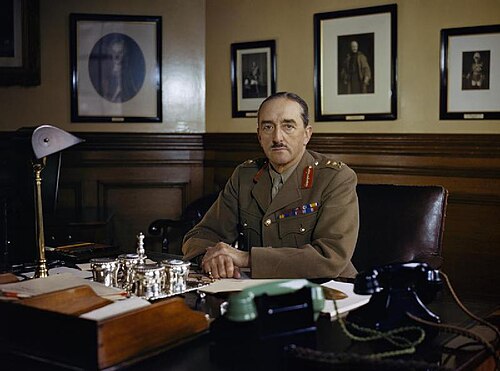
Alan Brooke
ModernGeneralUnited Kingdom1883 — 1963
Chief of the Imperial General Staff during WWII.
Compare Alan Brooke with another historical figure:
Quick Facts
Born
1883
Died
1963
Country
United Kingdom
Era
Modern
Occupation
General
Score Overview
Military (10%)55
Political (20%)72
Influence (20%)61
Legacy (20%)55
Leadership (15%)80
Strategy (15%)72
Total Score64.5
Alan Brooke — Complete Timeline
1941 AD
Appointed Chief of the Imperial General StaffOther◆ Major
In December 1941, Alan Brooke was appointed Chief of the Imperial General Staff (CIGS), the professional head of the British Army. He served in this role throughout World War II, overseeing military strategy and operations, and was a key member of the Chiefs of Staff Committee that advised Prime Minister Winston Churchill.
World War IIBritish ArmyMilitary Leadership
Impact: global
1943 AD
Participated in the Casablanca ConferenceOther◆ Major
In January 1943, Brooke attended the Casablanca Conference with Churchill and Roosevelt, where Allied strategy for the remainder of World War II was discussed. The conference agreed on the policy of 'unconditional surrender' for the Axis powers and the invasion of Sicily, with Brooke playing a key role in shaping military plans.
World War IIAllied StrategyCasablanca
Impact: global
Attended the Tehran ConferenceOther◆ Major
In November-December 1943, Brooke attended the Tehran Conference with Churchill, Roosevelt, and Stalin. The conference coordinated Allied military strategy against Germany, including the timing of the cross-channel invasion (Operation Overlord) and the Soviet offensive, with Brooke providing military advice on the feasibility of operations.
World War IIAllied StrategyTehran
Impact: global
1944 AD
Oversaw the D-Day PlanningOther◆ Major
As CIGS, Brooke was instrumental in planning the Normandy landings (D-Day) on June 6, 1944. He coordinated with Allied commanders to develop the invasion strategy, including the selection of landing beaches and the allocation of forces, which led to the successful liberation of Western Europe from Nazi occupation.
World War IID-DayNormandy Invasion
Impact: globalconstructive
Promoted to Field MarshalOther◆ Major
On January 1, 1944, Alan Brooke was promoted to the rank of Field Marshal, the highest rank in the British Army. This promotion recognized his exceptional service as CIGS and his contributions to Allied victory in World War II.
World War IIPromotionField Marshal
Impact: nationalconstructive
Detailed Scores
▶View all detailed scores
Military
Strategy
7
Tactics
7
Battles
7
Army Scale
7
War Impact
7
Political
Governance
7
Reform
7
Stability
7
Policy
8
Power
8
Influence
History
9
Global
8
Culture
9
Ideology
9
Legacy
9
People often compare with
See how Alan Brooke stacks up against other historical figures
Popular Comparisons
Alan Brooke vs Henry Hap Arnold
vs Henry Hap Arnold72
Alan Brooke vs Napoleon Bonaparte
vs Napoleon Bonaparte71
Alan Brooke vs Ernest J. King
vs Ernest J. King70
Alan Brooke vs James FitzJames Berwick
vs James FitzJames Berwick63
Alan Brooke vs Leonid Govorov
vs Leonid Govorov61
Alan Brooke vs Fidel V. Ramos
vs Fidel V. Ramos58