Loading...
Siaka Stevens vs Yan Xishan
Yan Xishan leads by 6.8 pts · 2 figures compared
…
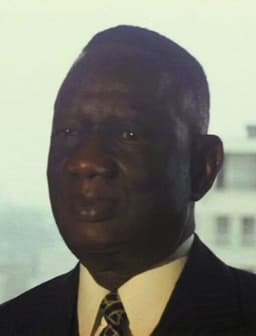
Siaka Stevens
Politician · Modern
49.5Total

Yan Xishan
Politician · Modern
56.3Total
Basic Information
Born
1905
1883
Died
1988
1960
Era
Modern
Modern
Nationality
Sierra Leone
China
Occupation
Politician
Politician
Civilization
Other
Eastern
Score Comparison
Military (10%)
50.0
45.0
Political (20%)
46.6
59.3
Influence (20%)
51.8
54.1
Legacy (20%)
43.3
46.7
Leadership (15%)
65.0
78.0
Strategy (15%)
39.5
60.0
TOTAL
49.5
56.3
Siaka Stevens — Complete Timeline
1967 AD
Became Prime Minister of Sierra LeonePolitical Action◆ Major
Siaka Stevens was appointed Prime Minister after his All People's Congress party won the 1967 general election. However, he was overthrown in a military coup within hours of taking office, forcing him into exile in Guinea.
ElectionCoupExile
Impact: national
1968 AD
Returned to Power and Became PresidentPolitical Action◆ Major
After a counter-coup, Stevens returned from exile and assumed the presidency. He consolidated power by declaring a one-party state in 1978, banning opposition parties, and centralizing control over the government and economy.
One-Party StateAuthoritarianismPresidency
Impact: nationaldestructive
1971 AD
Survived Multiple Coup AttemptsPolitical Action
Stevens faced several coup attempts, including a 1971 plot led by Brigadier John Bangura. He responded by purging the military, executing plotters, and relying on a paramilitary force and loyal army units to maintain his rule.
Coup AttemptRepressionMilitary
Impact: nationaldestructive
1980 AD
Implemented Economic DeclineReform◆ Major
Under Stevens' rule, Sierra Leone's economy deteriorated due to corruption, mismanagement, and declining diamond revenues. He nationalized industries and expanded the public sector, but living standards fell, and the country became heavily indebted.
Economic DeclineCorruptionMismanagement
Impact: nationaldestructive
1985 AD
Retired from PresidencyPolitical Action◆ Major
Stevens voluntarily stepped down as president, handing power to his chosen successor, Joseph Momoh. His retirement was rare in African politics at the time, but he left behind a weakened state and a legacy of authoritarian rule.
RetirementSuccessionLegacy
Impact: national
Yan Xishan — Complete Timeline
1912 AD
Establishment of Control over Shanxi ProvincePolitical Action◆ Major
Yan Xishan became the military governor of Shanxi Province after the Xinhai Revolution. He consolidated control over the province and implemented a series of reforms. His rule lasted for decades, making him one of the longest-serving warlords in China.
Warlord EraShanxiGovernance
Impact: regionalconstructive
1917 AD
Implementation of the 'Model Province' ReformsReform◆ Major
Yan Xishan implemented a series of reforms in Shanxi, including land redistribution, education, and infrastructure development. He promoted modern agriculture and industry, earning the nickname 'The Model Governor'. These reforms improved living standards but were authoritarian in nature.
ReformShanxiModernization
Impact: regionalconstructive
1926 AD
Participation in the Northern ExpeditionWar
Yan Xishan initially remained neutral during the Northern Expedition but later allied with the Nationalist government. He allowed Nationalist forces to pass through Shanxi and provided support. This decision helped him maintain his power after the Nationalists unified China.
WarAllianceNationalist
Impact: national
1930 AD
Defeat in the Central Plains WarWar◆ Major
Yan Xishan joined the anti-Chiang Kai-shek coalition in the Central Plains War. His forces were defeated by Chiang's National Revolutionary Army. The defeat forced Yan to flee to Dalian, but he later returned to Shanxi after negotiations with the Nationalist government.
WarDefeatWarlord
Impact: nationaldestructive
1949 AD
Surrender to the Communist PartyPolitical Action◆ Major
As the Chinese Civil War ended, Yan Xishan surrendered Shanxi to the Communist Party. He fled to Taiwan with the Nationalist government. His surrender marked the end of his long rule over Shanxi and the final defeat of the warlord era.
SurrenderCivil WarEnd of Rule
Impact: nationaltragic
Expert Analysis
Origins
Siaka Stevens was born in 1905 in Moyamba, Sierra Leone, to a Limba family. He studied at the Albert Academy in Freetown and later worked as a railway clerk and trade unionist. His early involvement in labor activism shaped his political career. Yan Xishan was born in 1883 in Wutai County, Shanxi, China, to a landlord family. He received a classical Confucian education and later attended the Imperial Japanese Army Academy, where he absorbed militarist and reformist ideas. Both came from modest backgrounds but rose through education and patronage.
Rise to Power
Stevens entered politics in the 1940s, co-founding the Sierra Leone People's Party (SLPP) in 1951. He broke away to form the All People's Congress (APC) in 1960, advocating for independence. After a disputed 1967 election, Stevens was sworn in as Prime Minister but was quickly ousted in a coup. He returned in 1968 after a counter-coup and became President in 1971. Yan Xishan rose after the 1911 Xinhai Revolution, becoming military governor of Shanxi in 1912. He skillfully navigated between warlords and the central government, expanding his control during the chaotic Warlord Era. By the 1920s, he was a key regional power.
Leadership & Governance
Stevens ruled Sierra Leone through patronage, corruption, and repression. He declared a one-party state in 1978, banned opposition, and centralized power. His economic policies, including nationalization and mismanagement of diamond revenues, led to decline. Yan Xishan implemented a 'Model Province' program in Shanxi, focusing on land reform, education, and infrastructure. He built roads, schools, and factories, and promoted modern agriculture. However, his rule was authoritarian, suppressing dissent and maintaining strict control. Stevens scored 65.0 in leadership, reflecting his ability to maintain power, while Yan scored 78.0, indicating more effective governance, but both used autocratic methods.
Triumph & Tragedy
Stevens' greatest success was maintaining power for 18 years and retiring voluntarily, a rarity in Africa. His tragedy was economic devastation: corruption and diamond smuggling caused GDP per capita to fall by 30% (from $500 in 1970 to $350 in 1985). He also faced multiple coup attempts, responding with executions. Yan Xishan's triumph was his 'Model Province' reforms, which made Shanxi a relative haven during China's turmoil. His tragedy was his defeat in the Central Plains War (1930) and eventual surrender to the Communists in 1949, leading to his exile in Taiwan. He scored 46.7 in legacy, reflecting mixed outcomes.
Character & Destiny
Stevens was a cunning political survivor, adept at manipulating factions. His focus on personal power over national development led to Sierra Leone's decline. Yan Xishan was pragmatic, cautious, and reform-minded, but his inability to adapt to the changing political landscape (e.g., the rise of the Communists) cost him his domain. Both were shaped by their environments: Stevens by post-colonial fragility, Yan by warlord-era competition. Their character traits—Stevens' ruthlessness and Yan's reformist authoritarianism—determined their fates.
Legacy
Stevens' legacy is largely negative: he institutionalized corruption and weakened state institutions, contributing to Sierra Leone's later civil war. His one-party state model was replicated elsewhere but failed. Yan Xishan's legacy is more positive: his reforms in Shanxi are remembered as a model of local development, and his emphasis on education and infrastructure influenced later Chinese governance. However, his collaboration with the Nationalists and later surrender tarnished his image in mainland China. Stevens scored 43.3 in legacy, Yan 46.7, reflecting Yan's greater enduring impact.
Conclusion
Yan Xishan had a greater overall impact than Siaka Stevens, with a total score of 56.3 vs 49.5. While both were autocrats, Yan's reforms in Shanxi created lasting improvements in education and infrastructure, whereas Stevens' rule left Sierra Leone impoverished and unstable. Yan's 'Model Province' approach demonstrated effective local governance, while Stevens' corruption and mismanagement caused long-term harm. Thus, Yan Xishan's legacy, though flawed, outweighs Stevens' in terms of constructive influence.
Rankings
🥇
Yan XishanLeader
Mil: 45.0Pol: 59.3Inf: 54.1
56.3
🥈
Siaka Stevens
Mil: 50.0Pol: 46.6Inf: 51.8
49.5
+6.8 behind
How This Comparison Works
Algorithm
Each figure is scored on 6 dimensions (0—100 scale) based on structured historical data: Military (10%), Political (20%), Influence (20%), Legacy (20%), Leadership (15%), Strategy (15%). The weighted total produces the final ranking.
Data Sources
Scores are computed from structured sub-indicators in the database. Scale factors adjust for era (Ancient ×0.85, Modern ×1.0) and civilization size (Eastern ×1.05, Other ×0.80) to account for differences in population and military scale.
Maximum 3 Figures
Comparisons are limited to 2—3 figures to ensure readability and statistical meaningfulness.
Error Margins
±5 points per dimension — Sub-scores are derived from historical records with inherent uncertainty. Two figures within 5 points on a dimension should be considered roughly equivalent in that area.
Total Score Accuracy
±3 points overall — The weighted combination of 6 dimensions produces a total score with approximately ±3 points of uncertainty. Differences of less than 3 points are not statistically significant— the figures are effectively tied.
Known Limitations
- Historical records are incomplete and uneven across civilizations
- Figures from oral-tradition societies may be underrepresented
- Occupation labels can misclassify multi-role figures
- Scores measure capability and impact, not moral character
- Quantitative scoring is a comparison tool, not absolute truth
Capability Radar
Military (10%) — Battles & Warfare
Battles
22
45
Win Rate
27
40
Expansion
27
30
Political (20%) — Governance & Reform
Reform
40
75
Diplomacy
45
65
Economy
30
70
Influence (20%) — Cultural & Global Reach
Cultural
30
40
Global
20
25
Legacy (20%) — Historical Impact
Historical
35
45
Longevity
25
35
Leadership (15%) — Power & Stability
Tenure
60
85
Stability
20
60
Strategy (15%) — Tactics & Innovation
Strategy
33
55
Tactics
36
50
Reform
35
60
Similar Comparisons
Comments & Discussion
No comments yet. Be the first to share your thoughts!