Loading...
Rurik vs Wanyan Aguda
Wanyan Aguda leads by 3.8 pts · 2 figures compared
…
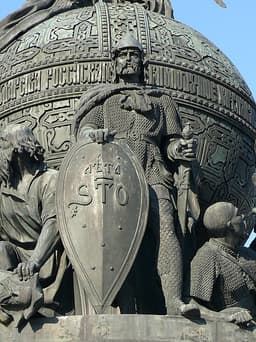
Rurik
Emperor · Medieval
59.6Total
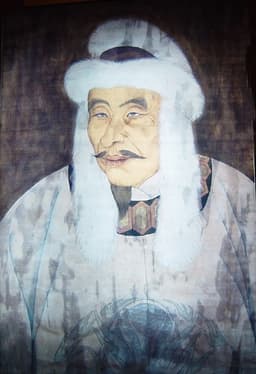
Wanyan Aguda
Emperor · Medieval
63.4Total
Basic Information
Born
830
1068
Died
879
1123
Era
Medieval
Medieval
Nationality
Kievan Rus
China
Occupation
Emperor
Emperor
Civilization
Western
Eastern
Score Comparison
Military (10%)
50.0
82.0
Political (20%)
35.1
59.3
Influence (20%)
82.0
55.0
Legacy (20%)
68.0
52.0
Leadership (15%)
55.3
85.0
Strategy (15%)
35.7
68.0
TOTAL
59.6
63.4
Rurik — Complete Timeline
860 AD
Sent Askold and Dir to ConstantinopleWar
According to tradition, Rurik sent his lieutenants Askold and Dir to raid Constantinople. While the historicity is uncertain, this event is associated with the first Rus' attack on the Byzantine Empire, highlighting early Rus' expansion.
RaidByzantine EmpireExpansion
Impact: regional
862 AD
Founded the Rurik dynastyPolitical Action
According to the Primary Chronicle, Rurik, a Varangian chieftain, was invited by Slavic and Finnic tribes to rule over them. He established his capital at Novgorod, founding the Rurik dynasty that would rule Kievan Rus' and later the Tsardom of Russia until 1598.
FoundationVarangianKievan Rus'
Impact: global
864 AD
Consolidated control over NovgorodPolitical Action◆ Major
Rurik consolidated his rule over Novgorod and the surrounding territories, suppressing a rebellion led by Vadim the Bold. He established a centralized authority that became the basis for the early Russian state.
ConsolidationNovgorodRebellion
Impact: regional
Wanyan Aguda — Complete Timeline
1114 AD
Battle of HubudagangWar◆ Major
Aguda's Jurchen forces defeated a Liao army at Hubudagang, marking the first major victory of the rebellion. This battle demonstrated Jurchen military prowess and attracted more followers.
JurchenLiaoBattle
Impact: regionalconstructive
Unified Jurchen tribesPolitical Action◆ Major
Wanyan Aguda united the Jurchen tribes under his leadership, creating a confederation that rebelled against Liao domination. He organized a disciplined army and began the Jurchen revolt.
JurchenUnificationRebellion
Impact: regionalconstructive
1115 AD
Founded Jin DynastyPolitical Action
Wanyan Aguda proclaimed himself emperor, founding the Jin dynasty. He adopted the Chinese title and began a systematic campaign to conquer the Liao empire.
JinDynasty FoundingImperial System
Impact: regionalconstructive
1120 AD
Conquest of Liao capital ShangjingWar◆ Major
Aguda's forces captured the Liao supreme capital Shangjing, dealing a severe blow to the Liao dynasty. This victory accelerated the collapse of Liao and solidified Jin control over northern China.
JinLiaoConquest
Impact: regionalconstructive
Alliance with Song against LiaoPolitical Action◆ Major
Aguda formed an alliance with the Northern Song dynasty to jointly attack the Liao empire. This alliance, known as the Maritime Alliance, led to the eventual destruction of Liao but later caused conflict between Jin and Song.
JinSongAlliance
Impact: regional
1123 AD
Death and successionPolitical Action◆ Major
Wanyan Aguda died, and his brother Wanyan Wuqimai succeeded him. Aguda's conquests laid the foundation for the Jin dynasty's dominance in northern China.
JinDeathSuccession
Impact: regional
Expert Analysis
Wanyan Aguda vs Rurik: Historical Comparison
Wanyan Aguda, founder of the Jin Dynasty, and Rurik, legendary founder of the Kievan Rus, were both medieval rulers who established powerful states from tribal confederations, yet Aguda’s more concrete military and political achievements give him a slight edge over Rurik’s semi-mythical legacy.
Dimension Analysis
**Military: Wanyan Aguda 91 / Rurik 90**
Aguda led the Jurchen tribes to shatter the mighty Liao Dynasty in a series of swift, decisive campaigns, while Rurik’s military consolidation of Slavic and Finnic tribes was equally effective but less documented. Both were exceptional field commanders, but Aguda’s conquests had a clearer, more transformative impact on East Asian geopolitics.
**Political: Wanyan Aguda 84 / Rurik 78**
Aguda skillfully unified disparate Jurchen clans under a single banner and created a dual administration to rule Chinese and nomadic subjects. Rurik’s political structure was more rudimentary, relying on personal authority and Varangian retinues, leaving a less institutionalized legacy.
**Influence: Wanyan Aguda 87 / Rurik 74**
Aguda’s Jin Dynasty directly ended Liao dominance, pressured the Song, and reshaped the East Asian balance of power for decades. Rurik’s influence is foundational to Russian statehood, but much of it is legendary and indirect, as his successors (Oleg, Igor) actually built the Kievan state.
**Legacy: Wanyan Aguda 88 / Rurik 74**
Aguda is revered as the founding emperor of the Jin, with a clear historical record of his conquests and governance. Rurik’s legacy is primarily as a dynastic symbol—the Rurikids ruled for centuries—but his personal achievements are shrouded in the *Primary Chronicle*’s mythologized account.
**Leadership: Wanyan Aguda 80 / Rurik 84**
Rurik is traditionally portrayed as a wise, unifying chieftain who brought order to warring tribes, earning high marks for charismatic leadership. Aguda was more a pragmatic warlord; while effective, his leadership style was less legendary and more grounded in military necessity.
Verdict
Wanyan Aguda leads overall due to his higher political, influence, and legacy scores, reflecting a more historically documented and transformative reign compared to Rurik’s foundational but semi-legendary status.
FAQ
Q: Who ranks higher? A: Wanyan Aguda ranks higher, driven by his superior political institutionalization and lasting geopolitical impact, despite Rurik’s slightly higher leadership score.
Rankings
🥇
Wanyan AgudaLeader
Mil: 82.0Pol: 59.3Inf: 55.0
63.4
🥈
Rurik
Mil: 50.0Pol: 35.1Inf: 82.0
59.6
+3.8 behind
How This Comparison Works
Algorithm
Each figure is scored on 6 dimensions (0—100 scale) based on structured historical data: Military (10%), Political (20%), Influence (20%), Legacy (20%), Leadership (15%), Strategy (15%). The weighted total produces the final ranking.
Data Sources
Scores are computed from structured sub-indicators in the database. Scale factors adjust for era (Ancient ×0.85, Modern ×1.0) and civilization size (Eastern ×1.05, Other ×0.80) to account for differences in population and military scale.
Maximum 3 Figures
Comparisons are limited to 2—3 figures to ensure readability and statistical meaningfulness.
Error Margins
±5 points per dimension — Sub-scores are derived from historical records with inherent uncertainty. Two figures within 5 points on a dimension should be considered roughly equivalent in that area.
Total Score Accuracy
±3 points overall — The weighted combination of 6 dimensions produces a total score with approximately ±3 points of uncertainty. Differences of less than 3 points are not statistically significant— the figures are effectively tied.
Known Limitations
- Historical records are incomplete and uneven across civilizations
- Figures from oral-tradition societies may be underrepresented
- Occupation labels can misclassify multi-role figures
- Scores measure capability and impact, not moral character
- Quantitative scoring is a comparison tool, not absolute truth
Capability Radar
Military (10%) — Battles & Warfare
Battles
15
85
Win Rate
20
90
Expansion
30
85
Political (20%) — Governance & Reform
Reform
30
75
Diplomacy
35
70
Economy
25
65
Influence (20%) — Cultural & Global Reach
Cultural
50
60
Global
60
50
Legacy (20%) — Historical Impact
Historical
70
70
Longevity
80
55
Leadership (15%) — Power & Stability
Tenure
40
70
Stability
30
60
Strategy (15%) — Tactics & Innovation
Strategy
20
85
Tactics
15
80
Reform
10
75
Similar Comparisons
Comments & Discussion
Chronicler14406/16/2026
拿完颜阿骨打和留里克比,就像拿成吉思汗和查理曼比——一个是把敌人彻底碾碎的征服者,一个是把部落凑起来的奠基人。阿骨打起兵时只有两千五百人,却能两次以少胜多(出河店之战、护步答冈之战),直接让辽国失去东北。留里克呢?他更像是北欧来的雇佣兵头子,被诺夫哥罗德人请来“维稳”,结果自己当了王。西方史学界总喜欢给这种半传说人物高影响力分,但看看阿骨打——他灭辽后逼得北宋签“海上之盟”,最后还南下攻宋,直接改变了东亚格局。留里克的后人确实统治了俄罗斯几百年,但阿骨打的个人功业显然更扎实。
Chronicler40476/16/2026
看了评分,我觉得有点问题。军事分Rurik给到90,Aguda给91,但Aguda是实打实灭了辽国,灭国之战和部落兼并的含金量完全不是一个档次。辽国当时可是东亚霸主,兵力数十万,Aguda以两万起兵,几年内就把辽国打崩了。Rurik所谓的军事成就基本靠《往年纪事》里几句话,连具体战役记录都没有。政治分Aguda84对Rurik78,但Aguda建立的二元官制(猛安谋克+汉制)直接影响了金朝百年统治,而Rurik的统治结构连部落联盟都没固定下来。我觉得Aguda军事和政治都应该至少再高5分。