Loading...
This comparison has not been analyzed yet.
One-time AI generation (~1 minute). Scores and timeline are already available below.
Ramiro II of Leon vs Sukjong of Goryeo
Ramiro II of Leon leads by 0.9 pts · 2 figures compared
…
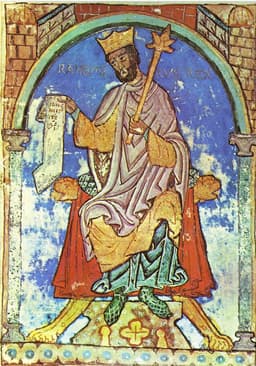
Ramiro II of Leon
Emperor · Medieval
51.1Total

Sukjong of Goryeo
Emperor · Medieval
50.2Total
Basic Information
Born
900
1054
Died
951
1105
Era
Medieval
Medieval
Nationality
Leon
Korea
Occupation
Emperor
Emperor
Civilization
Western
Eastern
Score Comparison
Military (10%)
47.5
21.2
Political (20%)
40.8
68.0
Influence (20%)
52.5
54.9
Legacy (20%)
45.0
45.8
Leadership (15%)
65.7
68.0
Strategy (15%)
60.0
25.0
TOTAL
51.1
50.2
Ramiro II of Leon — Complete Timeline
933 AD
Suppression of the Rebellion of the Banu QasiWar◆ Major
Ramiro II crushed a rebellion by the Banu Qasi family, a powerful Muslim dynasty in the Ebro Valley, who had allied with the Caliphate of Cordoba. He captured their strongholds and executed their leader, Muhammad ibn Hashim, eliminating a major threat to Leonese security.
RebellionBanu QasiEbro Valley
Impact: regionalconstructive
939 AD
Battle of SimancasWar
Ramiro II led a coalition of Christian forces to a decisive victory over the Caliphate of Cordoba under Abd al-Rahman III at Simancas. The battle was the first major defeat of the caliphate and halted Muslim expansion into the Duero Valley. Ramiro's victory secured Leonese independence and prestige.
BattleReconquistaCordoba
Impact: regionalconstructive
940 AD
Repopulation of SalamancaReform◆ Major
Following the victory at Simancas, Ramiro II ordered the repopulation of the abandoned city of Salamanca. He granted land and privileges to settlers from the north, establishing a fortified Christian presence on the southern bank of the Duero. This repopulation strengthened Leonese control over the region.
RepopulationSalamancaSettlement
Impact: regionalconstructive
Sukjong of Goryeo — Complete Timeline
1102 AD
Introduction of bronze coinageReform◆ Major
King Sukjong ordered the minting and circulation of bronze coins, known as 'haedong tongbo', to replace barter and cloth currency. This reform aimed to standardize trade and strengthen the Goryeo economy, though adoption was slow and limited to certain regions.
Economic ReformCurrencyGoryeo
Impact: nationalconstructive
1104 AD
Construction of the Namgyeong (Southern Capital)Political Action
Sukjong initiated the construction of a new secondary capital at Namgyeong (modern Seoul) to strengthen royal authority and counterbalance the influence of the Kaesong aristocracy. The project included palaces and defensive walls, but was not completed during his reign.
Urban PlanningCapitalGoryeo
Impact: nationalconstructive
1105 AD
Suppression of the Yi Ja-gyeom rebellionWar◆ Major
Sukjong faced a rebellion led by the powerful aristocrat Yi Ja-gyeom, who opposed the king's centralizing reforms. The rebellion was suppressed, but Sukjong died shortly after, leaving the conflict unresolved.
RebellionAristocracyGoryeo
Impact: nationaldestructive
This comparison has not been analyzed yet.
One-time AI generation (~1 minute). Scores and timeline are already available below.
Rankings
🥇
Ramiro II of LeonLeader
Mil: 47.5Pol: 40.8Inf: 52.5
51.1
🥈
Sukjong of Goryeo
Mil: 21.2Pol: 68.0Inf: 54.9
50.2
+0.9 behind
How This Comparison Works
Algorithm
Each figure is scored on 6 dimensions (0—100 scale) based on structured historical data: Military (10%), Political (20%), Influence (20%), Legacy (20%), Leadership (15%), Strategy (15%). The weighted total produces the final ranking.
Data Sources
Scores are computed from structured sub-indicators in the database. Scale factors adjust for era (Ancient ×0.85, Modern ×1.0) and civilization size (Eastern ×1.05, Other ×0.80) to account for differences in population and military scale.
Maximum 3 Figures
Comparisons are limited to 2—3 figures to ensure readability and statistical meaningfulness.
Error Margins
±5 points per dimension — Sub-scores are derived from historical records with inherent uncertainty. Two figures within 5 points on a dimension should be considered roughly equivalent in that area.
Total Score Accuracy
±3 points overall — The weighted combination of 6 dimensions produces a total score with approximately ±3 points of uncertainty. Differences of less than 3 points are not statistically significant— the figures are effectively tied.
Known Limitations
- Historical records are incomplete and uneven across civilizations
- Figures from oral-tradition societies may be underrepresented
- Occupation labels can misclassify multi-role figures
- Scores measure capability and impact, not moral character
- Quantitative scoring is a comparison tool, not absolute truth
Capability Radar
Military (10%) — Battles & Warfare
Battles
55
10
Win Rate
60
10
Expansion
40
10
Political (20%) — Governance & Reform
Reform
35
60
Diplomacy
40
50
Economy
35
70
Influence (20%) — Cultural & Global Reach
Cultural
30
40
Global
25
20
Legacy (20%) — Historical Impact
Historical
40
45
Longevity
30
30
Leadership (15%) — Power & Stability
Tenure
45
65
Stability
40
60
Strategy (15%) — Tactics & Innovation
Strategy
55
10
Tactics
50
10
Reform
30
15
Similar Comparisons
Comments & Discussion
No comments yet. Be the first to share your thoughts!