Loading...
Qin Er Shi vs Titus
Titus leads by 17.4 pts · 2 figures compared
…
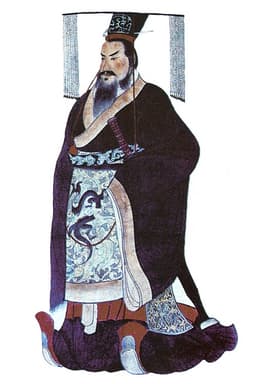
Qin Er Shi
Emperor · Ancient
44.1Total

Titus
Emperor · Ancient
61.5Total
Basic Information
Born
-229
39
Died
-207
81
Era
Ancient
Ancient
Nationality
China
Roman Empire
Occupation
Emperor
Emperor
Civilization
Eastern
Western
Score Comparison
Military (10%)
20.2
76.0
Political (20%)
68.0
68.0
Influence (20%)
42.4
60.0
Legacy (20%)
35.0
52.0
Leadership (15%)
43.6
65.7
Strategy (15%)
60.0
58.0
TOTAL
44.1
61.5
Qin Er Shi — Complete Timeline
210 BC
Accession as Second EmperorPolitical Action◆ Major
After Qin Shi Huang's death, Zhao Gao and Li Si forged a decree to force the crown prince Fusu to commit suicide and installed Huhai as Qin Er Shi. This illegitimate succession undermined the dynasty's legitimacy and placed an incompetent ruler on the throne.
SuccessionPalace IntrigueZhao Gao
Impact: nationaldestructive
209 BC
Outbreak of Dazexiang UprisingWar
Chen Sheng and Wu Guang led a rebellion of conscripted farmers at Dazexiang, sparking widespread revolts across the Qin empire. Qin Er Shi's harsh policies and heavy taxation had created widespread discontent, and the uprising quickly spread, leading to the dynasty's collapse.
RebellionQin CollapseChen Sheng
Impact: nationaldestructive
208 BC
Execution of Li SiPolitical Action◆ Major
Zhao Gao falsely accused Chancellor Li Si of treason. Qin Er Shi ordered Li Si's execution by the Five Pains method, along with his entire family. This removed the last capable administrator from the Qin court, accelerating the dynasty's decline.
ExecutionPolitical PurgeZhao Gao
Impact: nationaldestructive
207 BC
Death at the Hands of Zhao GaoPolitical Action◆ Major
Zhao Gao, fearing Qin Er Shi's anger over military defeats, staged a coup and forced the emperor to commit suicide. Zhao Gao then installed Ziying as the new king. This event marked the effective end of Qin rule, as Ziying surrendered to Liu Bang shortly after.
CoupDeathZhao Gao
Impact: nationaltragic
Titus — Complete Timeline
70 AD
Siege of Jerusalem (Titus)War
Titus, commanding four legions, besieged Jerusalem during the First Jewish-Roman War. After a five-month siege, he captured the city and destroyed the Second Temple, a pivotal event in Jewish history.
Jewish WarSiegeTemple Destruction
Impact: regionaldestructive
79 AD
Accession as EmperorPolitical Action◆ Major
Upon Vespasian's death, Titus became emperor, the first biological son to succeed his father in Roman history. He was popular for his generosity and efforts to aid disaster victims.
SuccessionFlavian DynastyImperial Rule
Impact: global
Eruption of Mount VesuviusOther◆ Major
Mount Vesuvius erupted, burying Pompeii and Herculaneum. Titus visited the area and provided relief funds, but the disaster killed thousands and destroyed entire cities.
Natural DisasterVesuviusPompeii
Impact: regionaltragic
80 AD
Completion of the ColosseumCultural◆ Major
Titus completed the Flavian Amphitheatre (Colosseum) and held inaugural games lasting 100 days, including gladiatorial contests and animal hunts. The Colosseum became a symbol of Roman engineering.
ArchitecturePublic WorksEntertainment
Impact: globalconstructive
Fire in Rome (Titus)Other
A fire broke out in Rome, destroying the Temple of Jupiter Optimus Maximus and other buildings. Titus personally directed relief efforts and compensated victims.
FireRomeDisaster Relief
tragic
Expert Analysis
Origins
Qin Er Shi, born Huhai in 230 BCE, was the 18th son of Qin Shi Huang, the first emperor of a unified China. His early life was sheltered, with little exposure to governance or military affairs. In contrast, Titus Flavius Vespasianus was born in 39 CE in Rome into a relatively modest equestrian family. His father, Vespasian, rose through the military ranks to become emperor. Titus was educated alongside the imperial court and gained military experience at a young age, serving as a tribune in Britain and Germany.
Rise to Power
Qin Er Shi ascended the throne in 210 BCE through a palace coup orchestrated by the eunuch Zhao Gao and Chancellor Li Si. They forged a decree from the dying Qin Shi Huang, ordering the crown prince Fusu to commit suicide and installing Huhai as emperor. This illegitimacy plagued his reign. Titus, by contrast, rose to power legitimately. He commanded the Roman legions in the First Jewish-Roman War, capturing Jerusalem in 70 CE after a five-month siege. This victory made him a military hero. Upon his father Vespasian's death in 79 CE, Titus became emperor, the first biological son to succeed his father in Roman history.
Leadership & Governance
Qin Er Shi's leadership was marked by incompetence and dependence on Zhao Gao. He ignored state affairs, intensified harsh laws, and executed Li Si in 208 BCE. His governance score of 68.0 reflects his ability to maintain control initially, but his political score was undermined by his failure to address rebellions. In contrast, Titus was known for his benevolence and efficiency. He completed the Colosseum and held lavish games, earning popularity. His political score of 68.0 matches Qin Er Shi's, but his leadership score of 65.7 far exceeds the latter's 43.6. Titus personally directed relief after the eruption of Mount Vesuvius in 79 CE and a fire in Rome, demonstrating active governance.
Triumph & Tragedy
Titus's greatest triumph was his conquest of Jerusalem, a turning point in Jewish history. He also completed the Colosseum, a lasting symbol of Rome. His tragedies include the Vesuvius eruption and a plague that struck Rome during his reign, though he handled both with compassion. Qin Er Shi's reign was a cascade of disasters: the Dazexiang Uprising in 209 BCE sparked widespread revolts, and his execution of Li Si eliminated a capable advisor. His death in 207 BCE at the hands of Zhao Gao marked the end of the Qin dynasty just three years after his accession. His military score of 20.2 reflects his complete inability to suppress rebellions.
Character & Destiny
Qin Er Shi was indecisive and easily manipulated, allowing Zhao Gao to control the court. His character led to the rapid collapse of the Qin dynasty. Titus, in contrast, was decisive and compassionate, earning the title "delight of mankind." His short reign (79-81 CE) was marked by effective crisis management. However, his early death at 41 prevented him from achieving more. Historical assessments rate Titus highly for his character, while Qin Er Shi is seen as a cautionary tale of weak leadership.
Legacy
Titus's legacy is enduring: the Colosseum remains a symbol of Rome, and his reign is remembered as a golden age. His military conquest of Jerusalem had profound historical consequences, including the Jewish diaspora. His legacy score of 52.0 reflects his lasting impact. Qin Er Shi's legacy is purely negative: he is remembered as the emperor who lost his father's empire. The Qin dynasty collapsed within three years of his reign, and his name is synonymous with misrule. His legacy score of 35.0 is lower, but his influence score of 42.4 acknowledges the dramatic fall of a dynasty.
Conclusion
Titus had a greater impact than Qin Er Shi. With total scores of 61.5 vs 44.1, Titus outperformed in military (76.0 vs 20.2), leadership (65.7 vs 43.6), and legacy (52.0 vs 35.0). While Qin Er Shi's political score ties at 68.0, his reign was a disaster that ended the Qin dynasty. Titus's achievements—conquering Jerusalem, completing the Colosseum, and governing effectively—left a positive and lasting mark on history. Thus, Titus stands as the more successful and impactful leader.
Rankings
🥇
TitusLeader
Mil: 76.0Pol: 68.0Inf: 60.0
61.5
🥈
Qin Er Shi
Mil: 20.2Pol: 68.0Inf: 42.4
44.1
+17.4 behind
How This Comparison Works
Algorithm
Each figure is scored on 6 dimensions (0—100 scale) based on structured historical data: Military (10%), Political (20%), Influence (20%), Legacy (20%), Leadership (15%), Strategy (15%). The weighted total produces the final ranking.
Data Sources
Scores are computed from structured sub-indicators in the database. Scale factors adjust for era (Ancient ×0.85, Modern ×1.0) and civilization size (Eastern ×1.05, Other ×0.80) to account for differences in population and military scale.
Maximum 3 Figures
Comparisons are limited to 2—3 figures to ensure readability and statistical meaningfulness.
Error Margins
±5 points per dimension — Sub-scores are derived from historical records with inherent uncertainty. Two figures within 5 points on a dimension should be considered roughly equivalent in that area.
Total Score Accuracy
±3 points overall — The weighted combination of 6 dimensions produces a total score with approximately ±3 points of uncertainty. Differences of less than 3 points are not statistically significant— the figures are effectively tied.
Known Limitations
- Historical records are incomplete and uneven across civilizations
- Figures from oral-tradition societies may be underrepresented
- Occupation labels can misclassify multi-role figures
- Scores measure capability and impact, not moral character
- Quantitative scoring is a comparison tool, not absolute truth
Capability Radar
Military (10%) — Battles & Warfare
Battles
33
70
Win Rate
37
85
Expansion
37
75
Political (20%) — Governance & Reform
Reform
0
50
Diplomacy
0
65
Economy
0
60
Influence (20%) — Cultural & Global Reach
Cultural
5
65
Global
5
55
Legacy (20%) — Historical Impact
Historical
15
70
Longevity
5
60
Leadership (15%) — Power & Stability
Tenure
3
30
Stability
0
55
Strategy (15%) — Tactics & Innovation
Strategy
41
80
Tactics
48
75
Reform
48
40
Similar Comparisons
Comments & Discussion
No comments yet. Be the first to share your thoughts!