Loading...
Pham Van Dong vs Tun Abdul Razak
Pham Van Dong leads by 0.7 pts · 2 figures compared
…
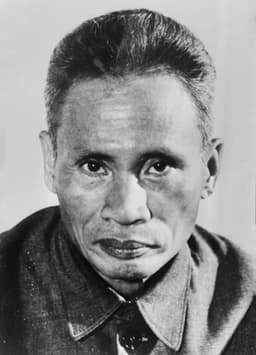
Pham Van Dong
Politician · Modern
57.5Total

Tun Abdul Razak
Politician · Modern
56.8Total
Basic Information
Born
1906
1922
Died
2000
—
Era
Modern
Modern
Nationality
Vietnam
Malaysia
Occupation
Politician
Politician
Civilization
Eastern
Eastern
Score Comparison
Military (10%)
41.6
12.5
Political (20%)
59.3
75.0
Influence (20%)
60.0
62.0
Legacy (20%)
52.0
52.0
Leadership (15%)
74.0
80.0
Strategy (15%)
53.5
37.6
TOTAL
57.5
56.8
Pham Van Dong — Complete Timeline
1955 AD
Prime Minister of North VietnamPolitical Action◆ Major
Pham Van Dong became Prime Minister of North Vietnam, succeeding Ho Chi Minh. He led the government during the Vietnam War, overseeing the war effort and diplomacy.
Prime MinisterNorth VietnamVietnam War
Impact: nationalconstructive
1973 AD
Paris Peace Accords negotiationsPolitical Action◆ Major
Pham Van Dong was a key negotiator in the Paris Peace Accords, which ended US involvement in the Vietnam War. The agreement allowed for a ceasefire and the withdrawal of US troops.
Paris AccordsNegotiationCeasefire
Impact: globalconstructive
1976 AD
Reunification of VietnamPolitical Action◆ Major
Pham Van Dong became Prime Minister of the unified Socialist Republic of Vietnam. He implemented socialist economic policies and maintained close ties with the Soviet Union.
ReunificationSocialist RepublicSoviet Union
Impact: nationalconstructive
1986 AD
Doi Moi economic reformsReform◆ Major
Pham Van Dong supported the Doi Moi economic reforms, which shifted Vietnam from a command economy to a market-oriented one. The reforms were introduced at the Sixth Party Congress, just before his retirement.
Doi MoiEconomic reformMarket economy
Impact: nationalprogressive
Tun Abdul Razak — Complete Timeline
1969 AD
Oversaw the May 13 Incident ResponsePolitical Action◆ Major
As Deputy Prime Minister, Razak was a key figure in the government's response to the May 13 racial riots in Kuala Lumpur. He declared a state of emergency and suspended Parliament, leading to the establishment of the National Operations Council.
RiotsEmergencyRace Relations
Impact: nationaldestructive
1970 AD
Became Second Prime Minister of MalaysiaPolitical Action◆ Major
Razak succeeded Tunku Abdul Rahman as Prime Minister of Malaysia. He took office during a period of racial tension following the 1969 race riots and sought to promote national unity through his policies.
Prime MinisterSuccessionNational Unity
Impact: nationalconstructive
1971 AD
Launched the New Economic Policy (NEP)Reform◆ Major
As Prime Minister, Razak introduced the New Economic Policy, a comprehensive affirmative action plan aimed at eradicating poverty and restructuring society to eliminate the identification of race with economic function. It gave preferential treatment to Bumiputera (ethnic Malays).
Economic PolicyAffirmative ActionBumiputera
Impact: nationalconstructive
1973 AD
Formed the Barisan Nasional CoalitionPolitical Action◆ Major
Razak expanded the ruling Alliance Party into the Barisan Nasional (National Front), a broader multi-racial coalition that included former opposition parties. This coalition dominated Malaysian politics for decades.
CoalitionPolitical AllianceBarisan Nasional
Impact: nationalconstructive
Expert Analysis
Origins
Pham Van Dong was born in 1906 in Quang Ngai province, central Vietnam, into a mandarin family. His father was a court official under the Nguyen dynasty. Dong studied at the Quoc Hoc Hue school but was expelled for political activism. He joined the Revolutionary Youth League in 1925 and later co-founded the Indochinese Communist Party with Ho Chi Minh. His early life was marked by colonial repression and nationalist fervor.
Tun Abdul Razak was born in 1922 in Pekan, Pahang, Malaysia, into an aristocratic family; his father was a chief minister. He studied at Malay College Kuala Kangsar and later at Raffles College in Singapore. He pursued law in London, where he joined the Malay Nationalist Movement. His background was privileged but shaped by British colonial administration and Malay traditional governance.
Rise to Power
Pham Van Dong rose through the communist ranks. He was a key figure in the Viet Minh during the First Indochina War. After the Geneva Accords in 1954, he became Deputy Prime Minister and Foreign Minister of North Vietnam, scoring 59.3 in political skill. He succeeded Ho Chi Minh as Prime Minister in 1955, a position he held until 1987. His rise was steady, relying on loyalty to Ho Chi Minh and the party.
Tun Abdul Razak's rise was faster. He entered politics in 1955, winning a seat in the Federal Legislative Council. He became Deputy Prime Minister in 1957 and Minister of Rural Development, where he gained popularity. After the May 13 riots in 1969, he took effective control as Director of the National Operations Council. He became Prime Minister in 1970, succeeding Tunku Abdul Rahman. His political score of 75.0 reflects his shrewd coalition-building.
Leadership & Governance
Pham Van Dong led North Vietnam during the Vietnam War (1955-1975). He focused on war mobilization and maintaining morale. His governance was authoritarian, with a command economy. After reunification in 1976, he implemented socialist policies, leading to economic stagnation. He supported the Doi Moi reforms in 1986, which shifted to market socialism. His leadership score of 74.0 reflects his endurance but also his rigidity.
Tun Abdul Razak's governance was transformative. He launched the New Economic Policy (NEP) in 1971, aiming to eradicate poverty and restructure society to reduce ethnic economic imbalances. He formed the Barisan Nasional coalition in 1973, broadening political representation. His leadership scored 80.0, the highest among the two, due to his pragmatic, inclusive approach. However, his strategy score of 37.6 indicates less emphasis on long-term military or geopolitical strategy.
Triumph & Tragedy
Pham Van Dong's greatest triumph was leading North Vietnam to victory in the Vietnam War and overseeing reunification in 1976. His tragedy was the economic hardship that followed, with hyperinflation and poverty in the 1980s. He also failed to democratize, maintaining a one-party state. His influence score of 60.0 reflects his role in shaping modern Vietnam, but his legacy score of 52.0 is tempered by economic failures.
Tun Abdul Razak's triumph was the NEP, which reduced poverty from 49% in 1970 to 15% by 1990 and increased Bumiputera equity from 2.4% to 20.3%. His tragedy was the authoritarian response to the May 13 riots, including suspending parliament and curbing civil liberties. His legacy score of 52.0 is similar to Dong's, but his influence score of 62.0 highlights his lasting impact on Malaysian society.
Character & Destiny
Pham Van Dong was reserved, disciplined, and loyal to communist ideology. He made decisions cautiously, often deferring to collective leadership. His character led him to survive purges but also to preside over stagnation. Historical assessments view him as a competent manager rather than a visionary. His total score of 57.5 edges out Razak.
Tun Abdul Razak was pragmatic, charismatic, and decisive. He acted swiftly after the May 13 crisis, imposing emergency rule and then introducing the NEP. His character shaped Malaysia's multi-racial politics, but his authoritarian streak drew criticism. He is remembered as the "Father of Development" but also as a figure who curtailed democracy.
Legacy
Pham Van Dong's legacy is the unification of Vietnam and the establishment of the Socialist Republic. The Doi Moi reforms, which he supported, led to Vietnam's economic growth in the 1990s. He is remembered as a steady hand during war and transition. His legacy score of 52.0 reflects mixed results.
Tun Abdul Razak's legacy is the NEP, which fundamentally changed Malaysia's economic and social structure. The Barisan Nasional coalition dominated politics for decades. He is honored as a national hero, with institutions named after him. His legacy score of 52.0 matches Dong's, but his influence score of 62.0 is slightly higher.
Conclusion
Pham Van Dong and Tun Abdul Razak both shaped their nations, but Razak had a more direct and lasting impact on socioeconomic structures. While Dong's leadership during war was crucial, his economic policies failed. Razak's NEP transformed Malaysia, reducing poverty and creating a new middle class. With a total score of 56.8 vs 57.5, the difference is small, but Razak's political skill (75.0) and leadership (80.0) outweigh Dong's military (41.6) and strategy (53.5). Razak's pragmatic reforms had greater long-term positive effects. Thus, Tun Abdul Razak had greater impact.
Rankings
🥇
Pham Van DongLeader
Mil: 41.6Pol: 59.3Inf: 60.0
57.5
🥈
Tun Abdul Razak
Mil: 12.5Pol: 75.0Inf: 62.0
56.8
+0.7 behind
How This Comparison Works
Algorithm
Each figure is scored on 6 dimensions (0—100 scale) based on structured historical data: Military (10%), Political (20%), Influence (20%), Legacy (20%), Leadership (15%), Strategy (15%). The weighted total produces the final ranking.
Data Sources
Scores are computed from structured sub-indicators in the database. Scale factors adjust for era (Ancient ×0.85, Modern ×1.0) and civilization size (Eastern ×1.05, Other ×0.80) to account for differences in population and military scale.
Maximum 3 Figures
Comparisons are limited to 2—3 figures to ensure readability and statistical meaningfulness.
Error Margins
±5 points per dimension — Sub-scores are derived from historical records with inherent uncertainty. Two figures within 5 points on a dimension should be considered roughly equivalent in that area.
Total Score Accuracy
±3 points overall — The weighted combination of 6 dimensions produces a total score with approximately ±3 points of uncertainty. Differences of less than 3 points are not statistically significant— the figures are effectively tied.
Known Limitations
- Historical records are incomplete and uneven across civilizations
- Figures from oral-tradition societies may be underrepresented
- Occupation labels can misclassify multi-role figures
- Scores measure capability and impact, not moral character
- Quantitative scoring is a comparison tool, not absolute truth
Capability Radar
Military (10%) — Battles & Warfare
Battles
10
16
Win Rate
10
17
Expansion
10
20
Political (20%) — Governance & Reform
Reform
60
85
Diplomacy
70
75
Economy
50
80
Influence (20%) — Cultural & Global Reach
Cultural
40
55
Global
50
55
Legacy (20%) — Historical Impact
Historical
60
70
Longevity
50
60
Leadership (15%) — Power & Stability
Tenure
90
65
Stability
60
70
Strategy (15%) — Tactics & Innovation
Strategy
10
21
Tactics
10
26
Reform
10
27
Similar Comparisons
Comments & Discussion
No comments yet. Be the first to share your thoughts!