Loading...
Levi Eshkol vs Pham Van Dong
Pham Van Dong leads by 6.4 pts · 2 figures compared
…

Levi Eshkol
Politician · Modern
51.1Total
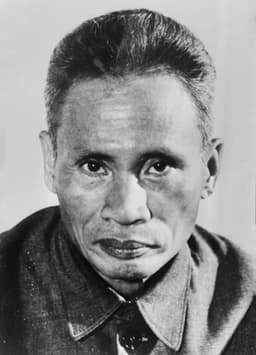
Pham Van Dong
Politician · Modern
57.5Total
Basic Information
Born
1895
1906
Died
1969
2000
Era
Modern
Modern
Nationality
Israel
Vietnam
Occupation
Politician
Politician
Civilization
Middle Eastern
Eastern
Score Comparison
Military (10%)
10.2
41.6
Political (20%)
60.0
59.3
Influence (20%)
59.0
60.0
Legacy (20%)
50.0
52.0
Leadership (15%)
68.0
74.0
Strategy (15%)
36.8
53.5
TOTAL
51.1
57.5
Levi Eshkol — Complete Timeline
1963 AD
Appointed Prime Minister of IsraelPolitical Action◆ Major
Levi Eshkol became the third Prime Minister of Israel in June 1963, succeeding David Ben-Gurion. He led the country during a period of economic growth and military buildup.
Prime MinisterLeadership
Impact: national
1964 AD
Established the National Water CarrierReform◆ Major
Eshkol oversaw the completion of the National Water Carrier, a massive infrastructure project that diverted water from the Sea of Galilee to the Negev desert. This project was crucial for Israel's agricultural development.
Water infrastructureDevelopment
Impact: nationalconstructive
1967 AD
Led Israel During the Six-Day WarWar
Eshkol was Prime Minister during the Six-Day War in June 1967. Despite initial hesitation, he authorized a preemptive strike against Egypt, Jordan, and Syria, resulting in Israel's capture of the Sinai, Gaza, West Bank, and Golan Heights.
Six-Day WarTerritorial expansion
Impact: global
1968 AD
Unified the Israeli Labor PartyPolitical Action◆ Major
Eshkol played a key role in merging Mapai, Ahdut HaAvoda, and Rafi to form the Israeli Labor Party in 1968. This unification strengthened the political left in Israel.
Political partyLabor Party
Impact: nationalconstructive
1969 AD
Died in OfficeOther◆ Major
Eshkol died of a heart attack in February 1969 while still in office. He was succeeded by Golda Meir. His death marked the end of a period of consolidation and expansion for Israel.
DeathTransition
Impact: nationaltragic
Pham Van Dong — Complete Timeline
1955 AD
Prime Minister of North VietnamPolitical Action◆ Major
Pham Van Dong became Prime Minister of North Vietnam, succeeding Ho Chi Minh. He led the government during the Vietnam War, overseeing the war effort and diplomacy.
Prime MinisterNorth VietnamVietnam War
Impact: nationalconstructive
1973 AD
Paris Peace Accords negotiationsPolitical Action◆ Major
Pham Van Dong was a key negotiator in the Paris Peace Accords, which ended US involvement in the Vietnam War. The agreement allowed for a ceasefire and the withdrawal of US troops.
Paris AccordsNegotiationCeasefire
Impact: globalconstructive
1976 AD
Reunification of VietnamPolitical Action◆ Major
Pham Van Dong became Prime Minister of the unified Socialist Republic of Vietnam. He implemented socialist economic policies and maintained close ties with the Soviet Union.
ReunificationSocialist RepublicSoviet Union
Impact: nationalconstructive
1986 AD
Doi Moi economic reformsReform◆ Major
Pham Van Dong supported the Doi Moi economic reforms, which shifted Vietnam from a command economy to a market-oriented one. The reforms were introduced at the Sixth Party Congress, just before his retirement.
Doi MoiEconomic reformMarket economy
Impact: nationalprogressive
Expert Analysis
Origins
Levi Eshkol was born on October 25, 1895, in the Russian Empire (now Ukraine) into a Jewish family. He received a traditional Jewish education and later studied at the University of Kyiv. He emigrated to Palestine in 1913, becoming a pioneer in agricultural settlements. His early involvement in the Zionist movement and the Histadrut union shaped his political career.
Pham Van Dong was born on March 1, 1906, in Quang Ngai province, French Indochina (now Vietnam), into a Confucian scholar family. He studied at the Quoc Hoc Hue school but was expelled for revolutionary activities. He joined the Communist Party of Vietnam in 1930 and spent years in French colonial prisons, which radicalized him.
Rise to Power
Eshkol rose through the ranks of the Zionist labor movement. He became treasurer of the Jewish Agency in 1942, managing finances for the pre-state Yishuv. After Israel's independence, he served as Minister of Agriculture (1951–1952) and Minister of Finance (1952–1963), where he oversaw economic development. He was elected Prime Minister on June 26, 1963, succeeding David Ben-Gurion.
Pham Van Dong rose as a close aide to Ho Chi Minh. He was a founding member of the Indochinese Communist Party and became a key figure in the Viet Minh. After the Geneva Conference in 1954, he became Prime Minister of North Vietnam on September 20, 1955, formally succeeding Ho Chi Minh. He led the government during the Vietnam War, overseeing war strategy and diplomacy.
Leadership & Governance
Eshkol's leadership style was conciliatory and pragmatic. He focused on economic growth, completing the National Water Carrier in 1964 to supply water to arid regions. He also unified the Israeli Labor Party in 1968, merging Mapai, Ahdut HaAvoda, and Rafi. His governance was marked by cautious decision-making, especially regarding military action. During the lead-up to the Six-Day War, he hesitated but ultimately authorized a preemptive strike, leading to a decisive victory.
Pham Van Dong was a steadfast communist leader, prioritizing national reunification and socialist transformation. He managed the war effort from Hanoi, maintaining morale and resource allocation. He was a key negotiator in the Paris Peace Accords (1973), which ended US involvement. After reunification, he implemented socialist economic policies, but these led to stagnation. He later supported the Doi Moi reforms in 1986, shifting to a market-oriented economy.
Triumph & Tragedy
Eshkol's greatest triumph was leading Israel during the Six-Day War (June 5–10, 1967), resulting in the capture of the Sinai, Gaza, West Bank, and Golan Heights. This victory secured Israel's borders for years. However, his hesitation before the war and reliance on a national unity government showed his cautious nature. His greatest failure was the economic slowdown in the early 1960s, though he addressed it with reforms.
Pham Van Dong's triumph was overseeing the reunification of Vietnam in 1976, fulfilling the long struggle for independence. The Paris Peace Accords in 1973 were a diplomatic success. However, his tragedy was the economic hardship after reunification due to failed collectivization and the US trade embargo. The Doi Moi reforms came too late to reverse his legacy of economic mismanagement.
Character & Destiny
Eshkol was known for his modesty, pragmatism, and consensus-building. He avoided confrontation, which sometimes delayed decisions. His character shaped his destiny: his cautious approach initially caused anxiety during the Six-Day War crisis, but his ultimate decisiveness brought victory. He died in office on February 26, 1969, leaving a legacy of consolidation.
Pham Van Dong was disciplined, loyal to communist ideology, and resilient. He endured prison and war, shaping his unyielding commitment to reunification. His character led him to prioritize political goals over economic efficiency, leading to post-war challenges. He remained in power until 1987, retiring after the Doi Moi reforms.
Legacy
Eshkol's legacy includes the expansion of Israel's territory and the unification of the Labor Party. The National Water Carrier remains a critical infrastructure. He scored 50.0 in legacy, with his cautious leadership style often overshadowed by successors. However, his role in the Six-Day War is pivotal in Middle Eastern history.
Pham Van Dong's legacy is tied to Vietnamese independence and reunification. He scored 52.0 in legacy, but his economic policies are criticized. The Doi Moi reforms, which he supported, eventually transformed Vietnam's economy. He is remembered as a dedicated revolutionary.
Conclusion
Pham Van Dong had greater impact due to his longer tenure and role in ending a major war and reunifying a nation. His total score of 57.5 exceeds Eshkol's 51.1. While Eshkol's military success was dramatic, Dong's influence spanned three decades and reshaped Vietnam. However, Eshkol's decisive leadership in the Six-Day War altered the Middle East. Ultimately, Dong's legacy of reunification and economic transformation gives him a slight edge in historical significance.
Rankings
🥇
Pham Van DongLeader
Mil: 41.6Pol: 59.3Inf: 60.0
57.5
🥈
Levi Eshkol
Mil: 10.2Pol: 60.0Inf: 59.0
51.1
+6.4 behind
How This Comparison Works
Algorithm
Each figure is scored on 6 dimensions (0—100 scale) based on structured historical data: Military (10%), Political (20%), Influence (20%), Legacy (20%), Leadership (15%), Strategy (15%). The weighted total produces the final ranking.
Data Sources
Scores are computed from structured sub-indicators in the database. Scale factors adjust for era (Ancient ×0.85, Modern ×1.0) and civilization size (Eastern ×1.05, Other ×0.80) to account for differences in population and military scale.
Maximum 3 Figures
Comparisons are limited to 2—3 figures to ensure readability and statistical meaningfulness.
Error Margins
±5 points per dimension — Sub-scores are derived from historical records with inherent uncertainty. Two figures within 5 points on a dimension should be considered roughly equivalent in that area.
Total Score Accuracy
±3 points overall — The weighted combination of 6 dimensions produces a total score with approximately ±3 points of uncertainty. Differences of less than 3 points are not statistically significant— the figures are effectively tied.
Known Limitations
- Historical records are incomplete and uneven across civilizations
- Figures from oral-tradition societies may be underrepresented
- Occupation labels can misclassify multi-role figures
- Scores measure capability and impact, not moral character
- Quantitative scoring is a comparison tool, not absolute truth
Capability Radar
Military (10%) — Battles & Warfare
Battles
15
10
Win Rate
15
10
Expansion
25
10
Political (20%) — Governance & Reform
Reform
60
60
Diplomacy
65
70
Economy
70
50
Influence (20%) — Cultural & Global Reach
Cultural
40
40
Global
55
50
Legacy (20%) — Historical Impact
Historical
60
60
Longevity
45
50
Leadership (15%) — Power & Stability
Tenure
55
90
Stability
50
60
Strategy (15%) — Tactics & Innovation
Strategy
20
10
Tactics
10
10
Reform
30
10
Similar Comparisons
Comments & Discussion
No comments yet. Be the first to share your thoughts!