Loading...
Mariano Rajoy vs Pham Van Dong
Pham Van Dong leads by 0.9 pts · 2 figures compared
…

Mariano Rajoy
Politician · Modern
56.6Total
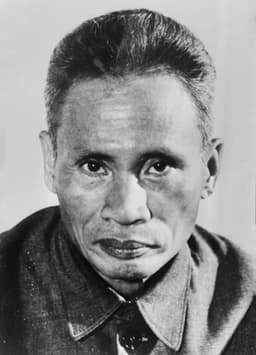
Pham Van Dong
Politician · Modern
57.5Total
Basic Information
Born
1955
1906
Died
—
2000
Era
Modern
Modern
Nationality
Spain
Vietnam
Occupation
Politician
Politician
Civilization
Western
Eastern
Score Comparison
Military (10%)
47.0
41.6
Political (20%)
72.0
59.3
Influence (20%)
58.0
60.0
Legacy (20%)
46.7
52.0
Leadership (15%)
72.0
74.0
Strategy (15%)
41.4
53.5
TOTAL
56.6
57.5
Mariano Rajoy — Complete Timeline
2011 AD
Election as Prime Minister of SpainPolitical Action◆ Major
Rajoy's Popular Party won a landslide victory in the 2011 general election, and he became Prime Minister on December 21. He took office during the Eurozone crisis, inheriting high unemployment and a large budget deficit.
ElectionGovernment
Impact: national
2012 AD
Bank Bailout and AusterityPolitical Action◆ Major
Rajoy's government requested a
Economic CrisisAusterity
Impact: nationaldestructive
2017 AD
Catalan Independence ReferendumPolitical Action◆ Major
Rajoy's government opposed the Catalan independence referendum held on October 1, 2017, which was declared illegal by the Constitutional Court. He invoked Article 155 of the Constitution to suspend Catalan autonomy and call new regional elections.
Catalan CrisisConstitutional
Impact: national
2018 AD
No-Confidence Vote and ResignationPolitical Action◆ Major
Rajoy lost a no-confidence motion on June 1, 2018, after corruption convictions of former Popular Party officials. He resigned as Prime Minister, replaced by Socialist leader Pedro S
CorruptionPolitical Change
Impact: nationaldestructive
Pham Van Dong — Complete Timeline
1955 AD
Prime Minister of North VietnamPolitical Action◆ Major
Pham Van Dong became Prime Minister of North Vietnam, succeeding Ho Chi Minh. He led the government during the Vietnam War, overseeing the war effort and diplomacy.
Prime MinisterNorth VietnamVietnam War
Impact: nationalconstructive
1973 AD
Paris Peace Accords negotiationsPolitical Action◆ Major
Pham Van Dong was a key negotiator in the Paris Peace Accords, which ended US involvement in the Vietnam War. The agreement allowed for a ceasefire and the withdrawal of US troops.
Paris AccordsNegotiationCeasefire
Impact: globalconstructive
1976 AD
Reunification of VietnamPolitical Action◆ Major
Pham Van Dong became Prime Minister of the unified Socialist Republic of Vietnam. He implemented socialist economic policies and maintained close ties with the Soviet Union.
ReunificationSocialist RepublicSoviet Union
Impact: nationalconstructive
1986 AD
Doi Moi economic reformsReform◆ Major
Pham Van Dong supported the Doi Moi economic reforms, which shifted Vietnam from a command economy to a market-oriented one. The reforms were introduced at the Sixth Party Congress, just before his retirement.
Doi MoiEconomic reformMarket economy
Impact: nationalprogressive
Expert Analysis
Origins
Mariano Rajoy was born in 1955 in Santiago de Compostela, Spain, into a family of lawyers. He studied law at the University of Santiago de Compostela and became a property registrar. His early career was in the conservative People's Party (PP), where he held various ministerial posts under Prime Minister José María Aznar from 1996 to 2004. Pham Van Dong was born in 1906 in Quang Ngai Province, French Indochina. He studied at the University of Hanoi but was expelled for political activities. He joined Ho Chi Minh's revolutionary movement and co-founded the Indochinese Communist Party in 1930. He spent years in French prisons, which hardened his resolve.
Rise to Power
Rajoy rose within the PP, serving as Minister of Public Administrations, Education, and Interior under Aznar. After the PP's defeat in 2004, he became party leader and opposition leader. He won the 2011 general election by a landslide, capitalizing on public discontent over the economic crisis. Pham Van Dong rose as a close ally of Ho Chi Minh. He served as Foreign Minister of North Vietnam from 1954 and became Prime Minister in 1955 after Ho Chi Minh stepped down. He led the government during the Vietnam War, coordinating war efforts and diplomacy.
Leadership & Governance
Rajoy's leadership was characterized by cautious, consensus-oriented governance. He implemented austerity measures, cutting public spending and labor reforms, which reduced the deficit but increased inequality. His handling of the Catalan independence crisis involved invoking Article 155 to impose direct rule, a legal but confrontational move. Pham Van Dong led a socialist government, nationalizing industries and collectivizing agriculture. He maintained strict party control but later supported Doi Moi reforms, introducing market elements. His governance was more ideological but pragmatic in wartime.
Triumph & Tragedy
Rajoy's triumph was stabilizing Spain's economy after the bailout, with growth returning by 2014. His tragedy was the Catalan crisis and the corruption scandals that led to his ouster. Pham Van Dong's triumph was achieving Vietnamese reunification in 1976 and negotiating the Paris Peace Accords. His tragedy was the economic stagnation under his early policies and the aftermath of war, including the Cambodian invasion.
Character & Destiny
Rajoy was known for his phlegmatic, unflappable demeanor. He avoided confrontation but was decisive when needed. His fate was sealed by corruption in his party, not his own actions. Pham Van Dong was a disciplined revolutionary, loyal to Ho Chi Minh's ideals. He adapted to changing circumstances, supporting reforms later. His destiny was tied to Vietnam's struggle and eventual unification.
Legacy
Rajoy's legacy is mixed: he is credited with economic recovery but blamed for austerity's social costs and mishandling Catalonia. His political score of 72.0 reflects his electoral success, but his influence score of 58.0 shows limited global impact. Pham Van Dong's legacy is that of a founding father of modern Vietnam. His political score of 59.3 and influence of 60.0 reflect his long tenure. His leadership score of 74.0 is higher than Rajoy's 72.0, reflecting his role in war and reunification.
Conclusion
While both were effective politicians, Pham Van Dong had greater impact due to his role in shaping a nation's destiny. Rajoy managed a crisis in an established democracy, but Pham Van Dong helped create a country. The score gap of 0.9 points favoring Pham Van Dong aligns with this: Pham Van Dong's total 57.5 vs Rajoy's 56.6. Pham Van Dong's strategic score of 53.5 also edges Rajoy's 41.4, indicating better long-term vision. Thus, Pham Van Dong emerges as the more consequential figure.
Rankings
🥇
Pham Van DongLeader
Mil: 41.6Pol: 59.3Inf: 60.0
57.5
🥈
Mariano Rajoy
Mil: 47.0Pol: 72.0Inf: 58.0
56.6
+0.9 behind
How This Comparison Works
Algorithm
Each figure is scored on 6 dimensions (0—100 scale) based on structured historical data: Military (10%), Political (20%), Influence (20%), Legacy (20%), Leadership (15%), Strategy (15%). The weighted total produces the final ranking.
Data Sources
Scores are computed from structured sub-indicators in the database. Scale factors adjust for era (Ancient ×0.85, Modern ×1.0) and civilization size (Eastern ×1.05, Other ×0.80) to account for differences in population and military scale.
Maximum 3 Figures
Comparisons are limited to 2—3 figures to ensure readability and statistical meaningfulness.
Error Margins
±5 points per dimension — Sub-scores are derived from historical records with inherent uncertainty. Two figures within 5 points on a dimension should be considered roughly equivalent in that area.
Total Score Accuracy
±3 points overall — The weighted combination of 6 dimensions produces a total score with approximately ±3 points of uncertainty. Differences of less than 3 points are not statistically significant— the figures are effectively tied.
Known Limitations
- Historical records are incomplete and uneven across civilizations
- Figures from oral-tradition societies may be underrepresented
- Occupation labels can misclassify multi-role figures
- Scores measure capability and impact, not moral character
- Quantitative scoring is a comparison tool, not absolute truth
Capability Radar
Military (10%) — Battles & Warfare
Battles
30
10
Win Rate
34
10
Expansion
38
10
Political (20%) — Governance & Reform
Reform
55
60
Diplomacy
60
70
Economy
55
50
Influence (20%) — Cultural & Global Reach
Cultural
30
40
Global
40
50
Legacy (20%) — Historical Impact
Historical
40
60
Longevity
30
50
Leadership (15%) — Power & Stability
Tenure
65
90
Stability
45
60
Strategy (15%) — Tactics & Innovation
Strategy
38
10
Tactics
38
10
Reform
44
10
Similar Comparisons
Comments & Discussion
No comments yet. Be the first to share your thoughts!