Loading...
This comparison has not been analyzed yet.
One-time AI generation (~1 minute). Scores and timeline are already available below.
Pham Minh Chinh vs Wojciech Jaruzelski
Pham Minh Chinh leads by 5.6 pts · 2 figures compared
…

Pham Minh Chinh
General · Modern
57.4Total
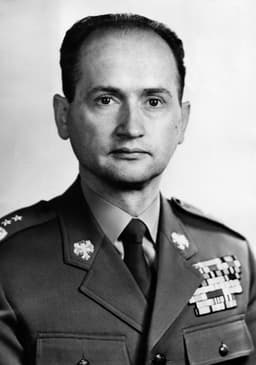
Wojciech Jaruzelski
General · Modern
51.8Total
Basic Information
Born
1958
1923
Died
—
—
Era
Modern
Modern
Nationality
Vietnam
Poland
Occupation
General
General
Civilization
Eastern
Western
Score Comparison
Military (10%)
60.6
50.0
Political (20%)
72.0
45.1
Influence (20%)
51.8
56.4
Legacy (20%)
41.7
47.5
Leadership (15%)
68.0
65.0
Strategy (15%)
69.3
43.3
TOTAL
57.4
51.8
Pham Minh Chinh — Complete Timeline
2021 AD
Appointed Prime Minister of VietnamPolitical Action◆ Major
Pham Minh Chinh was appointed Prime Minister of Vietnam by the National Assembly. He previously served as head of the Central Organizing Committee and was known for his security background.
Prime MinisterAppointmentVietnam
Impact: national
Leadership in COVID-19 ResponsePolitical Action◆ Major
Chinh led Vietnam's response to the COVID-19 pandemic, implementing strict lockdowns and a vaccination campaign. Vietnam initially had low case numbers but faced a Delta variant surge in mid-2021.
COVID-19Public HealthCrisis Management
Impact: national
2022 AD
Promotion of Digital Economy and InfrastructureReform
Chinh announced policies to boost Vietnam's digital economy and infrastructure development, including investments in 5G and smart cities. These reforms aimed to attract foreign investment and modernize the economy.
Digital EconomyInfrastructureReform
Impact: nationalconstructive
Wojciech Jaruzelski — Complete Timeline
1981 AD
Appointment as First Secretary of the Polish United Workers' PartyPolitical Action◆ Major
Jaruzelski became First Secretary of the Polish United Workers' Party (PZPR) amid a deep political and economic crisis. He also held the posts of Prime Minister and Minister of Defense, concentrating power in his hands.
Communist leadership
Impact: national
Imposition of Martial Law in PolandPolitical Action
Jaruzelski declared martial law on December 13, 1981, to crush the Solidarity trade union movement. The military arrested thousands of activists, including Lech Walesa, and suspended civil liberties. The crackdown was widely condemned internationally.
Martial lawRepression
Impact: nationaldestructive
1989 AD
Round Table TalksPolitical Action
Facing mounting pressure and economic collapse, Jaruzelski agreed to Round Table Talks with the opposition, including Solidarity. The talks led to partially free elections, which Solidarity won, marking the beginning of the end of communist rule in Poland.
Political transitionFall of communism
Impact: globalconstructive
1990 AD
Resignation as PresidentPolitical Action◆ Major
Jaruzelski resigned as President of Poland, handing over power to Lech Walesa, the leader of Solidarity. This completed the peaceful transition from communist to democratic rule in Poland.
Political transition
Impact: national
This comparison has not been analyzed yet.
One-time AI generation (~1 minute). Scores and timeline are already available below.
Rankings
🥇
Pham Minh ChinhLeader
Mil: 60.6Pol: 72.0Inf: 51.8
57.4
🥈
Wojciech Jaruzelski
Mil: 50.0Pol: 45.1Inf: 56.4
51.8
+5.6 behind
How This Comparison Works
Algorithm
Each figure is scored on 6 dimensions (0—100 scale) based on structured historical data: Military (10%), Political (20%), Influence (20%), Legacy (20%), Leadership (15%), Strategy (15%). The weighted total produces the final ranking.
Data Sources
Scores are computed from structured sub-indicators in the database. Scale factors adjust for era (Ancient ×0.85, Modern ×1.0) and civilization size (Eastern ×1.05, Other ×0.80) to account for differences in population and military scale.
Maximum 3 Figures
Comparisons are limited to 2—3 figures to ensure readability and statistical meaningfulness.
Error Margins
±5 points per dimension — Sub-scores are derived from historical records with inherent uncertainty. Two figures within 5 points on a dimension should be considered roughly equivalent in that area.
Total Score Accuracy
±3 points overall — The weighted combination of 6 dimensions produces a total score with approximately ±3 points of uncertainty. Differences of less than 3 points are not statistically significant— the figures are effectively tied.
Known Limitations
- Historical records are incomplete and uneven across civilizations
- Figures from oral-tradition societies may be underrepresented
- Occupation labels can misclassify multi-role figures
- Scores measure capability and impact, not moral character
- Quantitative scoring is a comparison tool, not absolute truth
Capability Radar
Military (10%) — Battles & Warfare
Battles
63
20
Win Rate
66
25
Expansion
69
10
Political (20%) — Governance & Reform
Reform
60
30
Diplomacy
55
40
Economy
60
25
Influence (20%) — Cultural & Global Reach
Cultural
20
30
Global
20
40
Legacy (20%) — Historical Impact
Historical
20
45
Longevity
20
30
Leadership (15%) — Power & Stability
Tenure
65
60
Stability
55
20
Strategy (15%) — Tactics & Innovation
Strategy
73
40
Tactics
77
30
Reform
81
35
Similar Comparisons
Comments & Discussion
No comments yet. Be the first to share your thoughts!