Loading...
Matsunaga Hisahide vs Wojciech Jaruzelski
Wojciech Jaruzelski leads by 4.2 pts · 2 figures compared
…

Matsunaga Hisahide
General · Modern
47.6Total
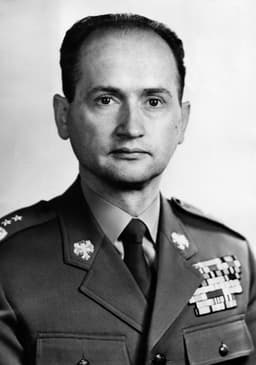
Wojciech Jaruzelski
General · Modern
51.8Total
Basic Information
Born
1508
1923
Died
1577
—
Era
Modern
Modern
Nationality
Japan
Poland
Occupation
General
General
Civilization
Eastern
Western
Score Comparison
Military (10%)
40.0
50.0
Political (20%)
36.5
45.1
Influence (20%)
54.9
56.4
Legacy (20%)
43.3
47.5
Leadership (15%)
50.7
65.0
Strategy (15%)
60.0
43.3
TOTAL
47.6
51.8
Matsunaga Hisahide — Complete Timeline
1564 AD
Betrayal of the Miyoshi clanPolitical Action◆ Major
Hisahide betrayed the Miyoshi clan, switching allegiance to Oda Nobunaga. This act contributed to the decline of the Miyoshi and increased Nobunaga's power in the Kinai region.
BetrayalMiyoshiOda
Impact: regional
1567 AD
Destruction of the Great Buddha of NaraWar◆ Major
Hisahide's forces burned T
NaraTemple destructionCultural loss
Impact: nationaldestructive
1577 AD
Siege of Shigisan CastleWar◆ Major
Hisahide was besieged at Shigisan Castle by Oda Nobunaga's forces. He committed seppuku after the castle fell, ending his rebellion against Nobunaga.
SiegeSeppukuOda
Impact: regionaltragic
Wojciech Jaruzelski — Complete Timeline
1981 AD
Appointment as First Secretary of the Polish United Workers' PartyPolitical Action◆ Major
Jaruzelski became First Secretary of the Polish United Workers' Party (PZPR) amid a deep political and economic crisis. He also held the posts of Prime Minister and Minister of Defense, concentrating power in his hands.
Communist leadership
Impact: national
Imposition of Martial Law in PolandPolitical Action
Jaruzelski declared martial law on December 13, 1981, to crush the Solidarity trade union movement. The military arrested thousands of activists, including Lech Walesa, and suspended civil liberties. The crackdown was widely condemned internationally.
Martial lawRepression
Impact: nationaldestructive
1989 AD
Round Table TalksPolitical Action
Facing mounting pressure and economic collapse, Jaruzelski agreed to Round Table Talks with the opposition, including Solidarity. The talks led to partially free elections, which Solidarity won, marking the beginning of the end of communist rule in Poland.
Political transitionFall of communism
Impact: globalconstructive
1990 AD
Resignation as PresidentPolitical Action◆ Major
Jaruzelski resigned as President of Poland, handing over power to Lech Walesa, the leader of Solidarity. This completed the peaceful transition from communist to democratic rule in Poland.
Political transition
Impact: national
Expert Analysis
Origins
Matsunaga Hisahide (1508–1577) was born into a samurai family in Yamato Province, Japan. Little is known of his early life, but he rose as a retainer of the Miyoshi clan, a powerful military family controlling much of central Japan. His upbringing in the chaotic Sengoku period (1467–1615) conditioned him to constant warfare and shifting allegiances.
Wojciech Jaruzelski (1923–2014) was born into a Polish landowning family in Kurow, Poland. After the Soviet invasion of 1939, his family was deported to Siberia, where his father died. Jaruzelski was conscripted into the Soviet-backed Polish People's Army in 1943 and trained in the USSR. This formative experience instilled a lifelong commitment to communism and military discipline.
Rise to Power
Hisahide's rise began as a senior vassal of the Miyoshi clan. By the 1550s, he controlled key castles in Yamato. In 1561, he orchestrated the assassination of Miyoshi Nagayoshi's heir, leading to a power vacuum. He then switched allegiance to Oda Nobunaga in 1568, gaining control of Yamato Province. His betrayal of the Miyoshi was a turning point that boosted Nobunaga's consolidation.
Jaruzelski rose through the Polish military hierarchy after World War II. He joined the Polish United Workers' Party (PZPR) in 1947 and became the youngest general in Poland in 1960. He served as Minister of Defence from 1968. His key turning point came in 1981 when he replaced Stanisław Kania as First Secretary of the PZPR amid the Solidarity crisis. He also became Prime Minister, holding both military and political power.
Leadership & Governance
Hisahide governed Yamato as a daimyo, relying on military force and strategic alliances. He was known for cunning and betrayal, exemplified by his destruction of Tōdai-ji in 1567 to prevent his enemies from using it as a fortress. This act scorched a Buddhist symbol but had limited strategic value, showing his ruthless pragmatism. His leadership score is 50.7, reflecting his ability to command but not to build stable institutions.
Jaruzelski's governance was defined by martial law (December 13, 1981) to suppress Solidarity. He arrested thousands, banned strikes, and imposed military control. His political score of 45.1 indicates his failure to gain popular legitimacy. However, he later initiated the Round Table Talks (1989), leading to semi-free elections and the peaceful end of communist rule. His strategy score of 43.3 reflects a reactive rather than visionary approach.
Triumph & Tragedy
Hisahide's greatest success was expanding his domain and surviving many shifts in power. His destruction of the Great Buddha of Nara (1567) was a major event that shocked Japan but also cemented his reputation as a villain. His tragedy came in 1577 when Nobunaga turned against him. Besieged at Shigisan Castle, Hisahide committed seppuku after his prized tea kettle was destroyed, symbolizing the end of his rebellion.
Jaruzelski's triumph was overseeing a peaceful transition from communism to democracy. The Round Table Talks (1989) allowed Solidarity to win elections, and he resigned as president in 1990, handing power to Lech Wałęsa. His tragedy was the human cost of martial law: at least 100 deaths, thousands imprisoned, and lasting division. His legacy is deeply controversial in Poland, with some viewing him as a traitor and others as a lesser evil.
Character & Destiny
Hisahide was characterized by ambition, treachery, and aesthetic refinement (he was a noted tea ceremony master). His pattern of betrayal ultimately led to his downfall when Nobunaga no longer trusted him. His military score of 40.0 reflects his limited strategic success against larger forces.
Jaruzelski was disciplined, pragmatic, and loyal to the Soviet system until it collapsed. He believed martial law prevented a Soviet invasion, a claim debated by historians. His political score of 45.1 and influence score of 56.4 show his impact on Poland's transition. His destiny was to be a transitional figure, hated by many but necessary for the peaceful end of communism.
Legacy
Hisahide's legacy is primarily negative in Japan: he is remembered as the destroyer of Nara's Great Buddha. His influence on later daimyo was limited, though his tea ceremony contributions endure. His total score of 47.6 reflects his minor historical impact.
Jaruzelski's legacy is complex. In Poland, he is often condemned for martial law, but internationally he is credited with a peaceful transition. His legacy score of 47.5 is slightly higher than Hisahide's 43.3. His actions shaped Poland's path to democracy and EU membership.
Conclusion
Wojciech Jaruzelski had greater impact than Matsunaga Hisahide. Despite a total score gap of only 4.2 points (51.8 vs 47.6), Jaruzelski's actions affected millions and altered Poland's trajectory from communism to democracy. Hisahide's destruction of a temple, while shocking, was a local event in Japan's civil wars. Jaruzelski's role in ending the Cold War in Eastern Europe gives him a broader historical significance. While both were controversial figures, Jaruzelski's influence on global history surpasses Hisahide's regional notoriety.
Rankings
🥇
Wojciech JaruzelskiLeader
Mil: 50.0Pol: 45.1Inf: 56.4
51.8
🥈
Matsunaga Hisahide
Mil: 40.0Pol: 36.5Inf: 54.9
47.6
+4.2 behind
How This Comparison Works
Algorithm
Each figure is scored on 6 dimensions (0—100 scale) based on structured historical data: Military (10%), Political (20%), Influence (20%), Legacy (20%), Leadership (15%), Strategy (15%). The weighted total produces the final ranking.
Data Sources
Scores are computed from structured sub-indicators in the database. Scale factors adjust for era (Ancient ×0.85, Modern ×1.0) and civilization size (Eastern ×1.05, Other ×0.80) to account for differences in population and military scale.
Maximum 3 Figures
Comparisons are limited to 2—3 figures to ensure readability and statistical meaningfulness.
Error Margins
±5 points per dimension — Sub-scores are derived from historical records with inherent uncertainty. Two figures within 5 points on a dimension should be considered roughly equivalent in that area.
Total Score Accuracy
±3 points overall — The weighted combination of 6 dimensions produces a total score with approximately ±3 points of uncertainty. Differences of less than 3 points are not statistically significant— the figures are effectively tied.
Known Limitations
- Historical records are incomplete and uneven across civilizations
- Figures from oral-tradition societies may be underrepresented
- Occupation labels can misclassify multi-role figures
- Scores measure capability and impact, not moral character
- Quantitative scoring is a comparison tool, not absolute truth
Capability Radar
Military (10%) — Battles & Warfare
Battles
45
20
Win Rate
40
25
Expansion
40
10
Political (20%) — Governance & Reform
Reform
15
30
Diplomacy
30
40
Economy
20
25
Influence (20%) — Cultural & Global Reach
Cultural
25
30
Global
15
40
Legacy (20%) — Historical Impact
Historical
30
45
Longevity
20
30
Leadership (15%) — Power & Stability
Tenure
40
60
Stability
10
20
Strategy (15%) — Tactics & Innovation
Strategy
45
40
Tactics
50
30
Reform
20
35
Similar Comparisons
Comments & Discussion
No comments yet. Be the first to share your thoughts!