Loading...
Nanny of the Maroons vs Wojciech Jaruzelski
Nanny of the Maroons leads by 12.7 pts · 2 figures compared
…

Nanny of the Maroons
General · Modern
64.5Total
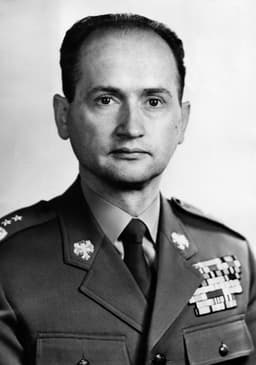
Wojciech Jaruzelski
General · Modern
51.8Total
Basic Information
Born
1686
1923
Died
1755
—
Era
Modern
Modern
Nationality
Jamaica
Poland
Occupation
General
General
Civilization
Other
Western
Score Comparison
Military (10%)
55.0
50.0
Political (20%)
68.0
45.1
Influence (20%)
82.0
56.4
Legacy (20%)
55.0
47.5
Leadership (15%)
62.0
65.0
Strategy (15%)
52.5
43.3
TOTAL
64.5
51.8
Nanny of the Maroons — Complete Timeline
1720 AD
Led First Maroon WarWar◆ Major
Nanny of the Maroons led the Windward Maroons in the First Maroon War against British colonial forces in Jamaica. She organized guerrilla warfare from the mountainous stronghold of Nanny Town, successfully defending the maroon communities from British attacks for over a decade.
Maroon WarGuerrillaResistance
Impact: regional
Established Nanny TownPolitical Action◆ Major
Nanny established Nanny Town in the Blue Mountains of Jamaica as the primary settlement and military headquarters of the Windward Maroons. The town's strategic location on a plateau with steep cliffs made it nearly impregnable to British attacks, serving as a base for maroon raids and defense.
SettlementMaroonStronghold
Impact: regionalconstructive
1734 AD
Defended Nanny Town from British AttackWar◆ Major
British forces launched a major assault on Nanny Town, using cannon and overwhelming numbers. Nanny and her maroons repelled the attack, inflicting heavy casualties on the British. The victory solidified Nanny's reputation as a military leader and ensured the survival of the Windward Maroon community.
BattleDefenseVictory
Impact: regional
1739 AD
Negotiated Peace Treaty with BritishPolitical Action◆ Major
Nanny of the Maroons negotiated a peace treaty with the British colonial government, securing land grants and autonomy for the Windward Maroons in exchange for ceasing hostilities and agreeing to return future runaway slaves. The treaty ended the First Maroon War and established maroon self-governance.
TreatyPeaceAutonomy
Impact: regionalconstructive
Wojciech Jaruzelski — Complete Timeline
1981 AD
Appointment as First Secretary of the Polish United Workers' PartyPolitical Action◆ Major
Jaruzelski became First Secretary of the Polish United Workers' Party (PZPR) amid a deep political and economic crisis. He also held the posts of Prime Minister and Minister of Defense, concentrating power in his hands.
Communist leadership
Impact: national
Imposition of Martial Law in PolandPolitical Action
Jaruzelski declared martial law on December 13, 1981, to crush the Solidarity trade union movement. The military arrested thousands of activists, including Lech Walesa, and suspended civil liberties. The crackdown was widely condemned internationally.
Martial lawRepression
Impact: nationaldestructive
1989 AD
Round Table TalksPolitical Action
Facing mounting pressure and economic collapse, Jaruzelski agreed to Round Table Talks with the opposition, including Solidarity. The talks led to partially free elections, which Solidarity won, marking the beginning of the end of communist rule in Poland.
Political transitionFall of communism
Impact: globalconstructive
1990 AD
Resignation as PresidentPolitical Action◆ Major
Jaruzelski resigned as President of Poland, handing over power to Lech Walesa, the leader of Solidarity. This completed the peaceful transition from communist to democratic rule in Poland.
Political transition
Impact: national
Expert Analysis
Origins
Nanny of the Maroons, born around 1685 in present-day Ghana, was captured and enslaved, later escaping to the Blue Mountains of Jamaica. She became a leader of the Windward Maroons, a community of escaped slaves who maintained African traditions. Little is documented about her early life, but her strategic acumen emerged in the harsh terrain.
Wojciech Jaruzelski was born on July 6, 1923, into a Polish landowning family. After the Soviet invasion of Poland in 1939, his family was deported to Siberia. He later joined the Soviet-backed Polish Army, rising through ranks due to political reliability.
Rise to Power
Nanny rose to prominence during the First Maroon War (1728-1739/40). She united disparate Maroon groups and established Nanny Town, a fortified settlement in the Blue Mountains. Her guerrilla tactics—ambushes, camouflage, and use of horns for communication—made her a formidable opponent. By 1739, she negotiated a peace treaty with the British, securing land grants for the Maroons.
Jaruzelski's rise began in the Polish People's Army. He became Chief of the General Staff in 1965 and Minister of Defense in 1968. In 1981, amid economic crisis and the rise of Solidarity, he was appointed First Secretary of the Polish United Workers' Party. He declared martial law on December 13, 1981, using military force to suppress dissent.
Leadership & Governance
Nanny's leadership was decentralized and based on consensus among Maroon communities. She governed Nanny Town with a council of elders, emphasizing self-sufficiency and defense. Her military strategy scored 52.5, reflecting effective guerrilla warfare but limited conventional capability. Politically, she scored 68.0 for negotiating autonomy with the British.
Jaruzelski led a centralized communist state. His imposition of martial law involved 70,000 troops and the arrest of 10,000 activists. He justified it as preventing Soviet invasion, but it crushed civil liberties. His political score of 45.1 reflects his role in maintaining communist rule, while his leadership score of 65.0 indicates decisive action.
Triumph & Tragedy
Nanny's greatest triumph was securing Maroon autonomy through the 1739 treaty, which preserved their freedom for generations. Her military success at Nanny Town, where she repelled British attacks using the terrain, is legendary. However, the treaty also required Maroons to return runaway slaves, a compromise that tarnished her legacy. Her influence score of 82.0 underscores her symbolic power.
Jaruzelski's triumph was orchestrating the Round Table Talks in 1989, which led to peaceful transition from communism. He resigned as president in 1990, handing power to Lech Wałęsa. Yet his imposition of martial law caused lasting trauma; the regime's brutality (e.g., 1982 deaths of nine miners) earned him condemnation. His legacy score of 47.5 reflects this mixed record.
Character & Destiny
Nanny was pragmatic and adaptable, using spirituality (Obeah) to inspire followers. Her decision to negotiate rather than fight to the death shows strategic realism. Jaruzelski was disciplined but isolated; he believed martial law was the lesser evil. Both faced impossible choices: Nanny between freedom and compromise, Jaruzelski between repression and chaos.
Legacy
Nanny is Jamaica's only female National Hero, celebrated for resistance against colonialism. Her story influences Pan-Africanism and Black liberation movements. Jaruzelski remains controversial: some see him as a savior from Soviet intervention, others as a tyrant. His legacy is tied to Poland's peaceful transition, but his methods are condemned.
Conclusion
Nanny of the Maroons had greater impact relative to her context. Despite lower military and political scores (total 64.5 vs Jaruzelski's 51.8), her influence score of 82.0 reflects enduring symbolic power. She secured freedom for her people and remains a global icon of resistance. Jaruzelski's actions preserved Poland's sovereignty but at the cost of civil liberties. Nanny's legacy is unequivocally positive, while Jaruzelski's is deeply ambivalent. Thus, Nanny's impact is more significant.
Rankings
🥇
Nanny of the MaroonsLeader
Mil: 55.0Pol: 68.0Inf: 82.0
64.5
🥈
Wojciech Jaruzelski
Mil: 50.0Pol: 45.1Inf: 56.4
51.8
+12.7 behind
How This Comparison Works
Algorithm
Each figure is scored on 6 dimensions (0—100 scale) based on structured historical data: Military (10%), Political (20%), Influence (20%), Legacy (20%), Leadership (15%), Strategy (15%). The weighted total produces the final ranking.
Data Sources
Scores are computed from structured sub-indicators in the database. Scale factors adjust for era (Ancient ×0.85, Modern ×1.0) and civilization size (Eastern ×1.05, Other ×0.80) to account for differences in population and military scale.
Maximum 3 Figures
Comparisons are limited to 2—3 figures to ensure readability and statistical meaningfulness.
Error Margins
±5 points per dimension — Sub-scores are derived from historical records with inherent uncertainty. Two figures within 5 points on a dimension should be considered roughly equivalent in that area.
Total Score Accuracy
±3 points overall — The weighted combination of 6 dimensions produces a total score with approximately ±3 points of uncertainty. Differences of less than 3 points are not statistically significant— the figures are effectively tied.
Known Limitations
- Historical records are incomplete and uneven across civilizations
- Figures from oral-tradition societies may be underrepresented
- Occupation labels can misclassify multi-role figures
- Scores measure capability and impact, not moral character
- Quantitative scoring is a comparison tool, not absolute truth
Capability Radar
Military (10%) — Battles & Warfare
Battles
45
20
Win Rate
55
25
Expansion
35
10
Political (20%) — Governance & Reform
Reform
45
30
Diplomacy
50
40
Economy
30
25
Influence (20%) — Cultural & Global Reach
Cultural
60
30
Global
50
40
Legacy (20%) — Historical Impact
Historical
65
45
Longevity
55
30
Leadership (15%) — Power & Stability
Tenure
40
60
Stability
45
20
Strategy (15%) — Tactics & Innovation
Strategy
55
40
Tactics
60
30
Reform
40
35
Similar Comparisons
Comments & Discussion
No comments yet. Be the first to share your thoughts!