Loading...
Pachacuti vs Parakramabahu VI
Pachacuti leads by 4.6 pts · 2 figures compared
…
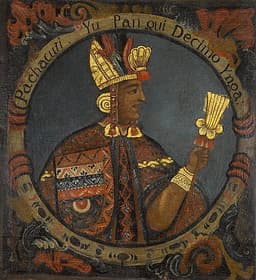
Pachacuti
Emperor · Medieval
69.4Total

Parakramabahu VI
Emperor · Medieval
64.8Total
Basic Information
Born
1418
1412
Died
1472
1467
Era
Medieval
Medieval
Nationality
Inca Empire
Sri Lanka
Occupation
Emperor
Emperor
Civilization
Other
Indian
Score Comparison
Military (10%)
78.5
72.5
Political (20%)
58.1
72.0
Influence (20%)
65.0
60.0
Legacy (20%)
72.0
56.0
Leadership (15%)
78.0
85.0
Strategy (15%)
69.2
50.0
TOTAL
69.4
64.8
Pachacuti — Complete Timeline
1438 AD
Conquest of the Chanka KingdomWar
Pachacuti led the Inca army to defeat the Chanka, a powerful rival, in a decisive battle near Cusco. This victory secured his position as Sapa Inca and initiated a period of rapid expansion, transforming the Inca from a small kingdom into a vast empire.
ConquestInca ExpansionChanka
Impact: regional
1440 AD
Reconstruction of CuscoCultural◆ Major
Pachacuti rebuilt Cusco as the imperial capital, designing it in the shape of a puma and constructing massive stone structures like Sacsayhuam
Urban PlanningArchitectureInca Empire
Impact: regionalconstructive
1450 AD
Initiation of Machu Picchu's ConstructionCultural◆ Major
Pachacuti ordered the construction of Machu Picchu, a royal estate and ceremonial site high in the Andes. The complex featured sophisticated dry-stone masonry and terraced agriculture, serving as a symbol of Inca engineering and a retreat for the emperor.
ArchitectureRoyal EstateInca Engineering
Impact: regionalconstructive
Parakramabahu VI — Complete Timeline
1420 AD
Construction of the Temple of the Tooth in KotteCultural◆ Major
Parakramabahu VI built a new Temple of the Tooth in his capital, Kotte. This reinforced Kotte's status as the religious and political center of the island.
BuddhismArchitectureCapital
Impact: nationalconstructive
1430 AD
Patronage of Literature and ArtsCultural◆ Major
Parakramabahu VI's court was a center of literary and artistic activity. He patronized poets and scholars, leading to a flourishing of Sinhalese literature, including the 'Sandesa' (message) poems.
LiteraturePatronageCultural Renaissance
Impact: nationalconstructive
1450 AD
Unification of Sri LankaWar
Parakramabahu VI unified the entire island of Sri Lanka under his rule for the first time since Parakramabahu I. He conquered the Kingdom of Jaffna in the north and brought the entire island under Kotte's control.
UnificationConquestMilitary Campaign
Impact: national
Conquest of the Kingdom of JaffnaWar◆ Major
Parakramabahu VI's forces, led by his adopted son Sapumal Kumaraya, conquered the Kingdom of Jaffna. This brought the Tamil north under Sinhalese rule and ended the Aryacakravarti dynasty.
ConquestMilitary CampaignTamil Kingdom
Impact: national
Expert Analysis
Pachacuti vs Parakramabahu VI
# The Hill and the Island: Two Paths to Empire
In the high Andes of 1438, a young prince rallied a panicked army against an invading force that had already routed his father's forces. On a small island in the Indian Ocean, a king's adopted son led a fleet across the Palk Strait to subdue a rival kingdom. These two moments—separated by oceans, cultures, and the very geography of power—capture the divergent fates of Pachacuti Inca Yupanqui and Parakramabahu VI. Both built empires, both unified fractured lands, but their legacies traveled radically different paths. Why did one become a name whispered in awe across continents while the other remains known only to specialists?
Origins
Pachacuti was born in 1418 into a world of stone and sky. The Inca were then merely one kingdom among many in the Andean highlands, their capital Cusco a modest settlement. His father, Viracocha Inca, ruled over a realm that was powerful but not dominant. The young prince, originally named Cusi Yupanqui, grew up in the shadow of the Chanka, a fierce rival confederation that threatened Inca existence itself. The Andes shaped his worldview: vertical landscapes, limited arable land, and a cosmos where mountains were deities and the sun demanded human blood.
Parakramabahu VI, born in 1412, came from the lush, monsoon-drenched island of Sri Lanka. His world was one of ancient Buddhist kingdoms, sophisticated irrigation systems, and a literary tradition stretching back a millennium. The Kotte kingdom, where he rose to power, was one of several competing Sinhalese states in the island's southwest. Unlike Pachacuti's world of high-altitude warfare, Parakramabahu's Sri Lanka was a place of rice paddies, ocean trade, and the constant threat of South Indian invasions. The prince absorbed the stories of Parakramabahu I, the great unifier of the 12th century, whose name he would later adopt.
Rise to Power
Pachacuti's ascent came through fire. In 1438, the Chanka launched a massive assault on Cusco. King Viracocha fled, but his son refused to retreat. "I will not abandon the city," he reportedly declared. Leading a desperate defense, the prince turned the battle into a rout, personally killing Chanka commanders and capturing their sacred idol. The victory was so complete that the Chanka never recovered. Pachacuti—whose name means "he who transforms the earth"—seized power from his father and began a campaign of conquest that would reshape the Andes.
Parakramabahu VI's rise was more gradual, a matter of court politics and strategic patience. He inherited the Kotte throne around 1410 and spent his first decades consolidating power through marriage alliances, administrative reforms, and cultural patronage. Unlike Pachacuti's dramatic battlefield coronation, Parakramabahu's authority grew through the slow accumulation of loyalty and the suppression of regional chieftains. His key turning point came not in a single battle but through the 1450 conquest of the Kingdom of Jaffna in the north, led by his adopted son Sapumal Kumaraya. This campaign unified the entire island for the first time since Parakramabahu I.
Leadership & Governance
Pachacuti was a revolutionary administrator. He rebuilt Cusco in 1440 as a puma-shaped capital with massive stone walls that still stand without mortar. He created the *mita* labor system, where communities contributed work for state projects in rotation. He established a network of royal roads, storehouses, and relay runners that bound the empire together. His military genius lay in combining terror with generosity: conquered peoples were offered submission and integration, but resistance meant annihilation. He initiated Machu Picchu's construction around 1450 as a royal estate, a testament to his vision of an empire that married power with beauty.
Parakramabahu VI ruled differently. His unification was administrative and cultural rather than infrastructural. He built the Temple of the Tooth in Kotte in 1420, making his capital the religious heart of Sinhalese Buddhism. His court became a literary renaissance, patronizing poets and scholars who produced works in Sinhala and Pali. He suppressed rebellions through negotiation and strategic marriages rather than mass resettlement. Where Pachacuti moved entire populations, Parakramabahu bound regions through shared devotion to the Buddha's tooth relic.
Triumph & Tragedy
Pachacuti's greatest triumph was the transformation of a small kingdom into an empire stretching from modern Colombia to Chile. His tragedy came from succession: he chose his son Tupac Inca Yupanqui as heir, but the transition was fraught with political maneuvering. The empire he built, magnificent as it was, rested entirely on his personal authority. Within decades of his 1472 death, Spanish conquistadors would exploit these internal divisions.
Parakramabahu's triumph was his unification of Sri Lanka in 1450, a feat not achieved for over two centuries. His tragedy was the fragility of that unity. After his death in 1467, the island fragmented again into competing kingdoms. The Portuguese arrived in 1505 and found a land already divided, easy prey for colonial manipulation.
Character & Destiny
Pachacuti was a visionary who saw possibility where others saw only mountains. His name means "earth-shaker," and he lived up to it—restless, ambitious, willing to destroy old orders to build new ones. He believed the Inca were destined to rule, and that belief became self-fulfilling.
Parakramabahu was a consolidator, a man who looked backward as much as forward. He sought to restore the golden age of Parakramabahu I, to recreate what had been lost. His character was that of a guardian, not a transformer.
Legacy
Pachacuti's legacy is global. Machu Picchu draws millions of visitors. The Inca road system is a UNESCO World Heritage site. His name is synonymous with the Inca Empire itself.
Parakramabahu VI is remembered in Sri Lanka as the last great Sinhalese king before colonialism. His literary patronage shaped Sinhala language and culture. But outside the island, he is virtually unknown.
Conclusion
The difference between these two rulers lies not in their achievements but in their geography of memory. Pachacuti built an empire that the Spanish destroyed but could not erase—its ruins became symbols of a lost world that fascinates the modern imagination. Parakramabahu built a unity that dissolved into the colonial era, leaving behind texts and temples but no monumental legacy. One transformed the earth; the other restored a kingdom. Both were great, but greatness alone does not determine which names survive the centuries.
Rankings
🥇
PachacutiLeader
Mil: 78.5Pol: 58.1Inf: 65.0
69.4
🥈
Parakramabahu VI
Mil: 72.5Pol: 72.0Inf: 60.0
64.8
+4.6 behind
How This Comparison Works
Algorithm
Each figure is scored on 6 dimensions (0—100 scale) based on structured historical data: Military (10%), Political (20%), Influence (20%), Legacy (20%), Leadership (15%), Strategy (15%). The weighted total produces the final ranking.
Data Sources
Scores are computed from structured sub-indicators in the database. Scale factors adjust for era (Ancient ×0.85, Modern ×1.0) and civilization size (Eastern ×1.05, Other ×0.80) to account for differences in population and military scale.
Maximum 3 Figures
Comparisons are limited to 2—3 figures to ensure readability and statistical meaningfulness.
Error Margins
±5 points per dimension — Sub-scores are derived from historical records with inherent uncertainty. Two figures within 5 points on a dimension should be considered roughly equivalent in that area.
Total Score Accuracy
±3 points overall — The weighted combination of 6 dimensions produces a total score with approximately ±3 points of uncertainty. Differences of less than 3 points are not statistically significant— the figures are effectively tied.
Known Limitations
- Historical records are incomplete and uneven across civilizations
- Figures from oral-tradition societies may be underrepresented
- Occupation labels can misclassify multi-role figures
- Scores measure capability and impact, not moral character
- Quantitative scoring is a comparison tool, not absolute truth
Capability Radar
Military (10%) — Battles & Warfare
Battles
85
60
Win Rate
90
65
Expansion
90
55
Political (20%) — Governance & Reform
Reform
92
65
Diplomacy
75
60
Economy
80
65
Influence (20%) — Cultural & Global Reach
Cultural
85
60
Global
65
40
Legacy (20%) — Historical Impact
Historical
80
65
Longevity
70
55
Leadership (15%) — Power & Stability
Tenure
85
70
Stability
82
70
Strategy (15%) — Tactics & Innovation
Strategy
88
60
Tactics
80
55
Reform
85
50
Similar Comparisons
Comments & Discussion
No comments yet. Be the first to share your thoughts!